

4 An Introduction to Emergence Dynamics in Complex Systems
165
t =
ϕ
ϕ 0
d − α sin θ ].
(4.50)
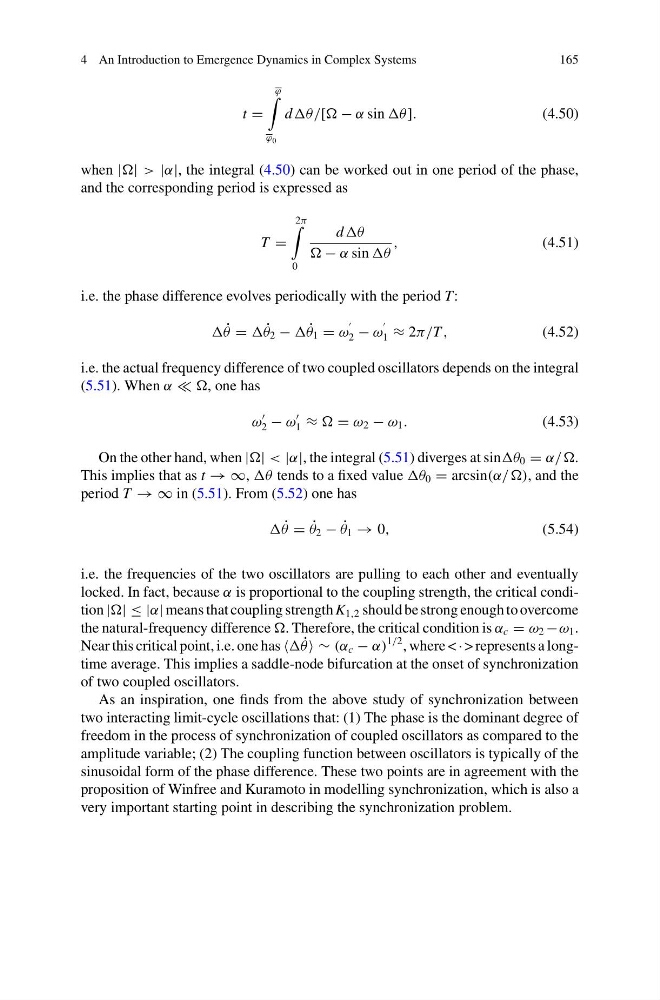
when || > |α|, the integral (4.50) can be worked out in one period of the phase,
and the corresponding period is expressed as
T =
2π
0
d θ
− α sin θ
,
(4.51)
i.e. the phase difference evolves periodically with the period T:
˙
θ = ˙
θ 2 − ˙
θ 1 = ω
2 − ω
1 ≈ 2π/T ,
(4.52)
i.e. the actual frequency difference of two coupled oscillators depends on the integral
(5.51). When α , one has
ω
2 − ω
1 ≈ = ω 2 − ω 1 .
(4.53)
On the other hand, when || < |α|, the integral (5.51) diverges at sinθ 0 = α//.
This implies that as t → ∞, θ tends to a fixed value θ 0 = arcsin(α//), and the
period T → ∞ in (5.51). From (5.52) one has
˙
θ = ˙
θ 2 − ˙
θ 1 → 0,
(5.54)
i.e. the frequencies of the two oscillators are pulling to each other and eventually
locked. In fact, because α is proportional to the coupling strength, the critical condition || ≤ |α| means that coupling strength K 1,2 should be strong enough to overcome
the natural-frequency difference . Therefore, the critical condition is α c = ω 2 −ω 1 .
Near this critical point, i.e. one has ˙
θ ∼ (α c − α)
1/2 , where < · > represents a longtime average. This implies a saddle-node bifurcation at the onset of synchronization
of two coupled oscillators.
As an inspiration, one finds from the above study of synchronization between
two interacting limit-cycle oscillations that: (1) The phase is the dominant degree of
freedom in the process of synchronization of coupled oscillators as compared to the
amplitude variable; (2) The coupling function between oscillators is typically of the
sinusoidal form of the phase difference. These two points are in agreement with the
proposition of Winfree and Kuramoto in modelling synchronization, which is also a
very important starting point in describing the synchronization problem.
165
t =
ϕ
ϕ 0
d − α sin θ ].
(4.50)
when || > |α|, the integral (4.50) can be worked out in one period of the phase,
and the corresponding period is expressed as
T =
2π
0
d θ
− α sin θ
,
(4.51)
i.e. the phase difference evolves periodically with the period T:
˙
θ = ˙
θ 2 − ˙
θ 1 = ω
2 − ω
1 ≈ 2π/T ,
(4.52)
i.e. the actual frequency difference of two coupled oscillators depends on the integral
(5.51). When α , one has
ω
2 − ω
1 ≈ = ω 2 − ω 1 .
(4.53)
On the other hand, when || < |α|, the integral (5.51) diverges at sinθ 0 = α//.
This implies that as t → ∞, θ tends to a fixed value θ 0 = arcsin(α//), and the
period T → ∞ in (5.51). From (5.52) one has
˙
θ = ˙
θ 2 − ˙
θ 1 → 0,
(5.54)
i.e. the frequencies of the two oscillators are pulling to each other and eventually
locked. In fact, because α is proportional to the coupling strength, the critical condition || ≤ |α| means that coupling strength K 1,2 should be strong enough to overcome
the natural-frequency difference . Therefore, the critical condition is α c = ω 2 −ω 1 .
Near this critical point, i.e. one has ˙
θ ∼ (α c − α)
1/2 , where < · > represents a longtime average. This implies a saddle-node bifurcation at the onset of synchronization
of two coupled oscillators.
As an inspiration, one finds from the above study of synchronization between
two interacting limit-cycle oscillations that: (1) The phase is the dominant degree of
freedom in the process of synchronization of coupled oscillators as compared to the
amplitude variable; (2) The coupling function between oscillators is typically of the
sinusoidal form of the phase difference. These two points are in agreement with the
proposition of Winfree and Kuramoto in modelling synchronization, which is also a
very important starting point in describing the synchronization problem.