

162
Z. Zheng
Although synchronization behaviors had been found in different disciplines such
as physics, acoustics, biology, and electronic devices, a common understanding
embedded these seemingly distinct phenomena was still lack. A breakthrough was
the study of sustained oscillations and limit cycles in nonlinear systems in the early
twentieth century [44]. Further, it is theoretically important to study the synchronization between the limit cycles of driving or interaction on the basis of limit cycles
[76, 77].
A fruitful modelling of synchronization was pioneered by Winfree, who studied
the nonlinear dynamics of a large population of weakly coupled limit-cycle oscillators
with distributed intrinsic frequencies [81]. The oscillators can be characterized by
their phases, and each oscillator is coupled to the collective rhythm generated by
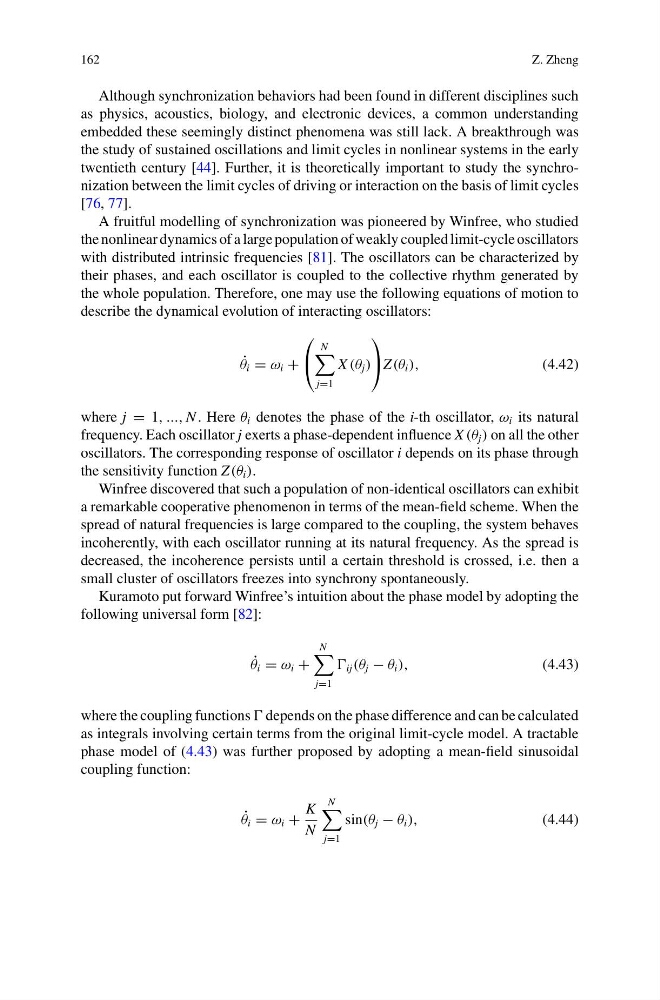
the whole population. Therefore, one may use the following equations of motion to
describe the dynamical evolution of interacting oscillators:
˙
θ i = ω i +
⎛
⎝
N
j=1
X (θ j )
⎞
⎠ Z(θ i ),
(4.42)
where j = 1, ..., N . Here θ i denotes the phase of the i-th oscillator, ω i its natural
frequency. Each oscillator j exerts a phase-dependent influence X (θ j ) on all the other
oscillators. The corresponding response of oscillator i depends on its phase through
the sensitivity function Z(θ i ).
Winfree discovered that such a population of non-identical oscillators can exhibit
a remarkable cooperative phenomenon in terms of the mean-field scheme. When the
spread of natural frequencies is large compared to the coupling, the system behaves
incoherently, with each oscillator running at its natural frequency. As the spread is
decreased, the incoherence persists until a certain threshold is crossed, i.e. then a
small cluster of oscillators freezes into synchrony spontaneously.
Kuramoto put forward Winfree’s intuition about the phase model by adopting the
following universal form [82]:
˙
θ i = ω i +
N
j=1
ij (θ j − θ i ),
(4.43)
where the coupling functions depends on the phase difference and can be calculated
as integrals involving certain terms from the original limit-cycle model. A tractable
phase model of (4.43) was further proposed by adopting a mean-field sinusoidal
coupling function:
˙
θ i = ω i +
K
N
N
j=1
sin(θ j − θ i ),
(4.44)
Z. Zheng
Although synchronization behaviors had been found in different disciplines such
as physics, acoustics, biology, and electronic devices, a common understanding
embedded these seemingly distinct phenomena was still lack. A breakthrough was
the study of sustained oscillations and limit cycles in nonlinear systems in the early
twentieth century [44]. Further, it is theoretically important to study the synchronization between the limit cycles of driving or interaction on the basis of limit cycles
[76, 77].
A fruitful modelling of synchronization was pioneered by Winfree, who studied
the nonlinear dynamics of a large population of weakly coupled limit-cycle oscillators
with distributed intrinsic frequencies [81]. The oscillators can be characterized by
their phases, and each oscillator is coupled to the collective rhythm generated by
the whole population. Therefore, one may use the following equations of motion to
describe the dynamical evolution of interacting oscillators:
˙
θ i = ω i +
⎛
⎝
N
j=1
X (θ j )
⎞
⎠ Z(θ i ),
(4.42)
where j = 1, ..., N . Here θ i denotes the phase of the i-th oscillator, ω i its natural
frequency. Each oscillator j exerts a phase-dependent influence X (θ j ) on all the other
oscillators. The corresponding response of oscillator i depends on its phase through
the sensitivity function Z(θ i ).
Winfree discovered that such a population of non-identical oscillators can exhibit
a remarkable cooperative phenomenon in terms of the mean-field scheme. When the
spread of natural frequencies is large compared to the coupling, the system behaves
incoherently, with each oscillator running at its natural frequency. As the spread is
decreased, the incoherence persists until a certain threshold is crossed, i.e. then a
small cluster of oscillators freezes into synchrony spontaneously.
Kuramoto put forward Winfree’s intuition about the phase model by adopting the
following universal form [82]:
˙
θ i = ω i +
N
j=1
ij (θ j − θ i ),
(4.43)
where the coupling functions depends on the phase difference and can be calculated
as integrals involving certain terms from the original limit-cycle model. A tractable
phase model of (4.43) was further proposed by adopting a mean-field sinusoidal
coupling function:
˙
θ i = ω i +
K
N
N
j=1
sin(θ j − θ i ),
(4.44)