

160
Z. Zheng
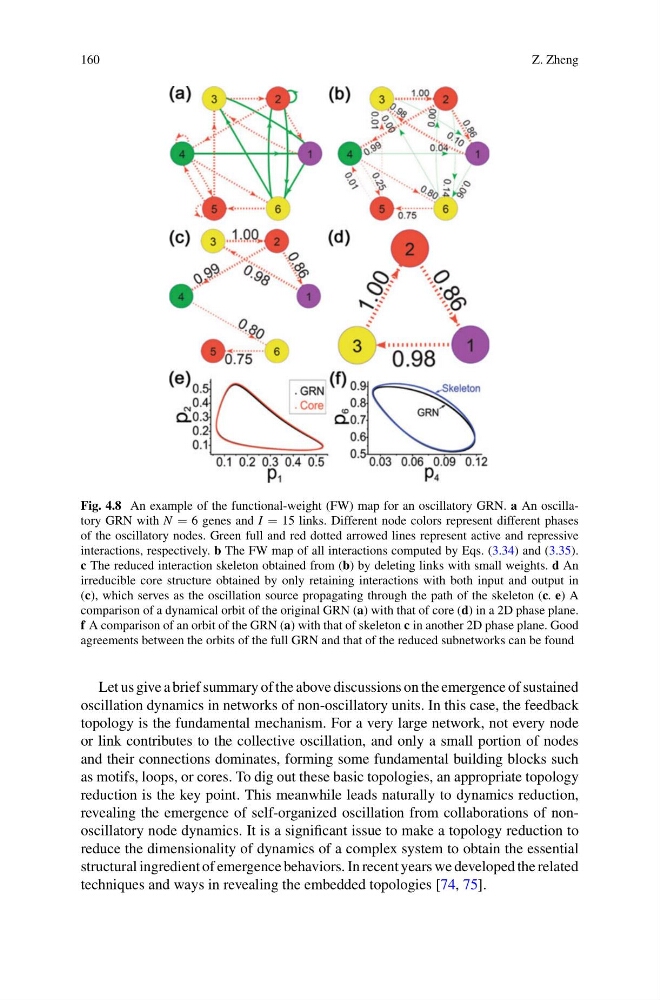
Fig. 4.8 An example of the functional-weight (FW) map for an oscillatory GRN. a An oscillatory GRN with N = 6 genes and I = 15 links. Different node colors represent different phases
of the oscillatory nodes. Green full and red dotted arrowed lines represent active and repressive
interactions, respectively. b The FW map of all interactions computed by Eqs. (3.34) and (3.35).
c The reduced interaction skeleton obtained from (b) by deleting links with small weights. d An
irreducible core structure obtained by only retaining interactions with both input and output in
(c), which serves as the oscillation source propagating through the path of the skeleton (c. e) A
comparison of a dynamical orbit of the original GRN (a) with that of core (d) in a 2D phase plane.
f A comparison of an orbit of the GRN (a) with that of skeleton c in another 2D phase plane. Good
agreements between the orbits of the full GRN and that of the reduced subnetworks can be found
Let us give a brief summary of the above discussions on the emergence of sustained
oscillation dynamics in networks of non-oscillatory units. In this case, the feedback
topology is the fundamental mechanism. For a very large network, not every node
or link contributes to the collective oscillation, and only a small portion of nodes
and their connections dominates, forming some fundamental building blocks such
as motifs, loops, or cores. To dig out these basic topologies, an appropriate topology
reduction is the key point. This meanwhile leads naturally to dynamics reduction,
revealing the emergence of self-organized oscillation from collaborations of nonoscillatory node dynamics. It is a significant issue to make a topology reduction to
reduce the dimensionality of dynamics of a complex system to obtain the essential
structural ingredient of emergence behaviors. In recent years we developed the related
techniques and ways in revealing the embedded topologies [74, 75].
Z. Zheng
Fig. 4.8 An example of the functional-weight (FW) map for an oscillatory GRN. a An oscillatory GRN with N = 6 genes and I = 15 links. Different node colors represent different phases
of the oscillatory nodes. Green full and red dotted arrowed lines represent active and repressive
interactions, respectively. b The FW map of all interactions computed by Eqs. (3.34) and (3.35).
c The reduced interaction skeleton obtained from (b) by deleting links with small weights. d An
irreducible core structure obtained by only retaining interactions with both input and output in
(c), which serves as the oscillation source propagating through the path of the skeleton (c. e) A
comparison of a dynamical orbit of the original GRN (a) with that of core (d) in a 2D phase plane.
f A comparison of an orbit of the GRN (a) with that of skeleton c in another 2D phase plane. Good
agreements between the orbits of the full GRN and that of the reduced subnetworks can be found
Let us give a brief summary of the above discussions on the emergence of sustained
oscillation dynamics in networks of non-oscillatory units. In this case, the feedback
topology is the fundamental mechanism. For a very large network, not every node
or link contributes to the collective oscillation, and only a small portion of nodes
and their connections dominates, forming some fundamental building blocks such
as motifs, loops, or cores. To dig out these basic topologies, an appropriate topology
reduction is the key point. This meanwhile leads naturally to dynamics reduction,
revealing the emergence of self-organized oscillation from collaborations of nonoscillatory node dynamics. It is a significant issue to make a topology reduction to
reduce the dimensionality of dynamics of a complex system to obtain the essential
structural ingredient of emergence behaviors. In recent years we developed the related
techniques and ways in revealing the embedded topologies [74, 75].