

4 An Introduction to Emergence Dynamics in Complex Systems
149
Given a network consisting of N nodes with non-oscillatory local dynamics
described by well-defined coupled ordinary differential equations, there are M (M
> N) links among these different nodes. We are interested in the situation when the
system displays a global self-sustained oscillation and all nodes that are individually non-oscillatory become oscillatory. It is our motivation to find the mechanism
supporting the oscillations in terms of the network topology and oscillation time
series of each node.
Let us first clarify the significance of nodes in a network with sustained oscillations by comparing their phase dynamics. Obviously, the oscillatory behavior of
an individually non-oscillatory node is driven by signals from one or more interactions with advanced phases, if such a phase variable can be properly defined. We
call such a signal the phase-advanced driving (PAD). Among all phase-advanced
interactions, the interaction giving the most significant contribution to the given
node can be defined as the dominant phase-advanced driving (DPAD). Based on
this idea, the corresponding DPAD for each node can be identified. By applying
this network reduction approach, the original oscillatory high-dimensional complex
network of N nodes with M vertices/interactions can be reduced to a one-dimensional
unidirectional network of size N with M
unidirectional dominant phase-advanced
interactions.
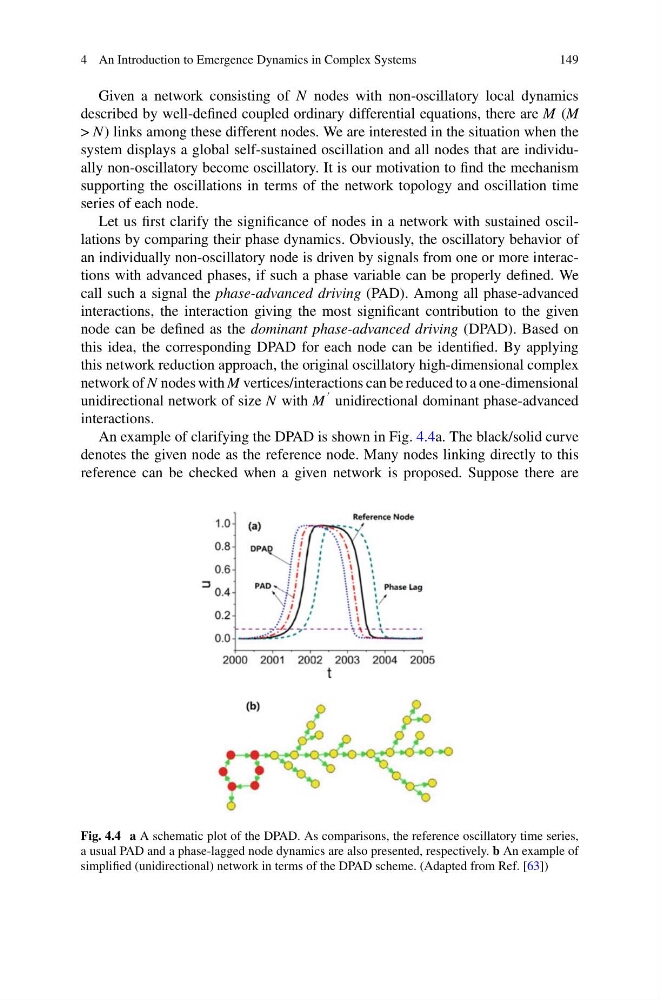
An example of clarifying the DPAD is shown in Fig. 4.4a. The black/solid curve
denotes the given node as the reference node. Many nodes linking directly to this
reference can be checked when a given network is proposed. Suppose there are
Fig. 4.4 a A schematic plot of the DPAD. As comparisons, the reference oscillatory time series,
a usual PAD and a phase-lagged node dynamics are also presented, respectively. b An example of
simplified (unidirectional) network in terms of the DPAD scheme. (Adapted from Ref. [63])
149
Given a network consisting of N nodes with non-oscillatory local dynamics
described by well-defined coupled ordinary differential equations, there are M (M
> N) links among these different nodes. We are interested in the situation when the
system displays a global self-sustained oscillation and all nodes that are individually non-oscillatory become oscillatory. It is our motivation to find the mechanism
supporting the oscillations in terms of the network topology and oscillation time
series of each node.
Let us first clarify the significance of nodes in a network with sustained oscillations by comparing their phase dynamics. Obviously, the oscillatory behavior of
an individually non-oscillatory node is driven by signals from one or more interactions with advanced phases, if such a phase variable can be properly defined. We
call such a signal the phase-advanced driving (PAD). Among all phase-advanced
interactions, the interaction giving the most significant contribution to the given
node can be defined as the dominant phase-advanced driving (DPAD). Based on
this idea, the corresponding DPAD for each node can be identified. By applying
this network reduction approach, the original oscillatory high-dimensional complex
network of N nodes with M vertices/interactions can be reduced to a one-dimensional
unidirectional network of size N with M
unidirectional dominant phase-advanced
interactions.
An example of clarifying the DPAD is shown in Fig. 4.4a. The black/solid curve
denotes the given node as the reference node. Many nodes linking directly to this
reference can be checked when a given network is proposed. Suppose there are
Fig. 4.4 a A schematic plot of the DPAD. As comparisons, the reference oscillatory time series,
a usual PAD and a phase-lagged node dynamics are also presented, respectively. b An example of
simplified (unidirectional) network in terms of the DPAD scheme. (Adapted from Ref. [63])