

142
Z. Zheng
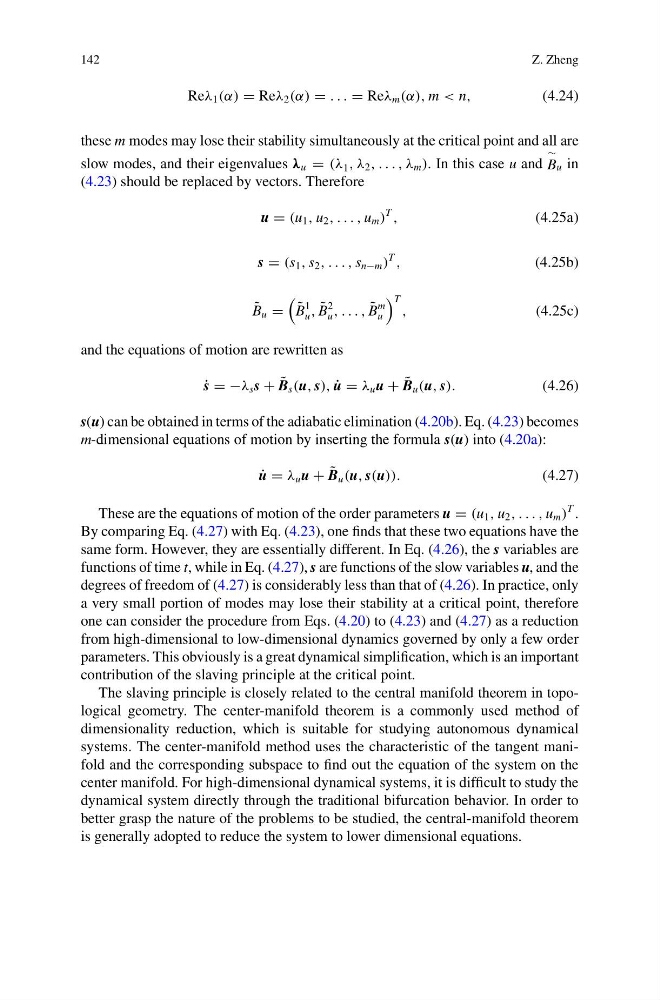
Reλ 1 (α) = Reλ 2 (α) = . . . = Reλ m (α), m < n,
(4.24)
these m modes may lose their stability simultaneously at the critical point and all are
slow modes, and their eigenvalues λ u = (λ 1 , λ 2 , . . . , λ m ). In this case u and
∼
Bu in
(4.23) should be replaced by vectors. Therefore
u = (u 1 , u 2 , . . . , u m )
T
,
(4.25a)
s = (s 1 , s 2 , . . . , s n−m )
T
,
(4.25b)
˜
B u =
˜
B
1
u , ˜
B
2
u , . . . , ˜
B
m
u
T ,
(4.25c)
and the equations of motion are rewritten as
˙
s = −λ s s + ˜
B s (u, s), ˙
u = λ u u + ˜
B u (u, s).
(4.26)
s(u) can be obtained in terms of the adiabatic elimination (4.20b). Eq. (4.23) becomes
m-dimensional equations of motion by inserting the formula s(u) into (4.20a):
˙
u = λ u u + ˜
B u (u, s(u)).
(4.27)
These are the equations of motion of the order parameters u = (u 1 , u 2 , . . . , u m )
T .
By comparing Eq. (4.27) with Eq. (4.23), one finds that these two equations have the
same form. However, they are essentially different. In Eq. (4.26), the s variables are
functions of time t, while in Eq. (4.27), s are functions of the slow variables u, and the
degrees of freedom of (4.27) is considerably less than that of (4.26). In practice, only
a very small portion of modes may lose their stability at a critical point, therefore
one can consider the procedure from Eqs. (4.20) to (4.23) and (4.27) as a reduction
from high-dimensional to low-dimensional dynamics governed by only a few order
parameters. This obviously is a great dynamical simplification, which is an important
contribution of the slaving principle at the critical point.
The slaving principle is closely related to the central manifold theorem in topological geometry. The center-manifold theorem is a commonly used method of
dimensionality reduction, which is suitable for studying autonomous dynamical
systems. The center-manifold method uses the characteristic of the tangent manifold and the corresponding subspace to find out the equation of the system on the
center manifold. For high-dimensional dynamical systems, it is difficult to study the
dynamical system directly through the traditional bifurcation behavior. In order to
better grasp the nature of the problems to be studied, the central-manifold theorem
is generally adopted to reduce the system to lower dimensional equations.
Z. Zheng
Reλ 1 (α) = Reλ 2 (α) = . . . = Reλ m (α), m < n,
(4.24)
these m modes may lose their stability simultaneously at the critical point and all are
slow modes, and their eigenvalues λ u = (λ 1 , λ 2 , . . . , λ m ). In this case u and
∼
Bu in
(4.23) should be replaced by vectors. Therefore
u = (u 1 , u 2 , . . . , u m )
T
,
(4.25a)
s = (s 1 , s 2 , . . . , s n−m )
T
,
(4.25b)
˜
B u =
˜
B
1
u , ˜
B
2
u , . . . , ˜
B
m
u
T ,
(4.25c)
and the equations of motion are rewritten as
˙
s = −λ s s + ˜
B s (u, s), ˙
u = λ u u + ˜
B u (u, s).
(4.26)
s(u) can be obtained in terms of the adiabatic elimination (4.20b). Eq. (4.23) becomes
m-dimensional equations of motion by inserting the formula s(u) into (4.20a):
˙
u = λ u u + ˜
B u (u, s(u)).
(4.27)
These are the equations of motion of the order parameters u = (u 1 , u 2 , . . . , u m )
T .
By comparing Eq. (4.27) with Eq. (4.23), one finds that these two equations have the
same form. However, they are essentially different. In Eq. (4.26), the s variables are
functions of time t, while in Eq. (4.27), s are functions of the slow variables u, and the
degrees of freedom of (4.27) is considerably less than that of (4.26). In practice, only
a very small portion of modes may lose their stability at a critical point, therefore
one can consider the procedure from Eqs. (4.20) to (4.23) and (4.27) as a reduction
from high-dimensional to low-dimensional dynamics governed by only a few order
parameters. This obviously is a great dynamical simplification, which is an important
contribution of the slaving principle at the critical point.
The slaving principle is closely related to the central manifold theorem in topological geometry. The center-manifold theorem is a commonly used method of
dimensionality reduction, which is suitable for studying autonomous dynamical
systems. The center-manifold method uses the characteristic of the tangent manifold and the corresponding subspace to find out the equation of the system on the
center manifold. For high-dimensional dynamical systems, it is difficult to study the
dynamical system directly through the traditional bifurcation behavior. In order to
better grasp the nature of the problems to be studied, the central-manifold theorem
is generally adopted to reduce the system to lower dimensional equations.