

136
Z. Zheng
microscopic level. To reveal the emergent dynamics at the macroscopic level, scientists have proposed various theories from microscopic to statistical and macroscopic
viewpoints.
4.2.1 Entropy Analysis and Dissipative Structure
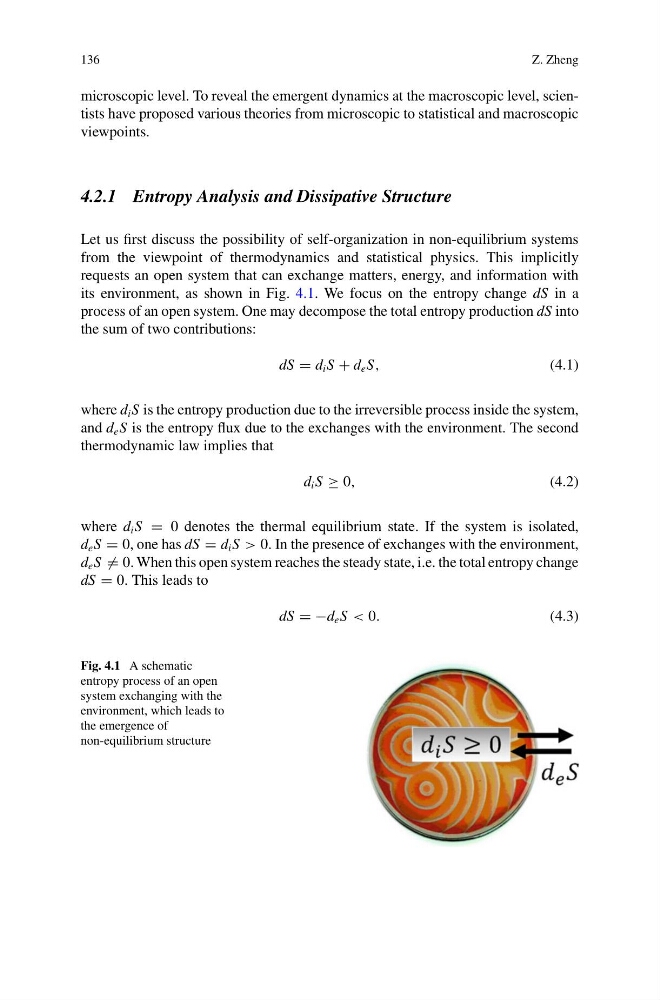
Let us first discuss the possibility of self-organization in non-equilibrium systems
from the viewpoint of thermodynamics and statistical physics. This implicitly
requests an open system that can exchange matters, energy, and information with
its environment, as shown in Fig. 4.1. We focus on the entropy change dS in a
process of an open system. One may decompose the total entropy production dS into
the sum of two contributions:
dS = d i S + d e S,
(4.1)
where d i S is the entropy production due to the irreversible process inside the system,
and d e S is the entropy flux due to the exchanges with the environment. The second
thermodynamic law implies that
d i S ≥ 0,
(4.2)
where d i S = 0 denotes the thermal equilibrium state. If the system is isolated,
d e S = 0, one has dS = d i S > 0. In the presence of exchanges with the environment,
d e S = 0. When this open system reaches the steady state, i.e. the total entropy change
dS = 0. This leads to
dS = −d e S < 0.
(4.3)
Fig. 4.1 A schematic
entropy process of an open
system exchanging with the
environment, which leads to
the emergence of
non-equilibrium structure
Z. Zheng
microscopic level. To reveal the emergent dynamics at the macroscopic level, scientists have proposed various theories from microscopic to statistical and macroscopic
viewpoints.
4.2.1 Entropy Analysis and Dissipative Structure
Let us first discuss the possibility of self-organization in non-equilibrium systems
from the viewpoint of thermodynamics and statistical physics. This implicitly
requests an open system that can exchange matters, energy, and information with
its environment, as shown in Fig. 4.1. We focus on the entropy change dS in a
process of an open system. One may decompose the total entropy production dS into
the sum of two contributions:
dS = d i S + d e S,
(4.1)
where d i S is the entropy production due to the irreversible process inside the system,
and d e S is the entropy flux due to the exchanges with the environment. The second
thermodynamic law implies that
d i S ≥ 0,
(4.2)
where d i S = 0 denotes the thermal equilibrium state. If the system is isolated,
d e S = 0, one has dS = d i S > 0. In the presence of exchanges with the environment,
d e S = 0. When this open system reaches the steady state, i.e. the total entropy change
dS = 0. This leads to
dS = −d e S < 0.
(4.3)
Fig. 4.1 A schematic
entropy process of an open
system exchanging with the
environment, which leads to
the emergence of
non-equilibrium structure