

130
Q. Wang
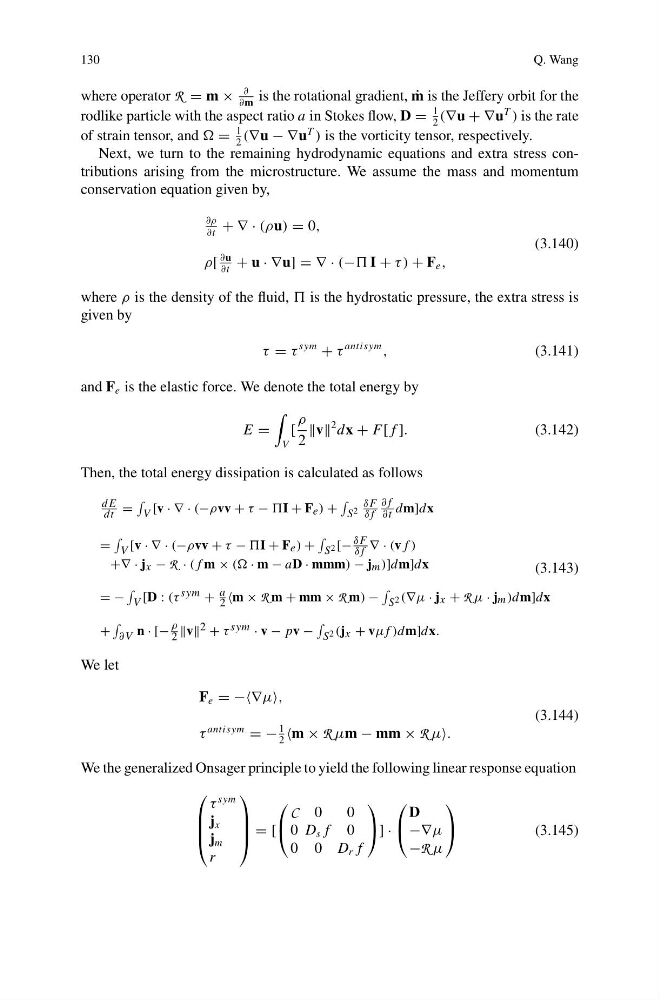
where operator R = m ×
∂
∂m
is the rotational gradient, ˙
m is the Jeffery orbit for the
rodlike particle with the aspect ratio a in Stokes flow, D =
1
2
(∇u + ∇u
T
) is the rate
of strain tensor, and =
1
2
(∇u − ∇u
T
) is the vorticity tensor, respectively.
Next, we turn to the remaining hydrodynamic equations and extra stress contributions arising from the microstructure. We assume the mass and momentum
conservation equation given by,
∂ρ
∂t
+ ∇ · (ρu) = 0,
ρ[
∂u
∂t
+ u · ∇u] = ∇ · (− I + τ ) + F e ,
(3.140)
where ρ is the density of the fluid, is the hydrostatic pressure, the extra stress is
given by
τ = τ
sym
+ τ
antisym
,
(3.141)
and F e is the elastic force. We denote the total energy by
E =
V
[
ρ
2
v
2 dx + F[ f ].
(3.142)
Then, the total energy dissipation is calculated as follows
d E
dt =
V [v · ∇ · (−ρvv + τ − I + F e ) +
S 2
δ F
δ f
∂ f
∂t dm]dx
=
V [v · ∇ · (−ρvv + τ − I + F e ) +
S 2 [− δ F
δ f ∇ · (v f )
+∇ · j x − R · ( f m × (( · m − aD · mmm) − j m )]dm]dx
= −
V [D : (τ sym + a
2 m × R m + mm × R m) −
S 2 (∇μ · j x + R μ · j m )dm]dx
+
∂ V n · [−
ρ
2 v 2 + τ sym · v − pv −
S 2 (j x + vμf )dm]dx.
(3.143)
We let
F e = −−∇μ,
τ
antisym
= −
1
2
m × R μm − mm × R μ.
(3.144)
We the generalized Onsager principle to yield the following linear response equation
⎛
⎜
⎜
⎝
τ
sym
j x
j m
r
⎞
⎟
⎟
⎠ = [
⎛
⎝
C 0
0
0 D s f 0
0 0 D r f
⎞
⎠ ] ·
⎛
⎝
D
−∇μ
−R μ
⎞
⎠
(3.145)
Q. Wang
where operator R = m ×
∂
∂m
is the rotational gradient, ˙
m is the Jeffery orbit for the
rodlike particle with the aspect ratio a in Stokes flow, D =
1
2
(∇u + ∇u
T
) is the rate
of strain tensor, and =
1
2
(∇u − ∇u
T
) is the vorticity tensor, respectively.
Next, we turn to the remaining hydrodynamic equations and extra stress contributions arising from the microstructure. We assume the mass and momentum
conservation equation given by,
∂ρ
∂t
+ ∇ · (ρu) = 0,
ρ[
∂u
∂t
+ u · ∇u] = ∇ · (− I + τ ) + F e ,
(3.140)
where ρ is the density of the fluid, is the hydrostatic pressure, the extra stress is
given by
τ = τ
sym
+ τ
antisym
,
(3.141)
and F e is the elastic force. We denote the total energy by
E =
V
[
ρ
2
v
2 dx + F[ f ].
(3.142)
Then, the total energy dissipation is calculated as follows
d E
dt =
V [v · ∇ · (−ρvv + τ − I + F e ) +
S 2
δ F
δ f
∂ f
∂t dm]dx
=
V [v · ∇ · (−ρvv + τ − I + F e ) +
S 2 [− δ F
δ f ∇ · (v f )
+∇ · j x − R · ( f m × (( · m − aD · mmm) − j m )]dm]dx
= −
V [D : (τ sym + a
2 m × R m + mm × R m) −
S 2 (∇μ · j x + R μ · j m )dm]dx
+
∂ V n · [−
ρ
2 v 2 + τ sym · v − pv −
S 2 (j x + vμf )dm]dx.
(3.143)
We let
F e = −−∇μ,
τ
antisym
= −
1
2
m × R μm − mm × R μ.
(3.144)
We the generalized Onsager principle to yield the following linear response equation
⎛
⎜
⎜
⎝
τ
sym
j x
j m
r
⎞
⎟
⎟
⎠ = [
⎛
⎝
C 0
0
0 D s f 0
0 0 D r f
⎞
⎠ ] ·
⎛
⎝
D
−∇μ
−R μ
⎞
⎠
(3.145)