

3 Generalized Onsager Principle and It Applications
105
x(t)x
T
(t + τ ) = =x(t + τ )x
T
(t),
(3.9)
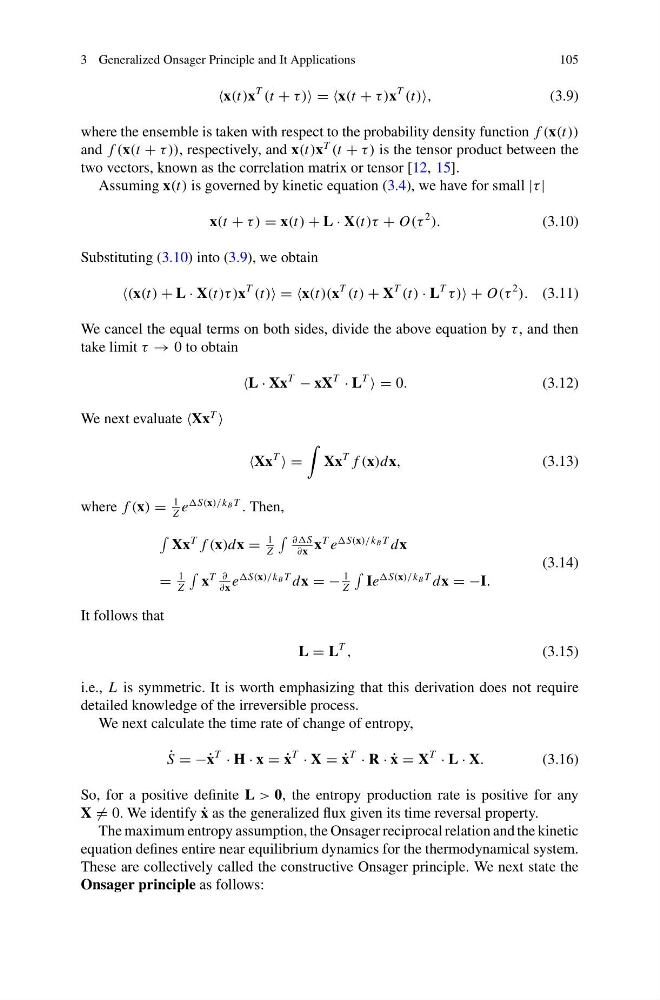
where the ensemble is taken with respect to the probability density function f (x(t))
and f (x(t + τ )), respectively, and x(t)x
T
(t + τ ) is the tensor product between the
two vectors, known as the correlation matrix or tensor [12, 15].
Assuming x(t) is governed by kinetic equation (3.4), we have for small |τ |
x(t + τ ) = x(t) + L · X(t)τ + O(τ
2
).
(3.10)
Substituting (3.10) into (3.9), we obtain
(x(t) + L · X(t)τ )x
T
(t) = =x(t)(x
T
(t) + X
T
(t) · L
T
τ ) + O(τ
2
). (3.11)
We cancel the equal terms on both sides, divide the above equation by τ , and then
take limit τ → 0 to obtain
L · Xx
T
− xX
T
· L
T
= 0.
(3.12)
We next evaluate Xx
T
Xx
T
=
Xx
T f (x)dx,
(3.13)
where f (x) =
1
Z
e
S(x)/k B T
. Then,
Xx
T f (x)dx =
1
Z
∂∂S
∂x
x
T e
S(x)/k B T dx
=
1
Z
x
T ∂
∂x
e
S(x)/k B T dx = −
1
Z
Ie
S(x)/k B T dx = −I.
(3.14)
It follows that
L = L
T
,
(3.15)
i.e., L is symmetric. It is worth emphasizing that this derivation does not require
detailed knowledge of the irreversible process.
We next calculate the time rate of change of entropy,
˙
S = −˙ x
T
· H · x = ˙
x
T
· X = ˙
x
T
· R · ˙
x = X
T
· L · X.
(3.16)
So, for a positive definite L > 0, the entropy production rate is positive for any
X = 0. We identify ˙
x as the generalized flux given its time reversal property.
The maximum entropy assumption, the Onsager reciprocal relation and the kinetic
equation defines entire near equilibrium dynamics for the thermodynamical system.
These are collectively called the constructive Onsager principle. We next state the
Onsager principle as follows:
105
x(t)x
T
(t + τ ) = =x(t + τ )x
T
(t),
(3.9)
where the ensemble is taken with respect to the probability density function f (x(t))
and f (x(t + τ )), respectively, and x(t)x
T
(t + τ ) is the tensor product between the
two vectors, known as the correlation matrix or tensor [12, 15].
Assuming x(t) is governed by kinetic equation (3.4), we have for small |τ |
x(t + τ ) = x(t) + L · X(t)τ + O(τ
2
).
(3.10)
Substituting (3.10) into (3.9), we obtain
(x(t) + L · X(t)τ )x
T
(t) = =x(t)(x
T
(t) + X
T
(t) · L
T
τ ) + O(τ
2
). (3.11)
We cancel the equal terms on both sides, divide the above equation by τ , and then
take limit τ → 0 to obtain
L · Xx
T
− xX
T
· L
T
= 0.
(3.12)
We next evaluate Xx
T
Xx
T
=
Xx
T f (x)dx,
(3.13)
where f (x) =
1
Z
e
S(x)/k B T
. Then,
Xx
T f (x)dx =
1
Z
∂∂S
∂x
x
T e
S(x)/k B T dx
=
1
Z
x
T ∂
∂x
e
S(x)/k B T dx = −
1
Z
Ie
S(x)/k B T dx = −I.
(3.14)
It follows that
L = L
T
,
(3.15)
i.e., L is symmetric. It is worth emphasizing that this derivation does not require
detailed knowledge of the irreversible process.
We next calculate the time rate of change of entropy,
˙
S = −˙ x
T
· H · x = ˙
x
T
· X = ˙
x
T
· R · ˙
x = X
T
· L · X.
(3.16)
So, for a positive definite L > 0, the entropy production rate is positive for any
X = 0. We identify ˙
x as the generalized flux given its time reversal property.
The maximum entropy assumption, the Onsager reciprocal relation and the kinetic
equation defines entire near equilibrium dynamics for the thermodynamical system.
These are collectively called the constructive Onsager principle. We next state the
Onsager principle as follows: