

76
3 Buzzing Lips: Sound Generation in Brass Instruments
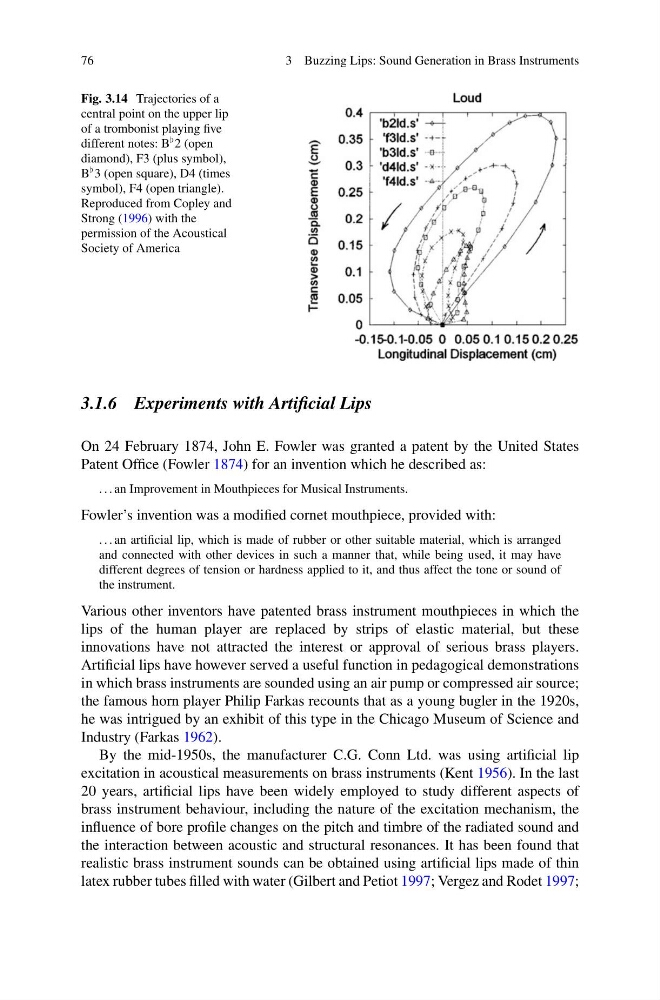
Fig. 3.14 Trajectories of a
central point on the upper lip
of a trombonist playing five
different notes: B 2 (open
diamond), F3 (plus symbol),
B 3 (open square), D4 (times
symbol), F4 (open triangle).
Reproduced from Copley and
Strong (1996) with the
permission of the Acoustical
Society of America
3.1.6 Experiments with Artificial Lips
On 24 February 1874, John E. Fowler was granted a patent by the United States
Patent Office (Fowler 1874) for an invention which he described as:
. . . an Improvement in Mouthpieces for Musical Instruments.
Fowler’s invention was a modified cornet mouthpiece, provided with:
. . . an artificial lip, which is made of rubber or other suitable material, which is arranged
and connected with other devices in such a manner that, while being used, it may have
different degrees of tension or hardness applied to it, and thus affect the tone or sound of
the instrument.
Various other inventors have patented brass instrument mouthpieces in which the
lips of the human player are replaced by strips of elastic material, but these
innovations have not attracted the interest or approval of serious brass players.
Artificial lips have however served a useful function in pedagogical demonstrations
in which brass instruments are sounded using an air pump or compressed air source;
the famous horn player Philip Farkas recounts that as a young bugler in the 1920s,
he was intrigued by an exhibit of this type in the Chicago Museum of Science and
Industry (Farkas 1962).
By the mid-1950s, the manufacturer C.G. Conn Ltd. was using artificial lip
excitation in acoustical measurements on brass instruments (Kent 1956). In the last
20 years, artificial lips have been widely employed to study different aspects of
brass instrument behaviour, including the nature of the excitation mechanism, the
influence of bore profile changes on the pitch and timbre of the radiated sound and
the interaction between acoustic and structural resonances. It has been found that
realistic brass instrument sounds can be obtained using artificial lips made of thin
latex rubber tubes filled with water (Gilbert and Petiot 1997; Vergez and Rodet 1997;
3 Buzzing Lips: Sound Generation in Brass Instruments
Fig. 3.14 Trajectories of a
central point on the upper lip
of a trombonist playing five
different notes: B 2 (open
diamond), F3 (plus symbol),
B 3 (open square), D4 (times
symbol), F4 (open triangle).
Reproduced from Copley and
Strong (1996) with the
permission of the Acoustical
Society of America
3.1.6 Experiments with Artificial Lips
On 24 February 1874, John E. Fowler was granted a patent by the United States
Patent Office (Fowler 1874) for an invention which he described as:
. . . an Improvement in Mouthpieces for Musical Instruments.
Fowler’s invention was a modified cornet mouthpiece, provided with:
. . . an artificial lip, which is made of rubber or other suitable material, which is arranged
and connected with other devices in such a manner that, while being used, it may have
different degrees of tension or hardness applied to it, and thus affect the tone or sound of
the instrument.
Various other inventors have patented brass instrument mouthpieces in which the
lips of the human player are replaced by strips of elastic material, but these
innovations have not attracted the interest or approval of serious brass players.
Artificial lips have however served a useful function in pedagogical demonstrations
in which brass instruments are sounded using an air pump or compressed air source;
the famous horn player Philip Farkas recounts that as a young bugler in the 1920s,
he was intrigued by an exhibit of this type in the Chicago Museum of Science and
Industry (Farkas 1962).
By the mid-1950s, the manufacturer C.G. Conn Ltd. was using artificial lip
excitation in acoustical measurements on brass instruments (Kent 1956). In the last
20 years, artificial lips have been widely employed to study different aspects of
brass instrument behaviour, including the nature of the excitation mechanism, the
influence of bore profile changes on the pitch and timbre of the radiated sound and
the interaction between acoustic and structural resonances. It has been found that
realistic brass instrument sounds can be obtained using artificial lips made of thin
latex rubber tubes filled with water (Gilbert and Petiot 1997; Vergez and Rodet 1997;