

74
3 Buzzing Lips: Sound Generation in Brass Instruments
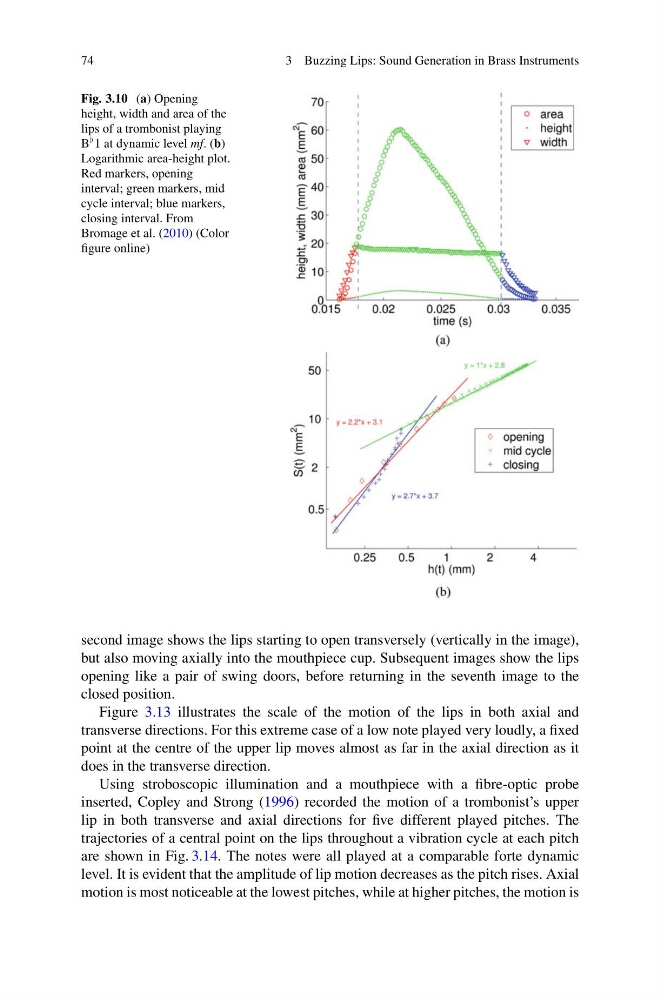
Fig. 3.10 (a) Opening
height, width and area of the
lips of a trombonist playing
B 1 at dynamic level mf. (b)
Logarithmic area-height plot.
Red markers, opening
interval; green markers, mid
cycle interval; blue markers,
closing interval. From
Bromage et al. (2010) (Color
figure online)
second image shows the lips starting to open transversely (vertically in the image),
but also moving axially into the mouthpiece cup. Subsequent images show the lips
opening like a pair of swing doors, before returning in the seventh image to the
closed position.
Figure 3.13 illustrates the scale of the motion of the lips in both axial and
transverse directions. For this extreme case of a low note played very loudly, a fixed
point at the centre of the upper lip moves almost as far in the axial direction as it
does in the transverse direction.
Using stroboscopic illumination and a mouthpiece with a fibre-optic probe
inserted, Copley and Strong (1996) recorded the motion of a trombonist’s upper
lip in both transverse and axial directions for five different played pitches. The
trajectories of a central point on the lips throughout a vibration cycle at each pitch
are shown in Fig. 3.14. The notes were all played at a comparable forte dynamic
level. It is evident that the amplitude of lip motion decreases as the pitch rises. Axial
motion is most noticeable at the lowest pitches, while at higher pitches, the motion is
3 Buzzing Lips: Sound Generation in Brass Instruments
Fig. 3.10 (a) Opening
height, width and area of the
lips of a trombonist playing
B 1 at dynamic level mf. (b)
Logarithmic area-height plot.
Red markers, opening
interval; green markers, mid
cycle interval; blue markers,
closing interval. From
Bromage et al. (2010) (Color
figure online)
second image shows the lips starting to open transversely (vertically in the image),
but also moving axially into the mouthpiece cup. Subsequent images show the lips
opening like a pair of swing doors, before returning in the seventh image to the
closed position.
Figure 3.13 illustrates the scale of the motion of the lips in both axial and
transverse directions. For this extreme case of a low note played very loudly, a fixed
point at the centre of the upper lip moves almost as far in the axial direction as it
does in the transverse direction.
Using stroboscopic illumination and a mouthpiece with a fibre-optic probe
inserted, Copley and Strong (1996) recorded the motion of a trombonist’s upper
lip in both transverse and axial directions for five different played pitches. The
trajectories of a central point on the lips throughout a vibration cycle at each pitch
are shown in Fig. 3.14. The notes were all played at a comparable forte dynamic
level. It is evident that the amplitude of lip motion decreases as the pitch rises. Axial
motion is most noticeable at the lowest pitches, while at higher pitches, the motion is