

3.1 The Nature of Lip Vibration
71
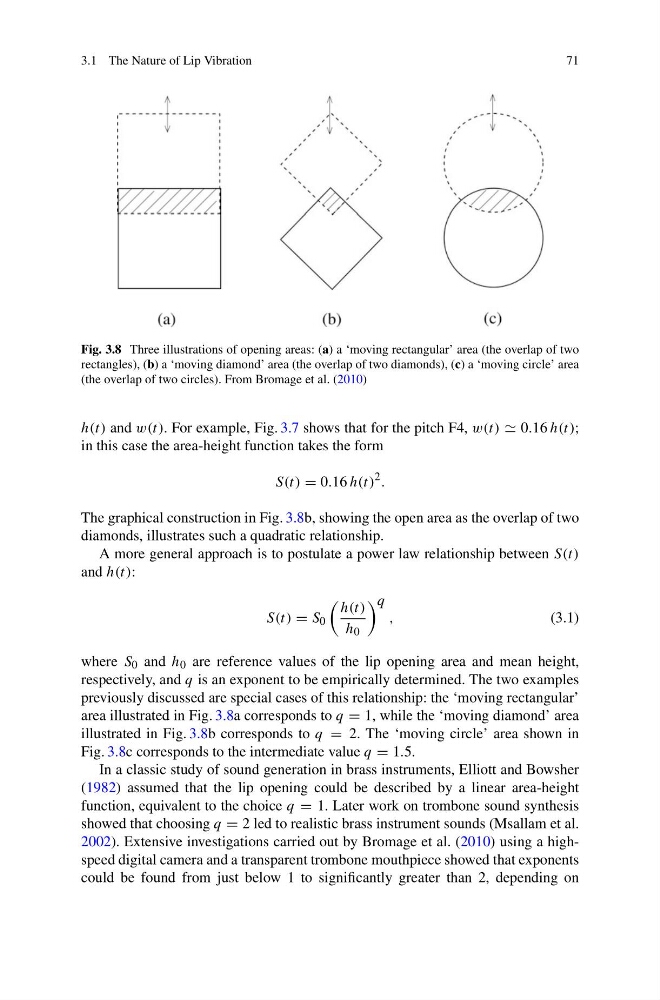
Fig. 3.8 Three illustrations of opening areas: (a) a ‘moving rectangular’ area (the overlap of two
rectangles), (b) a ‘moving diamond’ area (the overlap of two diamonds), (c) a ‘moving circle’ area
(the overlap of two circles). From Bromage et al. (2010)
h(t) and w(t). For example, Fig. 3.7 shows that for the pitch F4, w(t) 0.16 h(t);
in this case the area-height function takes the form
S(t) = 0.16 h(t)
2 .
The graphical construction in Fig. 3.8b, showing the open area as the overlap of two
diamonds, illustrates such a quadratic relationship.
A more general approach is to postulate a power law relationship between S(t)
and h(t):
S(t) = S 0
h(t)
h 0
q
,
(3.1)
where S 0 and h 0 are reference values of the lip opening area and mean height,
respectively, and q is an exponent to be empirically determined. The two examples
previously discussed are special cases of this relationship: the ‘moving rectangular’
area illustrated in Fig. 3.8a corresponds to q = 1, while the ‘moving diamond’ area
illustrated in Fig. 3.8b corresponds to q = 2. The ‘moving circle’ area shown in
Fig. 3.8c corresponds to the intermediate value q = 1.5.
In a classic study of sound generation in brass instruments, Elliott and Bowsher
(1982) assumed that the lip opening could be described by a linear area-height
function, equivalent to the choice q = 1. Later work on trombone sound synthesis
showed that choosing q = 2 led to realistic brass instrument sounds (Msallam et al.
2002). Extensive investigations carried out by Bromage et al. (2010) using a highspeed digital camera and a transparent trombone mouthpiece showed that exponents
could be found from just below 1 to significantly greater than 2, depending on
71
Fig. 3.8 Three illustrations of opening areas: (a) a ‘moving rectangular’ area (the overlap of two
rectangles), (b) a ‘moving diamond’ area (the overlap of two diamonds), (c) a ‘moving circle’ area
(the overlap of two circles). From Bromage et al. (2010)
h(t) and w(t). For example, Fig. 3.7 shows that for the pitch F4, w(t) 0.16 h(t);
in this case the area-height function takes the form
S(t) = 0.16 h(t)
2 .
The graphical construction in Fig. 3.8b, showing the open area as the overlap of two
diamonds, illustrates such a quadratic relationship.
A more general approach is to postulate a power law relationship between S(t)
and h(t):
S(t) = S 0
h(t)
h 0
q
,
(3.1)
where S 0 and h 0 are reference values of the lip opening area and mean height,
respectively, and q is an exponent to be empirically determined. The two examples
previously discussed are special cases of this relationship: the ‘moving rectangular’
area illustrated in Fig. 3.8a corresponds to q = 1, while the ‘moving diamond’ area
illustrated in Fig. 3.8b corresponds to q = 2. The ‘moving circle’ area shown in
Fig. 3.8c corresponds to the intermediate value q = 1.5.
In a classic study of sound generation in brass instruments, Elliott and Bowsher
(1982) assumed that the lip opening could be described by a linear area-height
function, equivalent to the choice q = 1. Later work on trombone sound synthesis
showed that choosing q = 2 led to realistic brass instrument sounds (Msallam et al.
2002). Extensive investigations carried out by Bromage et al. (2010) using a highspeed digital camera and a transparent trombone mouthpiece showed that exponents
could be found from just below 1 to significantly greater than 2, depending on