

58
2 The Scientist’s Perspective on Brass Instrument Behaviour
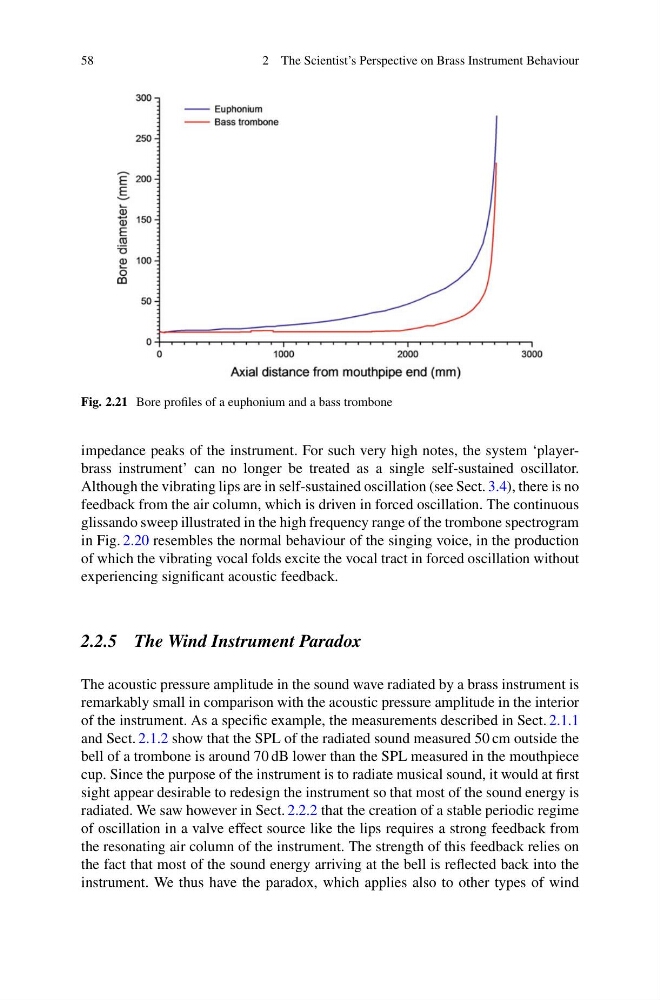
Fig. 2.21 Bore profiles of a euphonium and a bass trombone
impedance peaks of the instrument. For such very high notes, the system ‘playerbrass instrument’ can no longer be treated as a single self-sustained oscillator.
Although the vibrating lips are in self-sustained oscillation (see Sect. 3.4), there is no
feedback from the air column, which is driven in forced oscillation. The continuous
glissando sweep illustrated in the high frequency range of the trombone spectrogram
in Fig. 2.20 resembles the normal behaviour of the singing voice, in the production
of which the vibrating vocal folds excite the vocal tract in forced oscillation without
experiencing significant acoustic feedback.
2.2.5 The Wind Instrument Paradox
The acoustic pressure amplitude in the sound wave radiated by a brass instrument is
remarkably small in comparison with the acoustic pressure amplitude in the interior
of the instrument. As a specific example, the measurements described in Sect. 2.1.1
and Sect. 2.1.2 show that the SPL of the radiated sound measured 50 cm outside the
bell of a trombone is around 70 dB lower than the SPL measured in the mouthpiece
cup. Since the purpose of the instrument is to radiate musical sound, it would at first
sight appear desirable to redesign the instrument so that most of the sound energy is
radiated. We saw however in Sect. 2.2.2 that the creation of a stable periodic regime
of oscillation in a valve effect source like the lips requires a strong feedback from
the resonating air column of the instrument. The strength of this feedback relies on
the fact that most of the sound energy arriving at the bell is reflected back into the
instrument. We thus have the paradox, which applies also to other types of wind
2 The Scientist’s Perspective on Brass Instrument Behaviour
Fig. 2.21 Bore profiles of a euphonium and a bass trombone
impedance peaks of the instrument. For such very high notes, the system ‘playerbrass instrument’ can no longer be treated as a single self-sustained oscillator.
Although the vibrating lips are in self-sustained oscillation (see Sect. 3.4), there is no
feedback from the air column, which is driven in forced oscillation. The continuous
glissando sweep illustrated in the high frequency range of the trombone spectrogram
in Fig. 2.20 resembles the normal behaviour of the singing voice, in the production
of which the vibrating vocal folds excite the vocal tract in forced oscillation without
experiencing significant acoustic feedback.
2.2.5 The Wind Instrument Paradox
The acoustic pressure amplitude in the sound wave radiated by a brass instrument is
remarkably small in comparison with the acoustic pressure amplitude in the interior
of the instrument. As a specific example, the measurements described in Sect. 2.1.1
and Sect. 2.1.2 show that the SPL of the radiated sound measured 50 cm outside the
bell of a trombone is around 70 dB lower than the SPL measured in the mouthpiece
cup. Since the purpose of the instrument is to radiate musical sound, it would at first
sight appear desirable to redesign the instrument so that most of the sound energy is
radiated. We saw however in Sect. 2.2.2 that the creation of a stable periodic regime
of oscillation in a valve effect source like the lips requires a strong feedback from
the resonating air column of the instrument. The strength of this feedback relies on
the fact that most of the sound energy arriving at the bell is reflected back into the
instrument. We thus have the paradox, which applies also to other types of wind