

2.2 An Approach to Modelling Brass Instruments
55
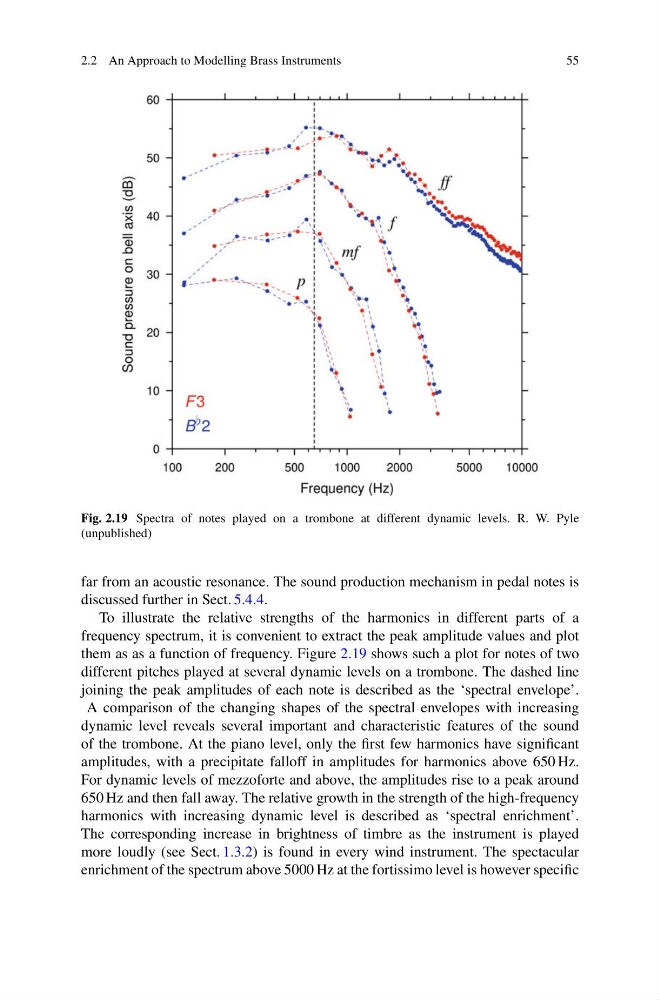
Fig. 2.19 Spectra of notes played on a trombone at different dynamic levels. R. W. Pyle
(unpublished)
far from an acoustic resonance. The sound production mechanism in pedal notes is
discussed further in Sect. 5.4.4.
To illustrate the relative strengths of the harmonics in different parts of a
frequency spectrum, it is convenient to extract the peak amplitude values and plot
them as as a function of frequency. Figure 2.19 shows such a plot for notes of two
different pitches played at several dynamic levels on a trombone. The dashed line
joining the peak amplitudes of each note is described as the ‘spectral envelope’.
A comparison of the changing shapes of the spectral envelopes with increasing
dynamic level reveals several important and characteristic features of the sound
of the trombone. At the piano level, only the first few harmonics have significant
amplitudes, with a precipitate falloff in amplitudes for harmonics above 650 Hz.
For dynamic levels of mezzoforte and above, the amplitudes rise to a peak around
650 Hz and then fall away. The relative growth in the strength of the high-frequency
harmonics with increasing dynamic level is described as ‘spectral enrichment’.
The corresponding increase in brightness of timbre as the instrument is played
more loudly (see Sect. 1.3.2) is found in every wind instrument. The spectacular
enrichment of the spectrum above 5000 Hz at the fortissimo level is however specific
55
Fig. 2.19 Spectra of notes played on a trombone at different dynamic levels. R. W. Pyle
(unpublished)
far from an acoustic resonance. The sound production mechanism in pedal notes is
discussed further in Sect. 5.4.4.
To illustrate the relative strengths of the harmonics in different parts of a
frequency spectrum, it is convenient to extract the peak amplitude values and plot
them as as a function of frequency. Figure 2.19 shows such a plot for notes of two
different pitches played at several dynamic levels on a trombone. The dashed line
joining the peak amplitudes of each note is described as the ‘spectral envelope’.
A comparison of the changing shapes of the spectral envelopes with increasing
dynamic level reveals several important and characteristic features of the sound
of the trombone. At the piano level, only the first few harmonics have significant
amplitudes, with a precipitate falloff in amplitudes for harmonics above 650 Hz.
For dynamic levels of mezzoforte and above, the amplitudes rise to a peak around
650 Hz and then fall away. The relative growth in the strength of the high-frequency
harmonics with increasing dynamic level is described as ‘spectral enrichment’.
The corresponding increase in brightness of timbre as the instrument is played
more loudly (see Sect. 1.3.2) is found in every wind instrument. The spectacular
enrichment of the spectrum above 5000 Hz at the fortissimo level is however specific