

52
2 The Scientist’s Perspective on Brass Instrument Behaviour
balance between strong centring of notes and flexibility of intonation will depend
on the individual playing technique and style of the performer. A significant part of
the musical character of some early instruments such as the serpent is related to the
weakness of feedback from the instrument, demanding a different playing technique
to control notes which are not well centred (see Sect. 1.2.2).
2.2.3 Natural Notes and Harmonics: The Scientific View
The natural notes which can be easily sounded on a brass instrument are commonly
described as ‘harmonics’ by musicians (Sect. 1.2.2). From the scientist’s viewpoint,
the natural notes themselves are not strictly speaking harmonics, but each natural
note contains within itself an almost exact harmonic set of frequencies. To explain
this apparently paradoxical statement, we need to understand how the musical
concepts of pitch and timbre are related to the scientific description of a musical
sound.
A periodic variation in any quantity is one that repeats itself regularly. The
time interval between two successive repetitions is the period τ , and the repetition
frequency is f R = 1/τ . If the variation in pressure due to a sound wave is at least
approximately periodic, it is perceived as having a definite pitch (see, e.g., Campbell
and Greated 1987). An oboe player sounds a standard A to which other members of
an orchestra can tune by generating a periodic pressure fluctuation with a repetition
frequency f R = 440 Hz.
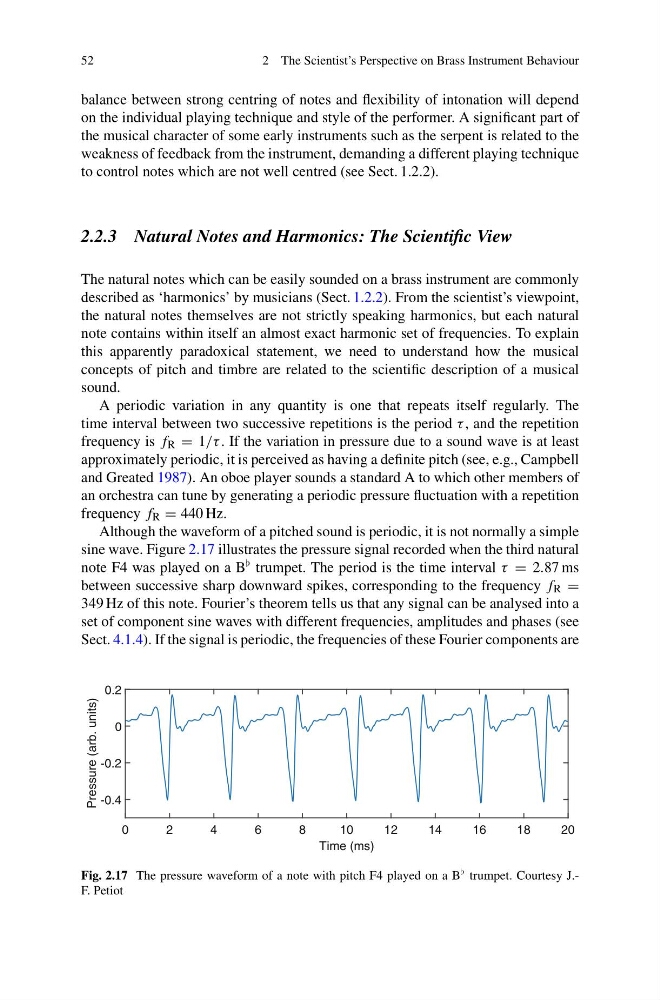
Although the waveform of a pitched sound is periodic, it is not normally a simple
sine wave. Figure 2.17 illustrates the pressure signal recorded when the third natural
note F4 was played on a B trumpet. The period is the time interval τ = 2.87 ms
between successive sharp downward spikes, corresponding to the frequency f R =
349 Hz of this note. Fourier’s theorem tells us that any signal can be analysed into a
set of component sine waves with different frequencies, amplitudes and phases (see
Sect. 4.1.4). If the signal is periodic, the frequencies of these Fourier components are
0
2
4
6
8
1 0
1 2
1 4
1 6
1 8
2 0
Time (ms)
-0.4
-0.2
0
0.2
Pressure (arb. units)
Fig. 2.17 The pressure waveform of a note with pitch F4 played on a B trumpet. Courtesy J.F. Petiot
2 The Scientist’s Perspective on Brass Instrument Behaviour
balance between strong centring of notes and flexibility of intonation will depend
on the individual playing technique and style of the performer. A significant part of
the musical character of some early instruments such as the serpent is related to the
weakness of feedback from the instrument, demanding a different playing technique
to control notes which are not well centred (see Sect. 1.2.2).
2.2.3 Natural Notes and Harmonics: The Scientific View
The natural notes which can be easily sounded on a brass instrument are commonly
described as ‘harmonics’ by musicians (Sect. 1.2.2). From the scientist’s viewpoint,
the natural notes themselves are not strictly speaking harmonics, but each natural
note contains within itself an almost exact harmonic set of frequencies. To explain
this apparently paradoxical statement, we need to understand how the musical
concepts of pitch and timbre are related to the scientific description of a musical
sound.
A periodic variation in any quantity is one that repeats itself regularly. The
time interval between two successive repetitions is the period τ , and the repetition
frequency is f R = 1/τ . If the variation in pressure due to a sound wave is at least
approximately periodic, it is perceived as having a definite pitch (see, e.g., Campbell
and Greated 1987). An oboe player sounds a standard A to which other members of
an orchestra can tune by generating a periodic pressure fluctuation with a repetition
frequency f R = 440 Hz.
Although the waveform of a pitched sound is periodic, it is not normally a simple
sine wave. Figure 2.17 illustrates the pressure signal recorded when the third natural
note F4 was played on a B trumpet. The period is the time interval τ = 2.87 ms
between successive sharp downward spikes, corresponding to the frequency f R =
349 Hz of this note. Fourier’s theorem tells us that any signal can be analysed into a
set of component sine waves with different frequencies, amplitudes and phases (see
Sect. 4.1.4). If the signal is periodic, the frequencies of these Fourier components are
0
2
4
6
8
1 0
1 2
1 4
1 6
1 8
2 0
Time (ms)
-0.4
-0.2
0
0.2
Pressure (arb. units)
Fig. 2.17 The pressure waveform of a note with pitch F4 played on a B trumpet. Courtesy J.F. Petiot