

2.2 An Approach to Modelling Brass Instruments
49
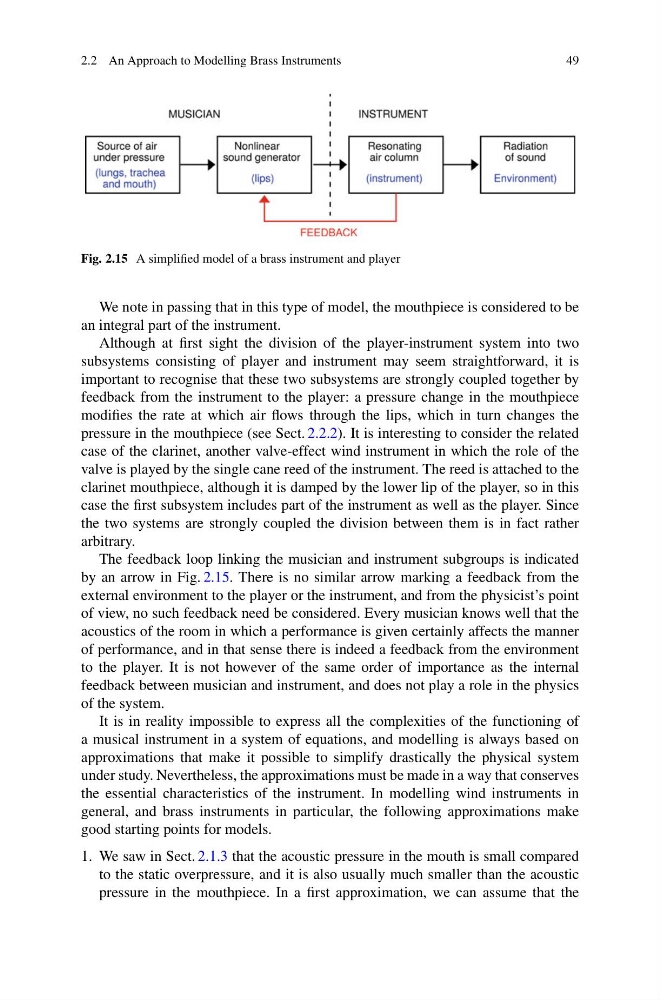
Fig. 2.15 A simplified model of a brass instrument and player
We note in passing that in this type of model, the mouthpiece is considered to be
an integral part of the instrument.
Although at first sight the division of the player-instrument system into two
subsystems consisting of player and instrument may seem straightforward, it is
important to recognise that these two subsystems are strongly coupled together by
feedback from the instrument to the player: a pressure change in the mouthpiece
modifies the rate at which air flows through the lips, which in turn changes the
pressure in the mouthpiece (see Sect. 2.2.2). It is interesting to consider the related
case of the clarinet, another valve-effect wind instrument in which the role of the
valve is played by the single cane reed of the instrument. The reed is attached to the
clarinet mouthpiece, although it is damped by the lower lip of the player, so in this
case the first subsystem includes part of the instrument as well as the player. Since
the two systems are strongly coupled the division between them is in fact rather
arbitrary.
The feedback loop linking the musician and instrument subgroups is indicated
by an arrow in Fig. 2.15. There is no similar arrow marking a feedback from the
external environment to the player or the instrument, and from the physicist’s point
of view, no such feedback need be considered. Every musician knows well that the
acoustics of the room in which a performance is given certainly affects the manner
of performance, and in that sense there is indeed a feedback from the environment
to the player. It is not however of the same order of importance as the internal
feedback between musician and instrument, and does not play a role in the physics
of the system.
It is in reality impossible to express all the complexities of the functioning of
a musical instrument in a system of equations, and modelling is always based on
approximations that make it possible to simplify drastically the physical system
under study. Nevertheless, the approximations must be made in a way that conserves
the essential characteristics of the instrument. In modelling wind instruments in
general, and brass instruments in particular, the following approximations make
good starting points for models.
1. We saw in Sect. 2.1.3 that the acoustic pressure in the mouth is small compared
to the static overpressure, and it is also usually much smaller than the acoustic
pressure in the mouthpiece. In a first approximation, we can assume that the
49
Fig. 2.15 A simplified model of a brass instrument and player
We note in passing that in this type of model, the mouthpiece is considered to be
an integral part of the instrument.
Although at first sight the division of the player-instrument system into two
subsystems consisting of player and instrument may seem straightforward, it is
important to recognise that these two subsystems are strongly coupled together by
feedback from the instrument to the player: a pressure change in the mouthpiece
modifies the rate at which air flows through the lips, which in turn changes the
pressure in the mouthpiece (see Sect. 2.2.2). It is interesting to consider the related
case of the clarinet, another valve-effect wind instrument in which the role of the
valve is played by the single cane reed of the instrument. The reed is attached to the
clarinet mouthpiece, although it is damped by the lower lip of the player, so in this
case the first subsystem includes part of the instrument as well as the player. Since
the two systems are strongly coupled the division between them is in fact rather
arbitrary.
The feedback loop linking the musician and instrument subgroups is indicated
by an arrow in Fig. 2.15. There is no similar arrow marking a feedback from the
external environment to the player or the instrument, and from the physicist’s point
of view, no such feedback need be considered. Every musician knows well that the
acoustics of the room in which a performance is given certainly affects the manner
of performance, and in that sense there is indeed a feedback from the environment
to the player. It is not however of the same order of importance as the internal
feedback between musician and instrument, and does not play a role in the physics
of the system.
It is in reality impossible to express all the complexities of the functioning of
a musical instrument in a system of equations, and modelling is always based on
approximations that make it possible to simplify drastically the physical system
under study. Nevertheless, the approximations must be made in a way that conserves
the essential characteristics of the instrument. In modelling wind instruments in
general, and brass instruments in particular, the following approximations make
good starting points for models.
1. We saw in Sect. 2.1.3 that the acoustic pressure in the mouth is small compared
to the static overpressure, and it is also usually much smaller than the acoustic
pressure in the mouthpiece. In a first approximation, we can assume that the