

32
2 The Scientist’s Perspective on Brass Instrument Behaviour
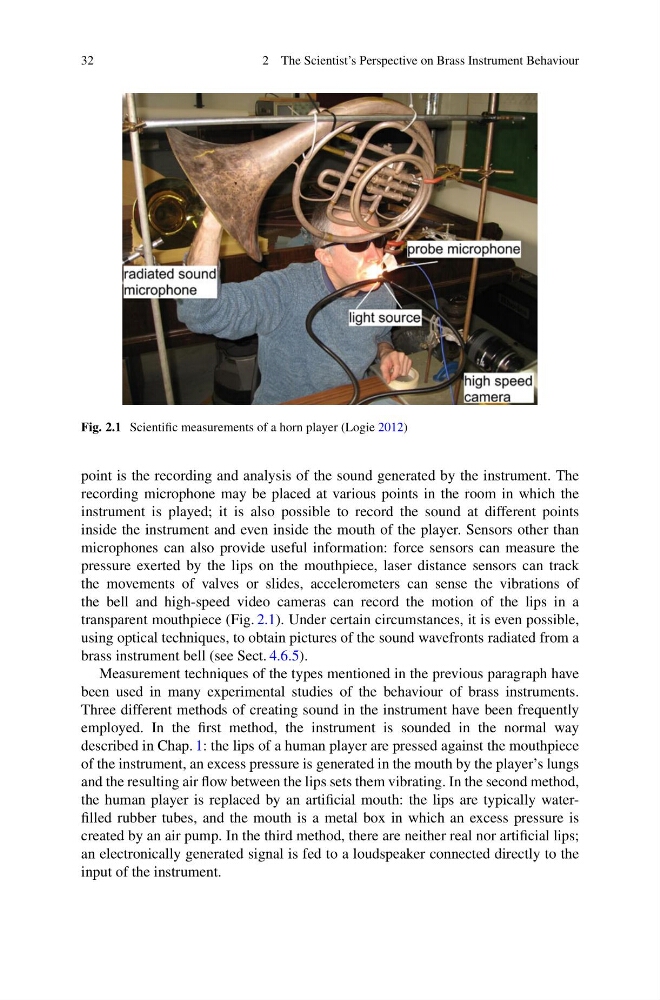
Fig. 2.1 Scientific measurements of a horn player (Logie 2012)
point is the recording and analysis of the sound generated by the instrument. The
recording microphone may be placed at various points in the room in which the
instrument is played; it is also possible to record the sound at different points
inside the instrument and even inside the mouth of the player. Sensors other than
microphones can also provide useful information: force sensors can measure the
pressure exerted by the lips on the mouthpiece, laser distance sensors can track
the movements of valves or slides, accelerometers can sense the vibrations of
the bell and high-speed video cameras can record the motion of the lips in a
transparent mouthpiece (Fig. 2.1). Under certain circumstances, it is even possible,
using optical techniques, to obtain pictures of the sound wavefronts radiated from a
brass instrument bell (see Sect. 4.6.5).
Measurement techniques of the types mentioned in the previous paragraph have
been used in many experimental studies of the behaviour of brass instruments.
Three different methods of creating sound in the instrument have been frequently
employed. In the first method, the instrument is sounded in the normal way
described in Chap. 1: the lips of a human player are pressed against the mouthpiece
of the instrument, an excess pressure is generated in the mouth by the player’s lungs
and the resulting air flow between the lips sets them vibrating. In the second method,
the human player is replaced by an artificial mouth: the lips are typically waterfilled rubber tubes, and the mouth is a metal box in which an excess pressure is
created by an air pump. In the third method, there are neither real nor artificial lips;
an electronically generated signal is fed to a loudspeaker connected directly to the
input of the instrument.
2 The Scientist’s Perspective on Brass Instrument Behaviour
Fig. 2.1 Scientific measurements of a horn player (Logie 2012)
point is the recording and analysis of the sound generated by the instrument. The
recording microphone may be placed at various points in the room in which the
instrument is played; it is also possible to record the sound at different points
inside the instrument and even inside the mouth of the player. Sensors other than
microphones can also provide useful information: force sensors can measure the
pressure exerted by the lips on the mouthpiece, laser distance sensors can track
the movements of valves or slides, accelerometers can sense the vibrations of
the bell and high-speed video cameras can record the motion of the lips in a
transparent mouthpiece (Fig. 2.1). Under certain circumstances, it is even possible,
using optical techniques, to obtain pictures of the sound wavefronts radiated from a
brass instrument bell (see Sect. 4.6.5).
Measurement techniques of the types mentioned in the previous paragraph have
been used in many experimental studies of the behaviour of brass instruments.
Three different methods of creating sound in the instrument have been frequently
employed. In the first method, the instrument is sounded in the normal way
described in Chap. 1: the lips of a human player are pressed against the mouthpiece
of the instrument, an excess pressure is generated in the mouth by the player’s lungs
and the resulting air flow between the lips sets them vibrating. In the second method,
the human player is replaced by an artificial mouth: the lips are typically waterfilled rubber tubes, and the mouth is a metal box in which an excess pressure is
created by an air pump. In the third method, there are neither real nor artificial lips;
an electronically generated signal is fed to a loudspeaker connected directly to the
input of the instrument.