

1.3 Subjective and Objective Evaluation of Brass Instrument Quality
29
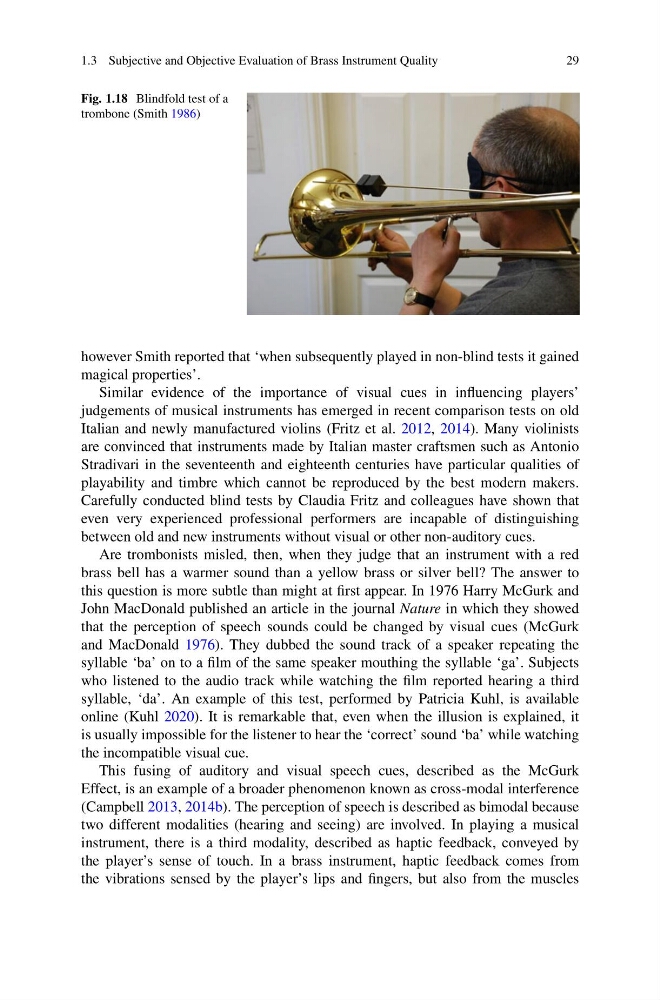
Fig. 1.18 Blindfold test of a
trombone (Smith 1986)
however Smith reported that ‘when subsequently played in non-blind tests it gained
magical properties’.
Similar evidence of the importance of visual cues in influencing players’
judgements of musical instruments has emerged in recent comparison tests on old
Italian and newly manufactured violins (Fritz et al. 2012, 2014). Many violinists
are convinced that instruments made by Italian master craftsmen such as Antonio
Stradivari in the seventeenth and eighteenth centuries have particular qualities of
playability and timbre which cannot be reproduced by the best modern makers.
Carefully conducted blind tests by Claudia Fritz and colleagues have shown that
even very experienced professional performers are incapable of distinguishing
between old and new instruments without visual or other non-auditory cues.
Are trombonists misled, then, when they judge that an instrument with a red
brass bell has a warmer sound than a yellow brass or silver bell? The answer to
this question is more subtle than might at first appear. In 1976 Harry McGurk and
John MacDonald published an article in the journal Nature in which they showed
that the perception of speech sounds could be changed by visual cues (McGurk
and MacDonald 1976). They dubbed the sound track of a speaker repeating the
syllable ‘ba’ on to a film of the same speaker mouthing the syllable ‘ga’. Subjects
who listened to the audio track while watching the film reported hearing a third
syllable, ‘da’. An example of this test, performed by Patricia Kuhl, is available
online (Kuhl 2020). It is remarkable that, even when the illusion is explained, it
is usually impossible for the listener to hear the ‘correct’ sound ‘ba’ while watching
the incompatible visual cue.
This fusing of auditory and visual speech cues, described as the McGurk
Effect, is an example of a broader phenomenon known as cross-modal interference
(Campbell 2013, 2014b). The perception of speech is described as bimodal because
two different modalities (hearing and seeing) are involved. In playing a musical
instrument, there is a third modality, described as haptic feedback, conveyed by
the player’s sense of touch. In a brass instrument, haptic feedback comes from
the vibrations sensed by the player’s lips and fingers, but also from the muscles
29
Fig. 1.18 Blindfold test of a
trombone (Smith 1986)
however Smith reported that ‘when subsequently played in non-blind tests it gained
magical properties’.
Similar evidence of the importance of visual cues in influencing players’
judgements of musical instruments has emerged in recent comparison tests on old
Italian and newly manufactured violins (Fritz et al. 2012, 2014). Many violinists
are convinced that instruments made by Italian master craftsmen such as Antonio
Stradivari in the seventeenth and eighteenth centuries have particular qualities of
playability and timbre which cannot be reproduced by the best modern makers.
Carefully conducted blind tests by Claudia Fritz and colleagues have shown that
even very experienced professional performers are incapable of distinguishing
between old and new instruments without visual or other non-auditory cues.
Are trombonists misled, then, when they judge that an instrument with a red
brass bell has a warmer sound than a yellow brass or silver bell? The answer to
this question is more subtle than might at first appear. In 1976 Harry McGurk and
John MacDonald published an article in the journal Nature in which they showed
that the perception of speech sounds could be changed by visual cues (McGurk
and MacDonald 1976). They dubbed the sound track of a speaker repeating the
syllable ‘ba’ on to a film of the same speaker mouthing the syllable ‘ga’. Subjects
who listened to the audio track while watching the film reported hearing a third
syllable, ‘da’. An example of this test, performed by Patricia Kuhl, is available
online (Kuhl 2020). It is remarkable that, even when the illusion is explained, it
is usually impossible for the listener to hear the ‘correct’ sound ‘ba’ while watching
the incompatible visual cue.
This fusing of auditory and visual speech cues, described as the McGurk
Effect, is an example of a broader phenomenon known as cross-modal interference
(Campbell 2013, 2014b). The perception of speech is described as bimodal because
two different modalities (hearing and seeing) are involved. In playing a musical
instrument, there is a third modality, described as haptic feedback, conveyed by
the player’s sense of touch. In a brass instrument, haptic feedback comes from
the vibrations sensed by the player’s lips and fingers, but also from the muscles