

9.1 Brass Instruments in the Ancient World
407
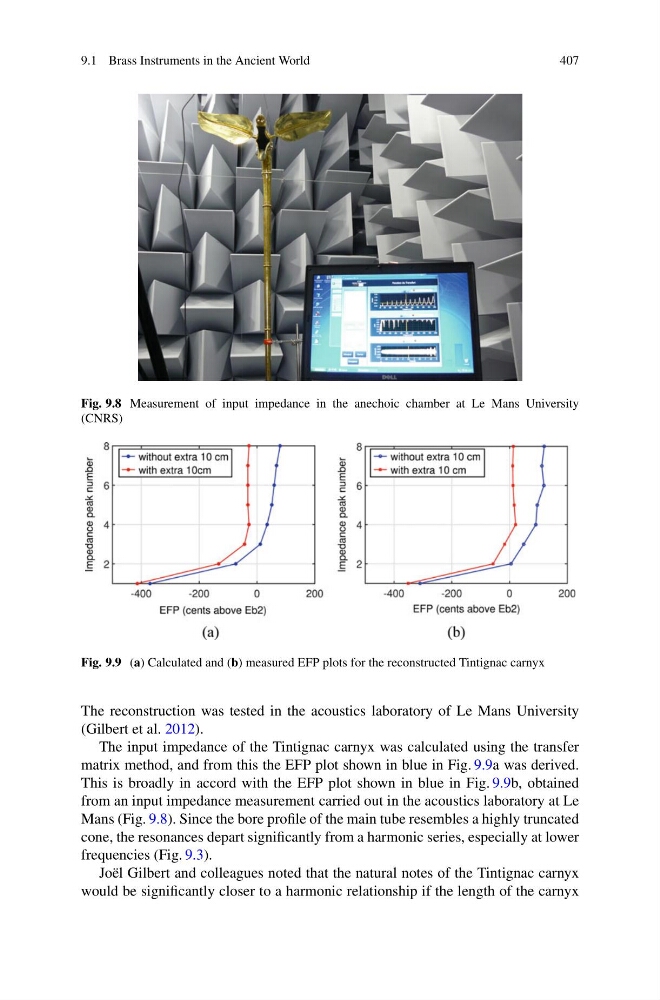
Fig. 9.8 Measurement of input impedance in the anechoic chamber at Le Mans University
(CNRS)
Fig. 9.9 (a) Calculated and (b) measured EFP plots for the reconstructed Tintignac carnyx
The reconstruction was tested in the acoustics laboratory of Le Mans University
(Gilbert et al. 2012).
The input impedance of the Tintignac carnyx was calculated using the transfer
matrix method, and from this the EFP plot shown in blue in Fig. 9.9a was derived.
This is broadly in accord with the EFP plot shown in blue in Fig. 9.9b, obtained
from an input impedance measurement carried out in the acoustics laboratory at Le
Mans (Fig. 9.8). Since the bore profile of the main tube resembles a highly truncated
cone, the resonances depart significantly from a harmonic series, especially at lower
frequencies (Fig. 9.3).
Joël Gilbert and colleagues noted that the natural notes of the Tintignac carnyx
would be significantly closer to a harmonic relationship if the length of the carnyx
407
Fig. 9.8 Measurement of input impedance in the anechoic chamber at Le Mans University
(CNRS)
Fig. 9.9 (a) Calculated and (b) measured EFP plots for the reconstructed Tintignac carnyx
The reconstruction was tested in the acoustics laboratory of Le Mans University
(Gilbert et al. 2012).
The input impedance of the Tintignac carnyx was calculated using the transfer
matrix method, and from this the EFP plot shown in blue in Fig. 9.9a was derived.
This is broadly in accord with the EFP plot shown in blue in Fig. 9.9b, obtained
from an input impedance measurement carried out in the acoustics laboratory at Le
Mans (Fig. 9.8). Since the bore profile of the main tube resembles a highly truncated
cone, the resonances depart significantly from a harmonic series, especially at lower
frequencies (Fig. 9.3).
Joël Gilbert and colleagues noted that the natural notes of the Tintignac carnyx
would be significantly closer to a harmonic relationship if the length of the carnyx