

9.1 Brass Instruments in the Ancient World
405
9.1.2 The Celtic Carnyx
The Roman legions which conquered Gaul under Julius Caesar and invaded Britain
under Claudius were faced by opposing armies which included players of an unusual
and intimidating brass instrument called the carnyx. This was an instrument which
had a straight bore around 2 m in length, terminated by an elaborate bell resembling
the head of a wild boar. There are many depictions of carnyces on Roman coins
and carved reliefs, but no original instrument has survived intact. In 1816 a bronze
boar’s head which was identified as the bell of a carnyx was discovered in a peat
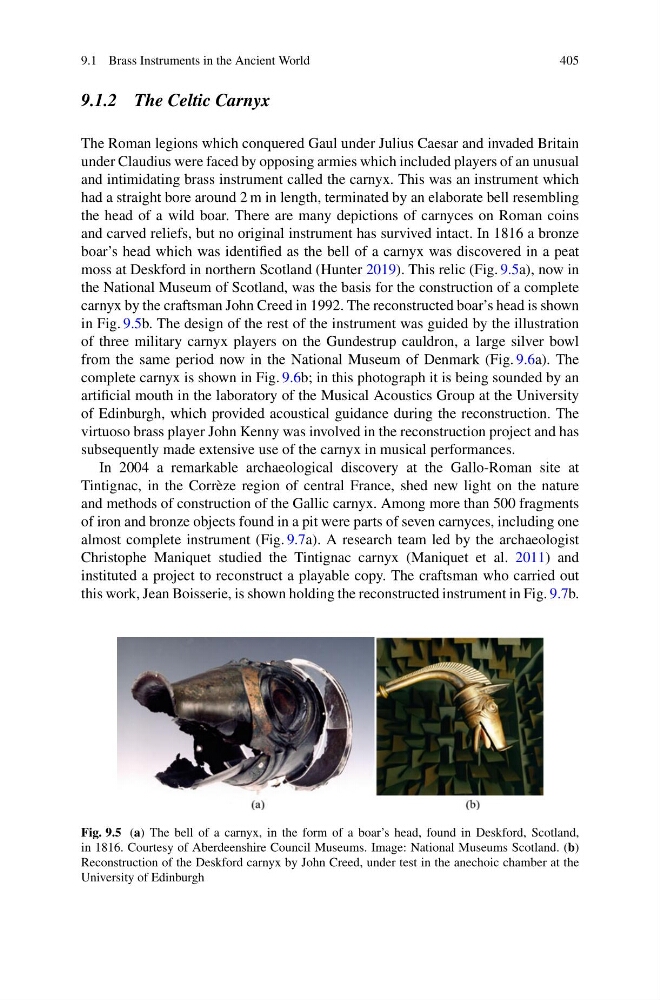
moss at Deskford in northern Scotland (Hunter 2019). This relic (Fig. 9.5a), now in
the National Museum of Scotland, was the basis for the construction of a complete
carnyx by the craftsman John Creed in 1992. The reconstructed boar’s head is shown
in Fig. 9.5b. The design of the rest of the instrument was guided by the illustration
of three military carnyx players on the Gundestrup cauldron, a large silver bowl
from the same period now in the National Museum of Denmark (Fig. 9.6a). The
complete carnyx is shown in Fig. 9.6b; in this photograph it is being sounded by an
artificial mouth in the laboratory of the Musical Acoustics Group at the University
of Edinburgh, which provided acoustical guidance during the reconstruction. The
virtuoso brass player John Kenny was involved in the reconstruction project and has
subsequently made extensive use of the carnyx in musical performances.
In 2004 a remarkable archaeological discovery at the Gallo-Roman site at
Tintignac, in the Corrèze region of central France, shed new light on the nature
and methods of construction of the Gallic carnyx. Among more than 500 fragments
of iron and bronze objects found in a pit were parts of seven carnyces, including one
almost complete instrument (Fig. 9.7a). A research team led by the archaeologist
Christophe Maniquet studied the Tintignac carnyx (Maniquet et al. 2011) and
instituted a project to reconstruct a playable copy. The craftsman who carried out
this work, Jean Boisserie, is shown holding the reconstructed instrument in Fig. 9.7b.
Fig. 9.5 (a) The bell of a carnyx, in the form of a boar’s head, found in Deskford, Scotland,
in 1816. Courtesy of Aberdeenshire Council Museums. Image: National Museums Scotland. (b)
Reconstruction of the Deskford carnyx by John Creed, under test in the anechoic chamber at the
University of Edinburgh
405
9.1.2 The Celtic Carnyx
The Roman legions which conquered Gaul under Julius Caesar and invaded Britain
under Claudius were faced by opposing armies which included players of an unusual
and intimidating brass instrument called the carnyx. This was an instrument which
had a straight bore around 2 m in length, terminated by an elaborate bell resembling
the head of a wild boar. There are many depictions of carnyces on Roman coins
and carved reliefs, but no original instrument has survived intact. In 1816 a bronze
boar’s head which was identified as the bell of a carnyx was discovered in a peat
moss at Deskford in northern Scotland (Hunter 2019). This relic (Fig. 9.5a), now in
the National Museum of Scotland, was the basis for the construction of a complete
carnyx by the craftsman John Creed in 1992. The reconstructed boar’s head is shown
in Fig. 9.5b. The design of the rest of the instrument was guided by the illustration
of three military carnyx players on the Gundestrup cauldron, a large silver bowl
from the same period now in the National Museum of Denmark (Fig. 9.6a). The
complete carnyx is shown in Fig. 9.6b; in this photograph it is being sounded by an
artificial mouth in the laboratory of the Musical Acoustics Group at the University
of Edinburgh, which provided acoustical guidance during the reconstruction. The
virtuoso brass player John Kenny was involved in the reconstruction project and has
subsequently made extensive use of the carnyx in musical performances.
In 2004 a remarkable archaeological discovery at the Gallo-Roman site at
Tintignac, in the Corrèze region of central France, shed new light on the nature
and methods of construction of the Gallic carnyx. Among more than 500 fragments
of iron and bronze objects found in a pit were parts of seven carnyces, including one
almost complete instrument (Fig. 9.7a). A research team led by the archaeologist
Christophe Maniquet studied the Tintignac carnyx (Maniquet et al. 2011) and
instituted a project to reconstruct a playable copy. The craftsman who carried out
this work, Jean Boisserie, is shown holding the reconstructed instrument in Fig. 9.7b.
Fig. 9.5 (a) The bell of a carnyx, in the form of a boar’s head, found in Deskford, Scotland,
in 1816. Courtesy of Aberdeenshire Council Museums. Image: National Museums Scotland. (b)
Reconstruction of the Deskford carnyx by John Creed, under test in the anechoic chamber at the
University of Edinburgh