

402
9 Looking Back and Looking Forward
of ancient brass instruments such as the Celtic carnyx and the Etruscan cornu.
Section 9.2 reviews developments using digital technology to extend the capabilities
of existing brass instruments and to map the new world of virtual brass instrument
sounds.
9.1 Brass Instruments in the Ancient World
The earliest known surviving brass instruments are two trumpets found in the burial
site of Tutankhamun, King of Egypt in the fourteenth century BCE. Surviving
instruments from Ancient Greek, Etruscan and Roman archaeological sites, together
with evidence from tomb carvings, wall paintings and other iconographic sources,
show that brass instruments also played important roles in the cultures of these
societies (Ziolkowski 2002). Playing a 2000-year-old instrument is now considered
to pose an unacceptable risk of damage, and in any cases the ravages of time have
left most original specimens in an unplayable state. The natural desire to hear what
the instruments might have sounded like has been satisfied by constructing accurate
reproductions of the originals, on which modern brass players can investigate
their playing properties. The following sections describe two such recent projects
in which scientific modelling techniques have aided the development of working
reproductions of ancient brass instruments.
9.1.1 Etruscan Cornu and Lituus
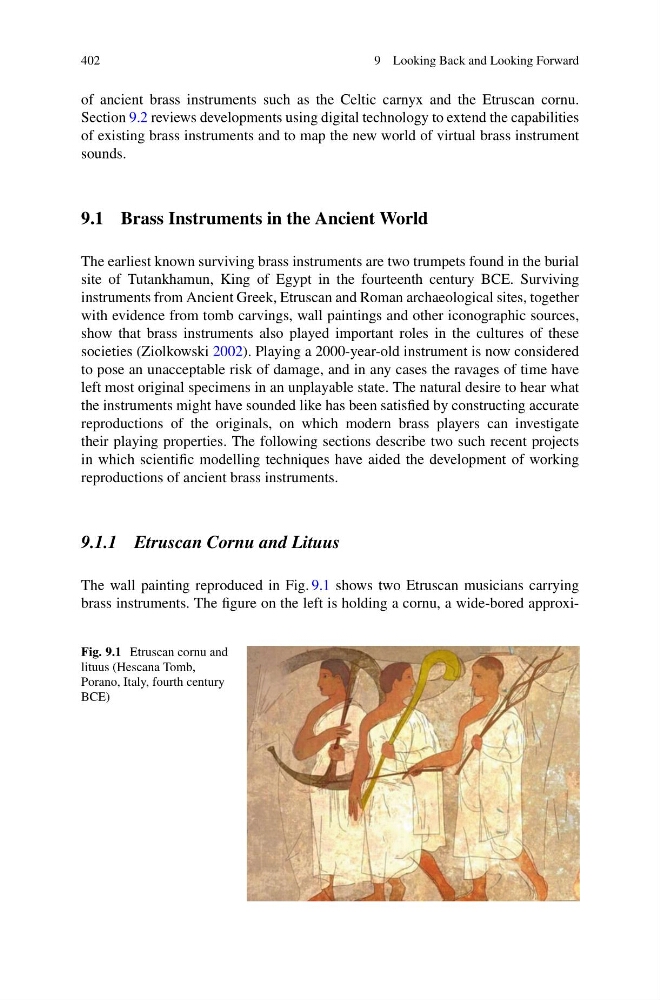
The wall painting reproduced in Fig. 9.1 shows two Etruscan musicians carrying
brass instruments. The figure on the left is holding a cornu, a wide-bored approxiFig. 9.1 Etruscan cornu and
lituus (Hescana Tomb,
Porano, Italy, fourth century
BCE)
9 Looking Back and Looking Forward
of ancient brass instruments such as the Celtic carnyx and the Etruscan cornu.
Section 9.2 reviews developments using digital technology to extend the capabilities
of existing brass instruments and to map the new world of virtual brass instrument
sounds.
9.1 Brass Instruments in the Ancient World
The earliest known surviving brass instruments are two trumpets found in the burial
site of Tutankhamun, King of Egypt in the fourteenth century BCE. Surviving
instruments from Ancient Greek, Etruscan and Roman archaeological sites, together
with evidence from tomb carvings, wall paintings and other iconographic sources,
show that brass instruments also played important roles in the cultures of these
societies (Ziolkowski 2002). Playing a 2000-year-old instrument is now considered
to pose an unacceptable risk of damage, and in any cases the ravages of time have
left most original specimens in an unplayable state. The natural desire to hear what
the instruments might have sounded like has been satisfied by constructing accurate
reproductions of the originals, on which modern brass players can investigate
their playing properties. The following sections describe two such recent projects
in which scientific modelling techniques have aided the development of working
reproductions of ancient brass instruments.
9.1.1 Etruscan Cornu and Lituus
The wall painting reproduced in Fig. 9.1 shows two Etruscan musicians carrying
brass instruments. The figure on the left is holding a cornu, a wide-bored approxiFig. 9.1 Etruscan cornu and
lituus (Hescana Tomb,
Porano, Italy, fourth century
BCE)