

380
7 The Amazing Diversity of Brass Instruments
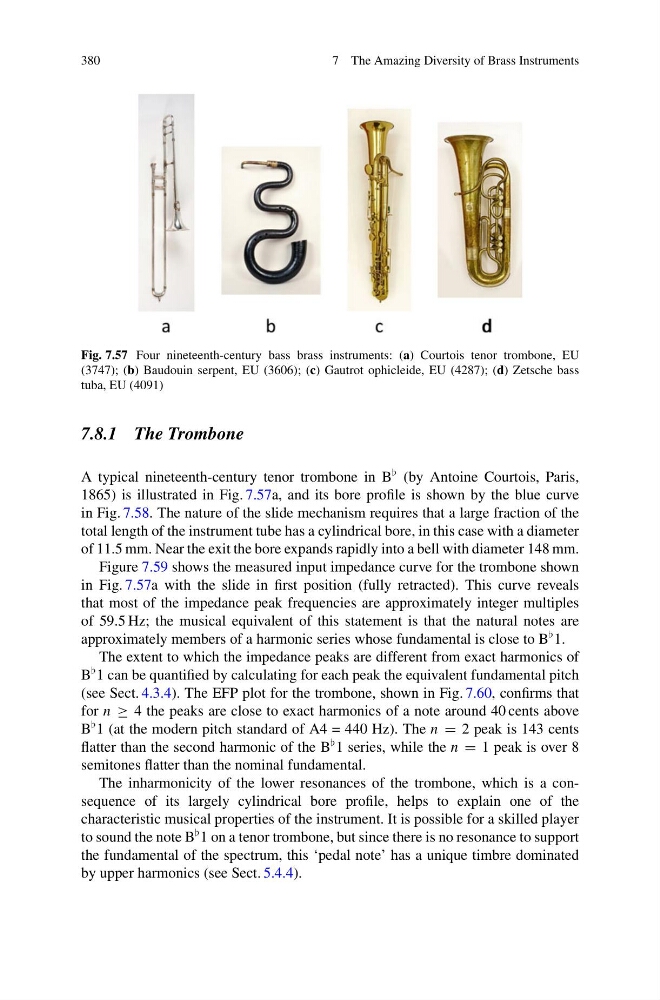
Fig. 7.57 Four nineteenth-century bass brass instruments: (a) Courtois tenor trombone, EU
(3747); (b) Baudouin serpent, EU (3606); (c) Gautrot ophicleide, EU (4287); (d) Zetsche bass
tuba, EU (4091)
7.8.1 The Trombone
A typical nineteenth-century tenor trombone in B (by Antoine Courtois, Paris,
1865) is illustrated in Fig. 7.57a, and its bore profile is shown by the blue curve
in Fig. 7.58. The nature of the slide mechanism requires that a large fraction of the
total length of the instrument tube has a cylindrical bore, in this case with a diameter
of 11.5 mm. Near the exit the bore expands rapidly into a bell with diameter 148 mm.
Figure 7.59 shows the measured input impedance curve for the trombone shown
in Fig. 7.57a with the slide in first position (fully retracted). This curve reveals
that most of the impedance peak frequencies are approximately integer multiples
of 59.5 Hz; the musical equivalent of this statement is that the natural notes are
approximately members of a harmonic series whose fundamental is close to B 1.
The extent to which the impedance peaks are different from exact harmonics of
B 1 can be quantified by calculating for each peak the equivalent fundamental pitch
(see Sect. 4.3.4). The EFP plot for the trombone, shown in Fig. 7.60, confirms that
for n ≥ 4 the peaks are close to exact harmonics of a note around 40 cents above
B 1 (at the modern pitch standard of A4 = 440 Hz). The n = 2 peak is 143 cents
flatter than the second harmonic of the B 1 series, while the n = 1 peak is over 8
semitones flatter than the nominal fundamental.
The inharmonicity of the lower resonances of the trombone, which is a consequence of its largely cylindrical bore profile, helps to explain one of the
characteristic musical properties of the instrument. It is possible for a skilled player
to sound the note B 1 on a tenor trombone, but since there is no resonance to support
the fundamental of the spectrum, this ‘pedal note’ has a unique timbre dominated
by upper harmonics (see Sect. 5.4.4).
7 The Amazing Diversity of Brass Instruments
Fig. 7.57 Four nineteenth-century bass brass instruments: (a) Courtois tenor trombone, EU
(3747); (b) Baudouin serpent, EU (3606); (c) Gautrot ophicleide, EU (4287); (d) Zetsche bass
tuba, EU (4091)
7.8.1 The Trombone
A typical nineteenth-century tenor trombone in B (by Antoine Courtois, Paris,
1865) is illustrated in Fig. 7.57a, and its bore profile is shown by the blue curve
in Fig. 7.58. The nature of the slide mechanism requires that a large fraction of the
total length of the instrument tube has a cylindrical bore, in this case with a diameter
of 11.5 mm. Near the exit the bore expands rapidly into a bell with diameter 148 mm.
Figure 7.59 shows the measured input impedance curve for the trombone shown
in Fig. 7.57a with the slide in first position (fully retracted). This curve reveals
that most of the impedance peak frequencies are approximately integer multiples
of 59.5 Hz; the musical equivalent of this statement is that the natural notes are
approximately members of a harmonic series whose fundamental is close to B 1.
The extent to which the impedance peaks are different from exact harmonics of
B 1 can be quantified by calculating for each peak the equivalent fundamental pitch
(see Sect. 4.3.4). The EFP plot for the trombone, shown in Fig. 7.60, confirms that
for n ≥ 4 the peaks are close to exact harmonics of a note around 40 cents above
B 1 (at the modern pitch standard of A4 = 440 Hz). The n = 2 peak is 143 cents
flatter than the second harmonic of the B 1 series, while the n = 1 peak is over 8
semitones flatter than the nominal fundamental.
The inharmonicity of the lower resonances of the trombone, which is a consequence of its largely cylindrical bore profile, helps to explain one of the
characteristic musical properties of the instrument. It is possible for a skilled player
to sound the note B 1 on a tenor trombone, but since there is no resonance to support
the fundamental of the spectrum, this ‘pedal note’ has a unique timbre dominated
by upper harmonics (see Sect. 5.4.4).