

7.4 Mouthpieces
369
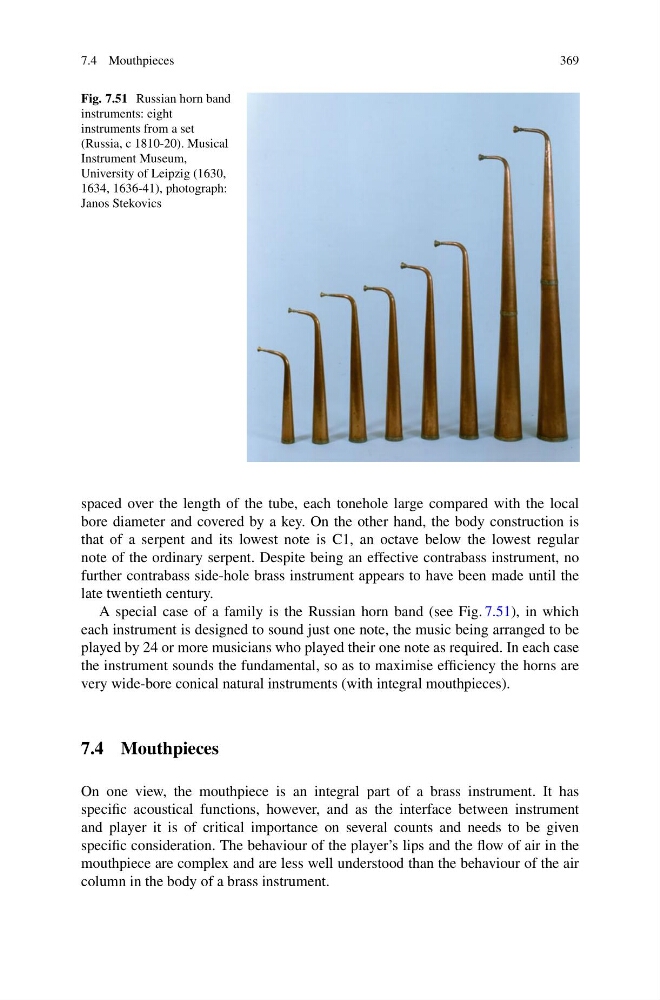
Fig. 7.51 Russian horn band
instruments: eight
instruments from a set
(Russia, c 1810-20). Musical
Instrument Museum,
University of Leipzig (1630,
1634, 1636-41), photograph:
Janos Stekovics
spaced over the length of the tube, each tonehole large compared with the local
bore diameter and covered by a key. On the other hand, the body construction is
that of a serpent and its lowest note is C1, an octave below the lowest regular
note of the ordinary serpent. Despite being an effective contrabass instrument, no
further contrabass side-hole brass instrument appears to have been made until the
late twentieth century.
A special case of a family is the Russian horn band (see Fig. 7.51), in which
each instrument is designed to sound just one note, the music being arranged to be
played by 24 or more musicians who played their one note as required. In each case
the instrument sounds the fundamental, so as to maximise efficiency the horns are
very wide-bore conical natural instruments (with integral mouthpieces).
7.4 Mouthpieces
On one view, the mouthpiece is an integral part of a brass instrument. It has
specific acoustical functions, however, and as the interface between instrument
and player it is of critical importance on several counts and needs to be given
specific consideration. The behaviour of the player’s lips and the flow of air in the
mouthpiece are complex and are less well understood than the behaviour of the air
column in the body of a brass instrument.
369
Fig. 7.51 Russian horn band
instruments: eight
instruments from a set
(Russia, c 1810-20). Musical
Instrument Museum,
University of Leipzig (1630,
1634, 1636-41), photograph:
Janos Stekovics
spaced over the length of the tube, each tonehole large compared with the local
bore diameter and covered by a key. On the other hand, the body construction is
that of a serpent and its lowest note is C1, an octave below the lowest regular
note of the ordinary serpent. Despite being an effective contrabass instrument, no
further contrabass side-hole brass instrument appears to have been made until the
late twentieth century.
A special case of a family is the Russian horn band (see Fig. 7.51), in which
each instrument is designed to sound just one note, the music being arranged to be
played by 24 or more musicians who played their one note as required. In each case
the instrument sounds the fundamental, so as to maximise efficiency the horns are
very wide-bore conical natural instruments (with integral mouthpieces).
7.4 Mouthpieces
On one view, the mouthpiece is an integral part of a brass instrument. It has
specific acoustical functions, however, and as the interface between instrument
and player it is of critical importance on several counts and needs to be given
specific consideration. The behaviour of the player’s lips and the flow of air in the
mouthpiece are complex and are less well understood than the behaviour of the air
column in the body of a brass instrument.