

1.2 The Musician’s Interpretation of the Brass Playing Experience
23
The situation is substantially different, however, when the lips of the player form
an embouchure and sound a note. High-speed filming of the motion of brass players’
lips has shown that over most of the playing range of orchestral brass instruments,
the average open area of the aperture between lips is much less than the open area
of the mouthpiece throat (see Sect. 3.1.3). The resistance presented to the mean flow
of air is therefore determined mainly by the player’s embouchure rather than the
mouthpiece throat. The relatively large lip opening area used for a low-pitch note
on a particular instrument corresponds to a relatively low mean flow resistance,
while for a high-pitch note on the same instrument, the lip opening aperture will
be much smaller and the mean flow resistance larger. The practical consequence is
that the supply of air in the lungs is used up more quickly for low notes than for
high notes. To play sustained notes with a low mean flow resistance, embouchure
players sometimes use a circular breathing technique, playing continuously without
interrupting the sound by breathing in through the nose while maintaining mouth
pressure using cheek muscles. This technique is an essential feature of performance
on the Australian didgeridoo (Sect. 6.3).
In discussing the playing properties of an instrument, musicians sometimes
employ the word ‘resistance’ to describe the amount of effort required to sound
a note. The characteristic which is being evoked by this use of the word is not the
mean flow resistance, which determines when the air supply is exhausted, but a
different property of the instrument related to the ease with which the player can
sound the note. There does not seem to be a strong consensus among players about
the precise nature of this property, which we could call the ‘sounding resistance’, but
it seems likely that it is related to the minimum blowing pressure which is needed to
start the lips vibrating. The hypothesis that the musician’s experience of sounding
resistance can be identified with the scientific concept of threshold mouth pressure
is discussed further in Sects. 2.1.3 and 5.4.3.
1.2.10 Responsiveness and Rapid Articulation
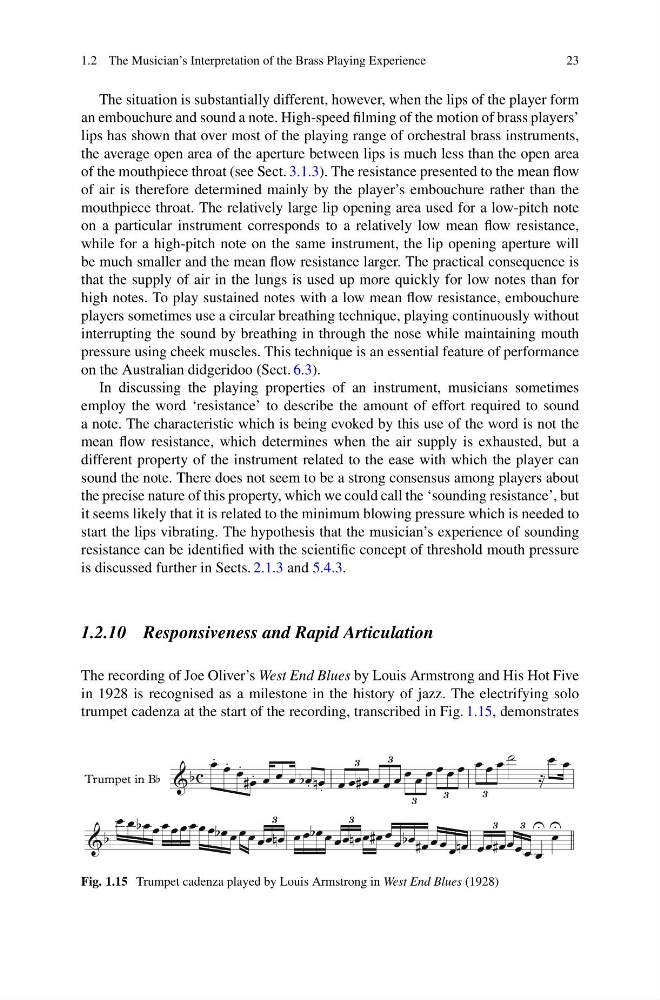
The recording of Joe Oliver’s West End Blues by Louis Armstrong and His Hot Five
in 1928 is recognised as a milestone in the history of jazz. The electrifying solo
trumpet cadenza at the start of the recording, transcribed in Fig. 1.15, demonstrates
Fig. 1.15 Trumpet cadenza played by Louis Armstrong in West End Blues (1928)
23
The situation is substantially different, however, when the lips of the player form
an embouchure and sound a note. High-speed filming of the motion of brass players’
lips has shown that over most of the playing range of orchestral brass instruments,
the average open area of the aperture between lips is much less than the open area
of the mouthpiece throat (see Sect. 3.1.3). The resistance presented to the mean flow
of air is therefore determined mainly by the player’s embouchure rather than the
mouthpiece throat. The relatively large lip opening area used for a low-pitch note
on a particular instrument corresponds to a relatively low mean flow resistance,
while for a high-pitch note on the same instrument, the lip opening aperture will
be much smaller and the mean flow resistance larger. The practical consequence is
that the supply of air in the lungs is used up more quickly for low notes than for
high notes. To play sustained notes with a low mean flow resistance, embouchure
players sometimes use a circular breathing technique, playing continuously without
interrupting the sound by breathing in through the nose while maintaining mouth
pressure using cheek muscles. This technique is an essential feature of performance
on the Australian didgeridoo (Sect. 6.3).
In discussing the playing properties of an instrument, musicians sometimes
employ the word ‘resistance’ to describe the amount of effort required to sound
a note. The characteristic which is being evoked by this use of the word is not the
mean flow resistance, which determines when the air supply is exhausted, but a
different property of the instrument related to the ease with which the player can
sound the note. There does not seem to be a strong consensus among players about
the precise nature of this property, which we could call the ‘sounding resistance’, but
it seems likely that it is related to the minimum blowing pressure which is needed to
start the lips vibrating. The hypothesis that the musician’s experience of sounding
resistance can be identified with the scientific concept of threshold mouth pressure
is discussed further in Sects. 2.1.3 and 5.4.3.
1.2.10 Responsiveness and Rapid Articulation
The recording of Joe Oliver’s West End Blues by Louis Armstrong and His Hot Five
in 1928 is recognised as a milestone in the history of jazz. The electrifying solo
trumpet cadenza at the start of the recording, transcribed in Fig. 1.15, demonstrates
Fig. 1.15 Trumpet cadenza played by Louis Armstrong in West End Blues (1928)