

362
7 The Amazing Diversity of Brass Instruments
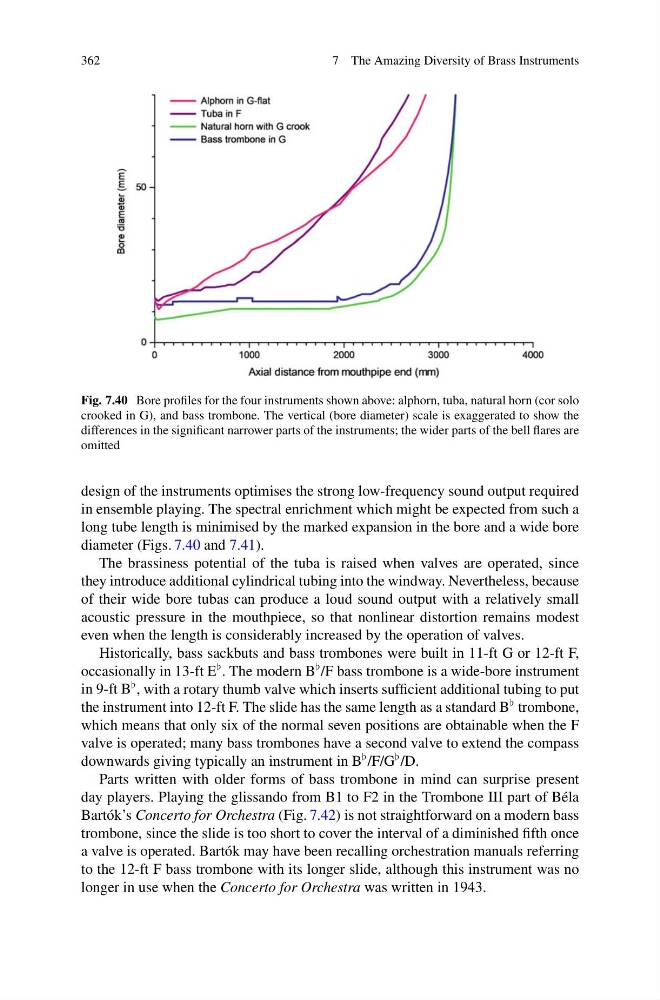
Fig. 7.40 Bore profiles for the four instruments shown above: alphorn, tuba, natural horn (cor solo
crooked in G), and bass trombone. The vertical (bore diameter) scale is exaggerated to show the
differences in the significant narrower parts of the instruments; the wider parts of the bell flares are
omitted
design of the instruments optimises the strong low-frequency sound output required
in ensemble playing. The spectral enrichment which might be expected from such a
long tube length is minimised by the marked expansion in the bore and a wide bore
diameter (Figs. 7.40 and 7.41).
The brassiness potential of the tuba is raised when valves are operated, since
they introduce additional cylindrical tubing into the windway. Nevertheless, because
of their wide bore tubas can produce a loud sound output with a relatively small
acoustic pressure in the mouthpiece, so that nonlinear distortion remains modest
even when the length is considerably increased by the operation of valves.
Historically, bass sackbuts and bass trombones were built in 11-ft G or 12-ft F,
occasionally in 13-ft E . The modern B /F bass trombone is a wide-bore instrument
in 9-ft B , with a rotary thumb valve which inserts sufficient additional tubing to put
the instrument into 12-ft F. The slide has the same length as a standard B trombone,
which means that only six of the normal seven positions are obtainable when the F
valve is operated; many bass trombones have a second valve to extend the compass
downwards giving typically an instrument in B /F/G /D.
Parts written with older forms of bass trombone in mind can surprise present
day players. Playing the glissando from B1 to F2 in the Trombone III part of Béla
Bartók’s Concerto for Orchestra (Fig. 7.42) is not straightforward on a modern bass
trombone, since the slide is too short to cover the interval of a diminished fifth once
a valve is operated. Bartók may have been recalling orchestration manuals referring
to the 12-ft F bass trombone with its longer slide, although this instrument was no
longer in use when the Concerto for Orchestra was written in 1943.
7 The Amazing Diversity of Brass Instruments
Fig. 7.40 Bore profiles for the four instruments shown above: alphorn, tuba, natural horn (cor solo
crooked in G), and bass trombone. The vertical (bore diameter) scale is exaggerated to show the
differences in the significant narrower parts of the instruments; the wider parts of the bell flares are
omitted
design of the instruments optimises the strong low-frequency sound output required
in ensemble playing. The spectral enrichment which might be expected from such a
long tube length is minimised by the marked expansion in the bore and a wide bore
diameter (Figs. 7.40 and 7.41).
The brassiness potential of the tuba is raised when valves are operated, since
they introduce additional cylindrical tubing into the windway. Nevertheless, because
of their wide bore tubas can produce a loud sound output with a relatively small
acoustic pressure in the mouthpiece, so that nonlinear distortion remains modest
even when the length is considerably increased by the operation of valves.
Historically, bass sackbuts and bass trombones were built in 11-ft G or 12-ft F,
occasionally in 13-ft E . The modern B /F bass trombone is a wide-bore instrument
in 9-ft B , with a rotary thumb valve which inserts sufficient additional tubing to put
the instrument into 12-ft F. The slide has the same length as a standard B trombone,
which means that only six of the normal seven positions are obtainable when the F
valve is operated; many bass trombones have a second valve to extend the compass
downwards giving typically an instrument in B /F/G /D.
Parts written with older forms of bass trombone in mind can surprise present
day players. Playing the glissando from B1 to F2 in the Trombone III part of Béla
Bartók’s Concerto for Orchestra (Fig. 7.42) is not straightforward on a modern bass
trombone, since the slide is too short to cover the interval of a diminished fifth once
a valve is operated. Bartók may have been recalling orchestration manuals referring
to the 12-ft F bass trombone with its longer slide, although this instrument was no
longer in use when the Concerto for Orchestra was written in 1943.