

360
7 The Amazing Diversity of Brass Instruments
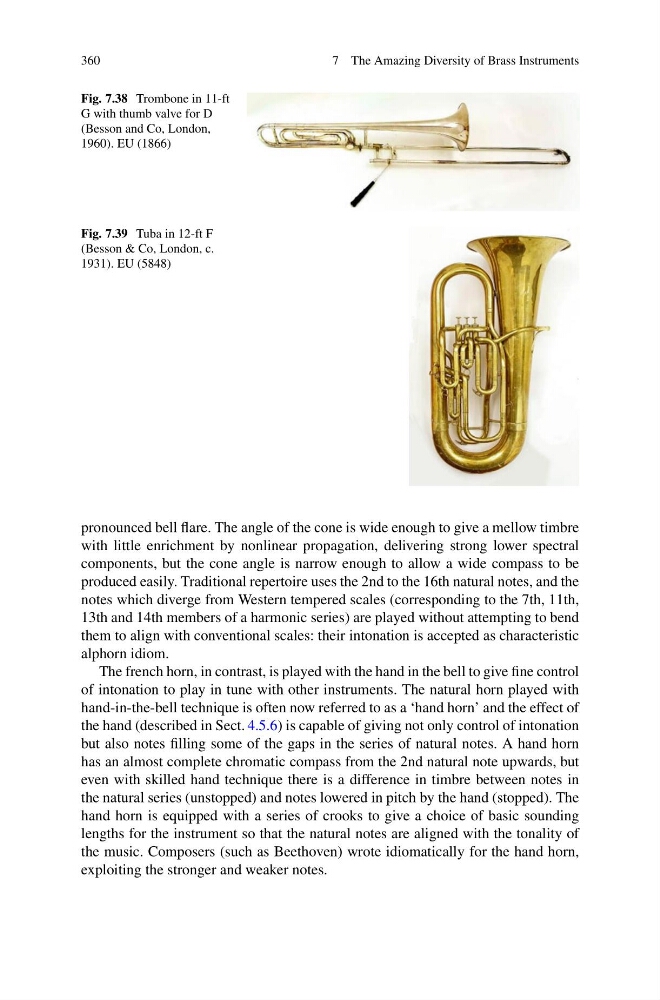
Fig. 7.38 Trombone in 11-ft
G with thumb valve for D
(Besson and Co, London,
1960). EU (1866)
Fig. 7.39 Tuba in 12-ft F
(Besson & Co, London, c.
1931). EU (5848)
pronounced bell flare. The angle of the cone is wide enough to give a mellow timbre
with little enrichment by nonlinear propagation, delivering strong lower spectral
components, but the cone angle is narrow enough to allow a wide compass to be
produced easily. Traditional repertoire uses the 2nd to the 16th natural notes, and the
notes which diverge from Western tempered scales (corresponding to the 7th, 11th,
13th and 14th members of a harmonic series) are played without attempting to bend
them to align with conventional scales: their intonation is accepted as characteristic
alphorn idiom.
The french horn, in contrast, is played with the hand in the bell to give fine control
of intonation to play in tune with other instruments. The natural horn played with
hand-in-the-bell technique is often now referred to as a ‘hand horn’ and the effect of
the hand (described in Sect. 4.5.6) is capable of giving not only control of intonation
but also notes filling some of the gaps in the series of natural notes. A hand horn
has an almost complete chromatic compass from the 2nd natural note upwards, but
even with skilled hand technique there is a difference in timbre between notes in
the natural series (unstopped) and notes lowered in pitch by the hand (stopped). The
hand horn is equipped with a series of crooks to give a choice of basic sounding
lengths for the instrument so that the natural notes are aligned with the tonality of
the music. Composers (such as Beethoven) wrote idiomatically for the hand horn,
exploiting the stronger and weaker notes.
7 The Amazing Diversity of Brass Instruments
Fig. 7.38 Trombone in 11-ft
G with thumb valve for D
(Besson and Co, London,
1960). EU (1866)
Fig. 7.39 Tuba in 12-ft F
(Besson & Co, London, c.
1931). EU (5848)
pronounced bell flare. The angle of the cone is wide enough to give a mellow timbre
with little enrichment by nonlinear propagation, delivering strong lower spectral
components, but the cone angle is narrow enough to allow a wide compass to be
produced easily. Traditional repertoire uses the 2nd to the 16th natural notes, and the
notes which diverge from Western tempered scales (corresponding to the 7th, 11th,
13th and 14th members of a harmonic series) are played without attempting to bend
them to align with conventional scales: their intonation is accepted as characteristic
alphorn idiom.
The french horn, in contrast, is played with the hand in the bell to give fine control
of intonation to play in tune with other instruments. The natural horn played with
hand-in-the-bell technique is often now referred to as a ‘hand horn’ and the effect of
the hand (described in Sect. 4.5.6) is capable of giving not only control of intonation
but also notes filling some of the gaps in the series of natural notes. A hand horn
has an almost complete chromatic compass from the 2nd natural note upwards, but
even with skilled hand technique there is a difference in timbre between notes in
the natural series (unstopped) and notes lowered in pitch by the hand (stopped). The
hand horn is equipped with a series of crooks to give a choice of basic sounding
lengths for the instrument so that the natural notes are aligned with the tonality of
the music. Composers (such as Beethoven) wrote idiomatically for the hand horn,
exploiting the stronger and weaker notes.