

358
7 The Amazing Diversity of Brass Instruments
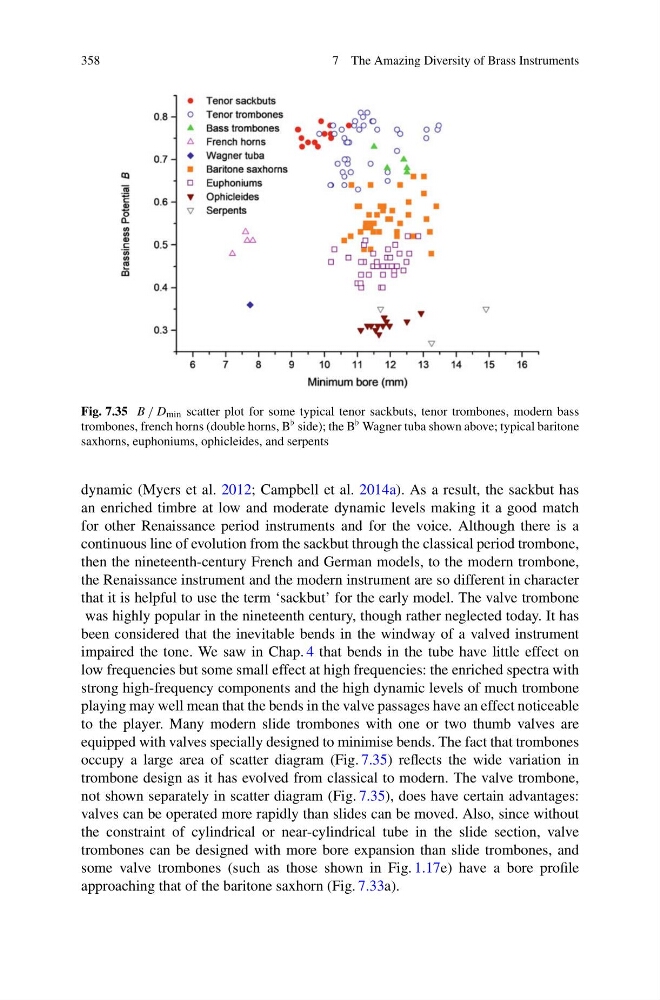
Fig. 7.35 B / D min scatter plot for some typical tenor sackbuts, tenor trombones, modern bass
trombones, french horns (double horns, B side); the B Wagner tuba shown above; typical baritone
saxhorns, euphoniums, ophicleides, and serpents
dynamic (Myers et al. 2012; Campbell et al. 2014a). As a result, the sackbut has
an enriched timbre at low and moderate dynamic levels making it a good match
for other Renaissance period instruments and for the voice. Although there is a
continuous line of evolution from the sackbut through the classical period trombone,
then the nineteenth-century French and German models, to the modern trombone,
the Renaissance instrument and the modern instrument are so different in character
that it is helpful to use the term ‘sackbut’ for the early model. The valve trombone
was highly popular in the nineteenth century, though rather neglected today. It has
been considered that the inevitable bends in the windway of a valved instrument
impaired the tone. We saw in Chap. 4 that bends in the tube have little effect on
low frequencies but some small effect at high frequencies: the enriched spectra with
strong high-frequency components and the high dynamic levels of much trombone
playing may well mean that the bends in the valve passages have an effect noticeable
to the player. Many modern slide trombones with one or two thumb valves are
equipped with valves specially designed to minimise bends. The fact that trombones
occupy a large area of scatter diagram (Fig. 7.35) reflects the wide variation in
trombone design as it has evolved from classical to modern. The valve trombone,
not shown separately in scatter diagram (Fig. 7.35), does have certain advantages:
valves can be operated more rapidly than slides can be moved. Also, since without
the constraint of cylindrical or near-cylindrical tube in the slide section, valve
trombones can be designed with more bore expansion than slide trombones, and
some valve trombones (such as those shown in Fig. 1.17e) have a bore profile
approaching that of the baritone saxhorn (Fig. 7.33a).
7 The Amazing Diversity of Brass Instruments
Fig. 7.35 B / D min scatter plot for some typical tenor sackbuts, tenor trombones, modern bass
trombones, french horns (double horns, B side); the B Wagner tuba shown above; typical baritone
saxhorns, euphoniums, ophicleides, and serpents
dynamic (Myers et al. 2012; Campbell et al. 2014a). As a result, the sackbut has
an enriched timbre at low and moderate dynamic levels making it a good match
for other Renaissance period instruments and for the voice. Although there is a
continuous line of evolution from the sackbut through the classical period trombone,
then the nineteenth-century French and German models, to the modern trombone,
the Renaissance instrument and the modern instrument are so different in character
that it is helpful to use the term ‘sackbut’ for the early model. The valve trombone
was highly popular in the nineteenth century, though rather neglected today. It has
been considered that the inevitable bends in the windway of a valved instrument
impaired the tone. We saw in Chap. 4 that bends in the tube have little effect on
low frequencies but some small effect at high frequencies: the enriched spectra with
strong high-frequency components and the high dynamic levels of much trombone
playing may well mean that the bends in the valve passages have an effect noticeable
to the player. Many modern slide trombones with one or two thumb valves are
equipped with valves specially designed to minimise bends. The fact that trombones
occupy a large area of scatter diagram (Fig. 7.35) reflects the wide variation in
trombone design as it has evolved from classical to modern. The valve trombone,
not shown separately in scatter diagram (Fig. 7.35), does have certain advantages:
valves can be operated more rapidly than slides can be moved. Also, since without
the constraint of cylindrical or near-cylindrical tube in the slide section, valve
trombones can be designed with more bore expansion than slide trombones, and
some valve trombones (such as those shown in Fig. 1.17e) have a bore profile
approaching that of the baritone saxhorn (Fig. 7.33a).