

7.2 The Different Kinds of Brass Instrument
349
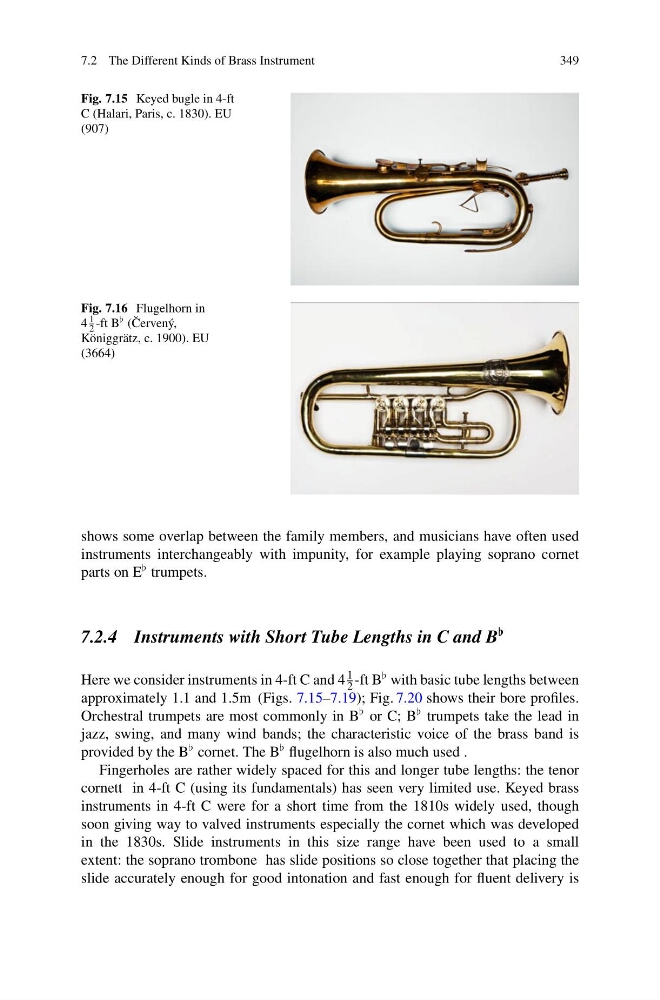
Fig. 7.15 Keyed bugle in 4-ft
C (Halari, Paris, c. 1830). EU
(907)
Fig. 7.16 Flugelhorn in
4
1
2 -ft B ( ˘
Cervený,
Königgrätz, c. 1900). EU
(3664)
shows some overlap between the family members, and musicians have often used
instruments interchangeably with impunity, for example playing soprano cornet
parts on E trumpets.
7.2.4 Instruments with Short Tube Lengths in C and B
Here we consider instruments in 4-ft C and 4
1
2 -ft B with basic tube lengths between
approximately 1.1 and 1.5m (Figs. 7.15–7.19); Fig. 7.20 shows their bore profiles.
Orchestral trumpets are most commonly in B or C; B trumpets take the lead in
jazz, swing, and many wind bands; the characteristic voice of the brass band is
provided by the B cornet. The B flugelhorn is also much used .
Fingerholes are rather widely spaced for this and longer tube lengths: the tenor
cornett in 4-ft C (using its fundamentals) has seen very limited use. Keyed brass
instruments in 4-ft C were for a short time from the 1810s widely used, though
soon giving way to valved instruments especially the cornet which was developed
in the 1830s. Slide instruments in this size range have been used to a small
extent: the soprano trombone has slide positions so close together that placing the
slide accurately enough for good intonation and fast enough for fluent delivery is
349
Fig. 7.15 Keyed bugle in 4-ft
C (Halari, Paris, c. 1830). EU
(907)
Fig. 7.16 Flugelhorn in
4
1
2 -ft B ( ˘
Cervený,
Königgrätz, c. 1900). EU
(3664)
shows some overlap between the family members, and musicians have often used
instruments interchangeably with impunity, for example playing soprano cornet
parts on E trumpets.
7.2.4 Instruments with Short Tube Lengths in C and B
Here we consider instruments in 4-ft C and 4
1
2 -ft B with basic tube lengths between
approximately 1.1 and 1.5m (Figs. 7.15–7.19); Fig. 7.20 shows their bore profiles.
Orchestral trumpets are most commonly in B or C; B trumpets take the lead in
jazz, swing, and many wind bands; the characteristic voice of the brass band is
provided by the B cornet. The B flugelhorn is also much used .
Fingerholes are rather widely spaced for this and longer tube lengths: the tenor
cornett in 4-ft C (using its fundamentals) has seen very limited use. Keyed brass
instruments in 4-ft C were for a short time from the 1810s widely used, though
soon giving way to valved instruments especially the cornet which was developed
in the 1830s. Slide instruments in this size range have been used to a small
extent: the soprano trombone has slide positions so close together that placing the
slide accurately enough for good intonation and fast enough for fluent delivery is