

1.2 The Musician’s Interpretation of the Brass Playing Experience
19
tubing to lower the instrument by n semitones, it will not add enough tubing to
lower the instrument by n semitones when another valve is in use at the same time.
The calculations are more complex than the simple proportions often presented,
since valves increase the amount of cylindrical tubing in the windway and affect the
bore profile as well as the air column length. Typically, a three-semitone third valve
used in combination with a five-semitone fourth valve will give a lowering of nearer
seven rather than eight semitones. Various ways of overcoming this problem have
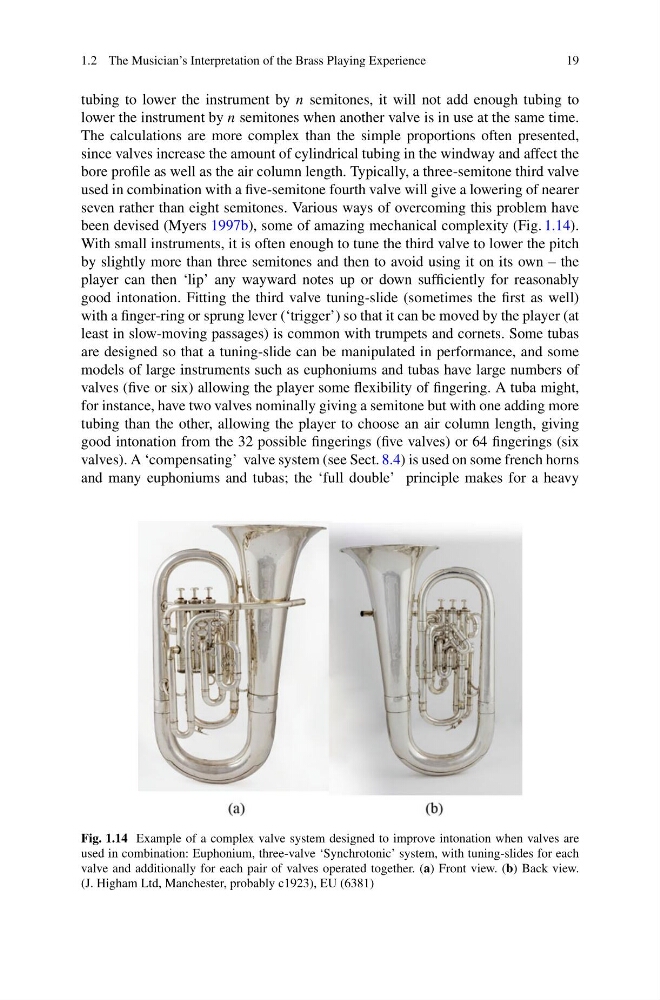
been devised (Myers 1997b), some of amazing mechanical complexity (Fig. 1.14).
With small instruments, it is often enough to tune the third valve to lower the pitch
by slightly more than three semitones and then to avoid using it on its own – the
player can then ‘lip’ any wayward notes up or down sufficiently for reasonably
good intonation. Fitting the third valve tuning-slide (sometimes the first as well)
with a finger-ring or sprung lever (‘trigger’) so that it can be moved by the player (at
least in slow-moving passages) is common with trumpets and cornets. Some tubas
are designed so that a tuning-slide can be manipulated in performance, and some
models of large instruments such as euphoniums and tubas have large numbers of
valves (five or six) allowing the player some flexibility of fingering. A tuba might,
for instance, have two valves nominally giving a semitone but with one adding more
tubing than the other, allowing the player to choose an air column length, giving
good intonation from the 32 possible fingerings (five valves) or 64 fingerings (six
valves). A ‘compensating’ valve system (see Sect. 8.4) is used on some french horns
and many euphoniums and tubas; the ‘full double’ principle makes for a heavy
Fig. 1.14 Example of a complex valve system designed to improve intonation when valves are
used in combination: Euphonium, three-valve ‘Synchrotonic’ system, with tuning-slides for each
valve and additionally for each pair of valves operated together. (a) Front view. (b) Back view.
(J. Higham Ltd, Manchester, probably c1923), EU (6381)
19
tubing to lower the instrument by n semitones, it will not add enough tubing to
lower the instrument by n semitones when another valve is in use at the same time.
The calculations are more complex than the simple proportions often presented,
since valves increase the amount of cylindrical tubing in the windway and affect the
bore profile as well as the air column length. Typically, a three-semitone third valve
used in combination with a five-semitone fourth valve will give a lowering of nearer
seven rather than eight semitones. Various ways of overcoming this problem have
been devised (Myers 1997b), some of amazing mechanical complexity (Fig. 1.14).
With small instruments, it is often enough to tune the third valve to lower the pitch
by slightly more than three semitones and then to avoid using it on its own – the
player can then ‘lip’ any wayward notes up or down sufficiently for reasonably
good intonation. Fitting the third valve tuning-slide (sometimes the first as well)
with a finger-ring or sprung lever (‘trigger’) so that it can be moved by the player (at
least in slow-moving passages) is common with trumpets and cornets. Some tubas
are designed so that a tuning-slide can be manipulated in performance, and some
models of large instruments such as euphoniums and tubas have large numbers of
valves (five or six) allowing the player some flexibility of fingering. A tuba might,
for instance, have two valves nominally giving a semitone but with one adding more
tubing than the other, allowing the player to choose an air column length, giving
good intonation from the 32 possible fingerings (five valves) or 64 fingerings (six
valves). A ‘compensating’ valve system (see Sect. 8.4) is used on some french horns
and many euphoniums and tubas; the ‘full double’ principle makes for a heavy
Fig. 1.14 Example of a complex valve system designed to improve intonation when valves are
used in combination: Euphonium, three-valve ‘Synchrotonic’ system, with tuning-slides for each
valve and additionally for each pair of valves operated together. (a) Front view. (b) Back view.
(J. Higham Ltd, Manchester, probably c1923), EU (6381)