

316
6 Shocks and Surprises: Refining the Elementary Model
6.6.3 Pathological Wall Vibration Effects in Wind Instruments
Although no dramatic perceptual effects of wall vibrations have yet been demonstrated on brass instruments, some examples of ‘pathological’ circumstances in
which structural resonances can disrupt sound production have been found in
other wind instruments. A century ago, the journal Science published a spectacular
experimental study on the physics of organ pipes in which Dayton C. Miller (1909)
observed that the sound produced by an organ pipe can depend on the vibration
of its walls. He compared flue pipes having rectangular cross-section, of identical
internal geometry, but with different thicknesses and construction materials. In one
of these experiments using a double-walled organ pipe, the space between the two
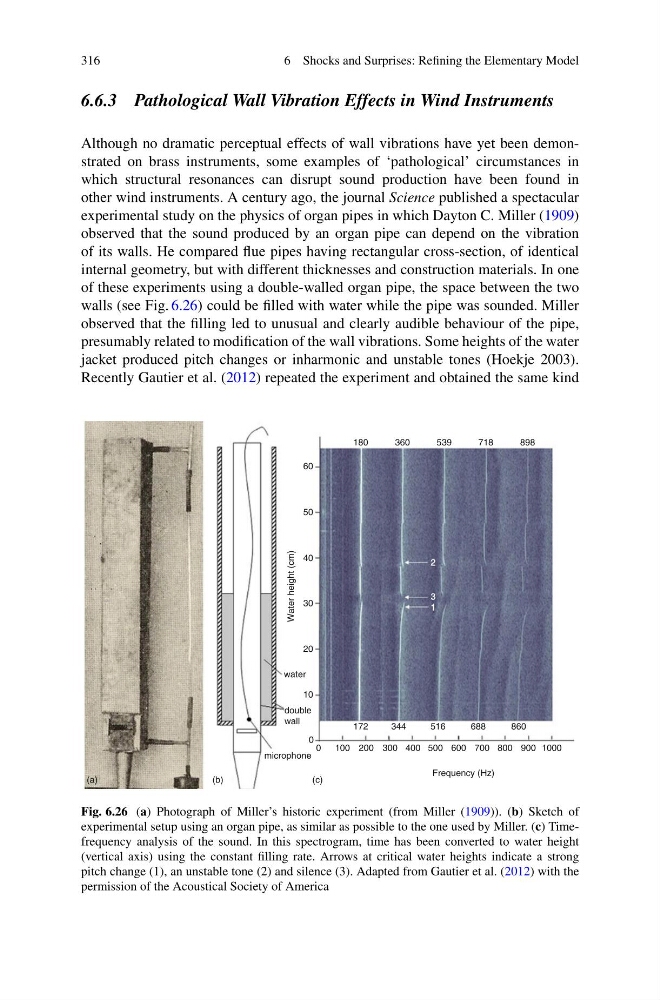
walls (see Fig. 6.26) could be filled with water while the pipe was sounded. Miller
observed that the filling led to unusual and clearly audible behaviour of the pipe,
presumably related to modification of the wall vibrations. Some heights of the water
jacket produced pitch changes or inharmonic and unstable tones (Hoekje 2003).
Recently Gautier et al. (2012) repeated the experiment and obtained the same kind
180
360
539
718
898
60
50
40
30
20
10
0
172
344
516
688
860
0
100 200 300 400 500 600 700 800 900 1000
Frequency (Hz)
Water height (cm)
water
double
wall
microphone
(a)
(b)
(c)
2
3
1
Fig. 6.26 (a) Photograph of Miller’s historic experiment (from Miller (1909)). (b) Sketch of
experimental setup using an organ pipe, as similar as possible to the one used by Miller. (c) Timefrequency analysis of the sound. In this spectrogram, time has been converted to water height
(vertical axis) using the constant filling rate. Arrows at critical water heights indicate a strong
pitch change (1), an unstable tone (2) and silence (3). Adapted from Gautier et al. (2012) with the
permission of the Acoustical Society of America
6 Shocks and Surprises: Refining the Elementary Model
6.6.3 Pathological Wall Vibration Effects in Wind Instruments
Although no dramatic perceptual effects of wall vibrations have yet been demonstrated on brass instruments, some examples of ‘pathological’ circumstances in
which structural resonances can disrupt sound production have been found in
other wind instruments. A century ago, the journal Science published a spectacular
experimental study on the physics of organ pipes in which Dayton C. Miller (1909)
observed that the sound produced by an organ pipe can depend on the vibration
of its walls. He compared flue pipes having rectangular cross-section, of identical
internal geometry, but with different thicknesses and construction materials. In one
of these experiments using a double-walled organ pipe, the space between the two
walls (see Fig. 6.26) could be filled with water while the pipe was sounded. Miller
observed that the filling led to unusual and clearly audible behaviour of the pipe,
presumably related to modification of the wall vibrations. Some heights of the water
jacket produced pitch changes or inharmonic and unstable tones (Hoekje 2003).
Recently Gautier et al. (2012) repeated the experiment and obtained the same kind
180
360
539
718
898
60
50
40
30
20
10
0
172
344
516
688
860
0
100 200 300 400 500 600 700 800 900 1000
Frequency (Hz)
Water height (cm)
water
double
wall
microphone
(a)
(b)
(c)
2
3
1
Fig. 6.26 (a) Photograph of Miller’s historic experiment (from Miller (1909)). (b) Sketch of
experimental setup using an organ pipe, as similar as possible to the one used by Miller. (c) Timefrequency analysis of the sound. In this spectrogram, time has been converted to water height
(vertical axis) using the constant filling rate. Arrows at critical water heights indicate a strong
pitch change (1), an unstable tone (2) and silence (3). Adapted from Gautier et al. (2012) with the
permission of the Acoustical Society of America