

6.6 The Influence of Wall Material on Brass Instrument Performance
313
column. The musically important question is whether the wall vibrations exert an
influence on the overall sound which can be perceived by the player or listener, and
if so under what circumstances.
In a groundbreaking series of experiments in the 1970s, Richard Smith investigated the influence of wall thickness on the structural modes and radiated
sound spectra of tenor trombones (Smith 1986). Six bells were formed on the
same mandrel, with wall thickness varying from 0.3 mm to 0.5 mm. Using these
bells, six otherwise identical trombones were manufactured. In a first experiment,
the instruments were excited using a sinusoidal pressure signal generated in the
mouthpiece by an acoustic driver. Using the recently developed technique of
interference holography, Smith obtained images showing the wall vibration patterns
corresponding to different structural resonances.
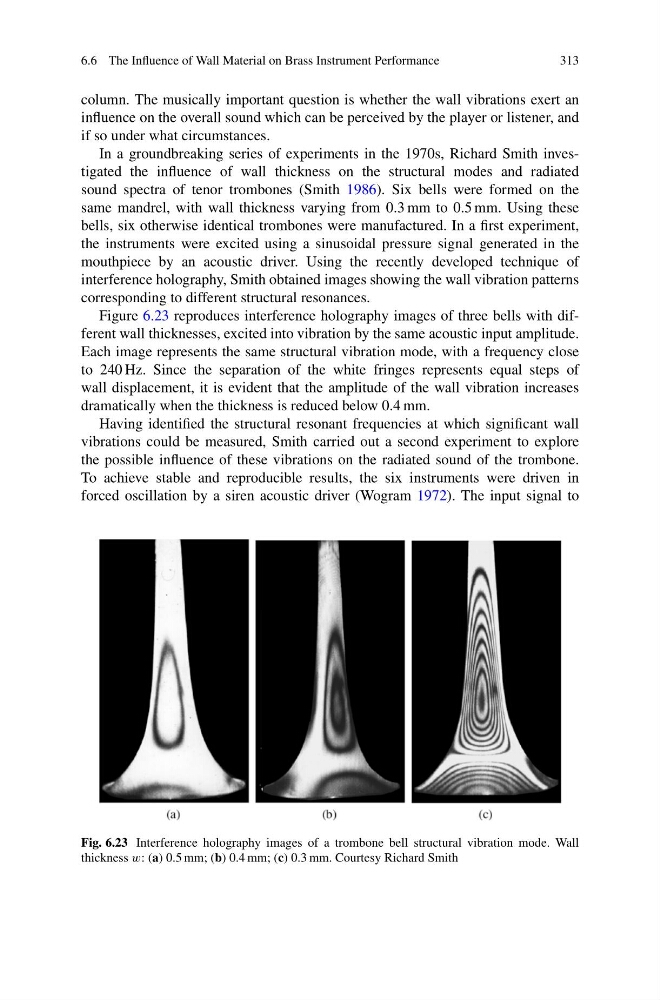
Figure 6.23 reproduces interference holography images of three bells with different wall thicknesses, excited into vibration by the same acoustic input amplitude.
Each image represents the same structural vibration mode, with a frequency close
to 240 Hz. Since the separation of the white fringes represents equal steps of
wall displacement, it is evident that the amplitude of the wall vibration increases
dramatically when the thickness is reduced below 0.4 mm.
Having identified the structural resonant frequencies at which significant wall
vibrations could be measured, Smith carried out a second experiment to explore
the possible influence of these vibrations on the radiated sound of the trombone.
To achieve stable and reproducible results, the six instruments were driven in
forced oscillation by a siren acoustic driver (Wogram 1972). The input signal to
Fig. 6.23 Interference holography images of a trombone bell structural vibration mode. Wall
thickness w: (a) 0.5 mm; (b) 0.4 mm; (c) 0.3 mm. Courtesy Richard Smith
313
column. The musically important question is whether the wall vibrations exert an
influence on the overall sound which can be perceived by the player or listener, and
if so under what circumstances.
In a groundbreaking series of experiments in the 1970s, Richard Smith investigated the influence of wall thickness on the structural modes and radiated
sound spectra of tenor trombones (Smith 1986). Six bells were formed on the
same mandrel, with wall thickness varying from 0.3 mm to 0.5 mm. Using these
bells, six otherwise identical trombones were manufactured. In a first experiment,
the instruments were excited using a sinusoidal pressure signal generated in the
mouthpiece by an acoustic driver. Using the recently developed technique of
interference holography, Smith obtained images showing the wall vibration patterns
corresponding to different structural resonances.
Figure 6.23 reproduces interference holography images of three bells with different wall thicknesses, excited into vibration by the same acoustic input amplitude.
Each image represents the same structural vibration mode, with a frequency close
to 240 Hz. Since the separation of the white fringes represents equal steps of
wall displacement, it is evident that the amplitude of the wall vibration increases
dramatically when the thickness is reduced below 0.4 mm.
Having identified the structural resonant frequencies at which significant wall
vibrations could be measured, Smith carried out a second experiment to explore
the possible influence of these vibrations on the radiated sound of the trombone.
To achieve stable and reproducible results, the six instruments were driven in
forced oscillation by a siren acoustic driver (Wogram 1972). The input signal to
Fig. 6.23 Interference holography images of a trombone bell structural vibration mode. Wall
thickness w: (a) 0.5 mm; (b) 0.4 mm; (c) 0.3 mm. Courtesy Richard Smith