

6.4 Improving the Lip Model
303
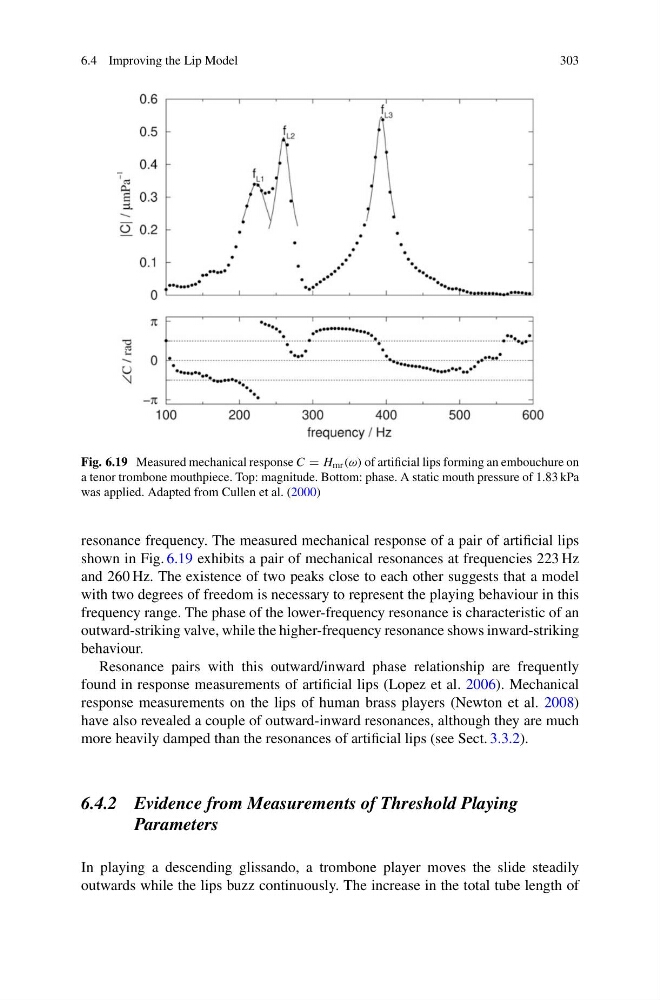
Fig. 6.19 Measured mechanical response C = H mr (ω) of artificial lips forming an embouchure on
a tenor trombone mouthpiece. Top: magnitude. Bottom: phase. A static mouth pressure of 1.83 kPa
was applied. Adapted from Cullen et al. (2000)
resonance frequency. The measured mechanical response of a pair of artificial lips
shown in Fig. 6.19 exhibits a pair of mechanical resonances at frequencies 223 Hz
and 260 Hz. The existence of two peaks close to each other suggests that a model
with two degrees of freedom is necessary to represent the playing behaviour in this
frequency range. The phase of the lower-frequency resonance is characteristic of an
outward-striking valve, while the higher-frequency resonance shows inward-striking
behaviour.
Resonance pairs with this outward/inward phase relationship are frequently
found in response measurements of artificial lips (Lopez et al. 2006). Mechanical
response measurements on the lips of human brass players (Newton et al. 2008)
have also revealed a couple of outward-inward resonances, although they are much
more heavily damped than the resonances of artificial lips (see Sect. 3.3.2).
6.4.2 Evidence from Measurements of Threshold Playing
Parameters
In playing a descending glissando, a trombone player moves the slide steadily
outwards while the lips buzz continuously. The increase in the total tube length of
303
Fig. 6.19 Measured mechanical response C = H mr (ω) of artificial lips forming an embouchure on
a tenor trombone mouthpiece. Top: magnitude. Bottom: phase. A static mouth pressure of 1.83 kPa
was applied. Adapted from Cullen et al. (2000)
resonance frequency. The measured mechanical response of a pair of artificial lips
shown in Fig. 6.19 exhibits a pair of mechanical resonances at frequencies 223 Hz
and 260 Hz. The existence of two peaks close to each other suggests that a model
with two degrees of freedom is necessary to represent the playing behaviour in this
frequency range. The phase of the lower-frequency resonance is characteristic of an
outward-striking valve, while the higher-frequency resonance shows inward-striking
behaviour.
Resonance pairs with this outward/inward phase relationship are frequently
found in response measurements of artificial lips (Lopez et al. 2006). Mechanical
response measurements on the lips of human brass players (Newton et al. 2008)
have also revealed a couple of outward-inward resonances, although they are much
more heavily damped than the resonances of artificial lips (see Sect. 3.3.2).
6.4.2 Evidence from Measurements of Threshold Playing
Parameters
In playing a descending glissando, a trombone player moves the slide steadily
outwards while the lips buzz continuously. The increase in the total tube length of