

290
6 Shocks and Surprises: Refining the Elementary Model
p
p 0
=
ρ
ρ 0
γ
,
(6.20)
where (p 0 , ρ 0 ) is a reference state. Expanding Eq. 6.19 as a power series in
ρ
ρ 0
c
2
= γ
p 0
ρ
γ
0
ρ
γ −1
= γ
p o
ρ o
1 +
ρ
ρ 0
γ −1
= γ
p o
ρ o
1 + (γ − 1)
ρ
ρ 0
+ · · ·
,
(6.21)
from which it follows that
c c 0
1 +
γ − 1
2
ρ
ρ 0
,
(6.22)
with c 2
0 = γp 0 /ρ 0 .
Recalling that p /p 0 = γρ /ρ 0 , and that for a forward travelling wave
p = +ρ 0 c 0 v , the local speed of sound c becomes
c c 0
1 +
γ − 1)
2
p
γp 0
= c 0
1 +
γ − 1
2
ρ 0 c 0 v
γp 0
= c 0 +
γ − 1
2
v
.
(6.23)
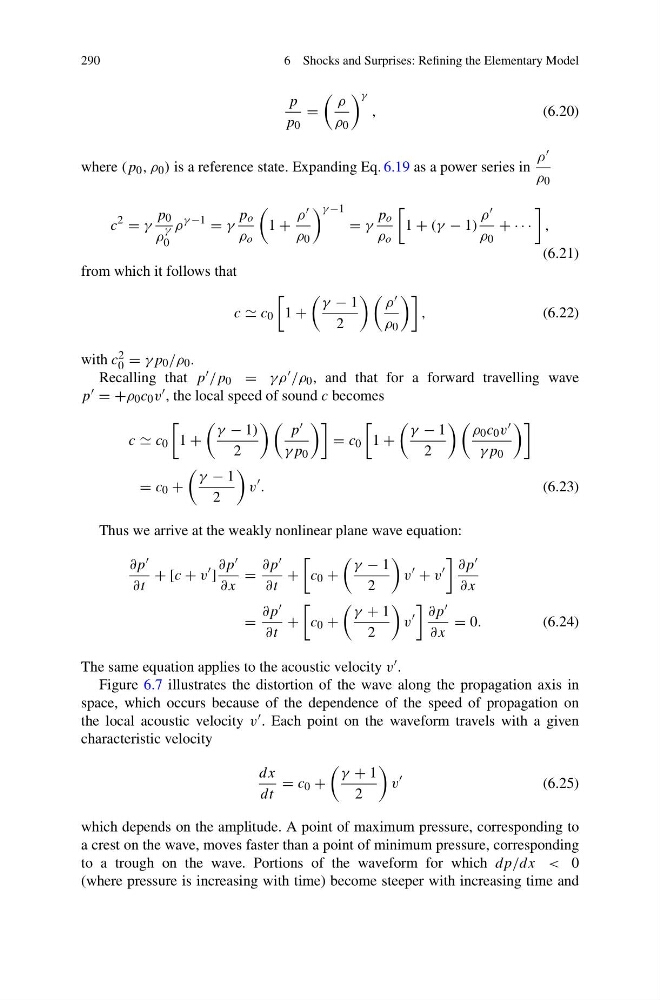
Thus we arrive at the weakly nonlinear plane wave equation:
∂p
∂t
+ [c + v
]
∂p
∂x
=
∂p
∂t
+
c 0 +
γ − 1
2
v
+ v
∂p
∂x
=
∂p
∂t
+
c 0 +
γ + 1
2
v
∂p
∂x
= 0.
(6.24)
The same equation applies to the acoustic velocity v .
Figure 6.7 illustrates the distortion of the wave along the propagation axis in
space, which occurs because of the dependence of the speed of propagation on
the local acoustic velocity v . Each point on the waveform travels with a given
characteristic velocity
dx
dt
= c 0 +
γ + 1
2
v
(6.25)
which depends on the amplitude. A point of maximum pressure, corresponding to
a crest on the wave, moves faster than a point of minimum pressure, corresponding
to a trough on the wave. Portions of the waveform for which dp/dx < 0
(where pressure is increasing with time) become steeper with increasing time and
6 Shocks and Surprises: Refining the Elementary Model
p
p 0
=
ρ
ρ 0
γ
,
(6.20)
where (p 0 , ρ 0 ) is a reference state. Expanding Eq. 6.19 as a power series in
ρ
ρ 0
c
2
= γ
p 0
ρ
γ
0
ρ
γ −1
= γ
p o
ρ o
1 +
ρ
ρ 0
γ −1
= γ
p o
ρ o
1 + (γ − 1)
ρ
ρ 0
+ · · ·
,
(6.21)
from which it follows that
c c 0
1 +
γ − 1
2
ρ
ρ 0
,
(6.22)
with c 2
0 = γp 0 /ρ 0 .
Recalling that p /p 0 = γρ /ρ 0 , and that for a forward travelling wave
p = +ρ 0 c 0 v , the local speed of sound c becomes
c c 0
1 +
γ − 1)
2
p
γp 0
= c 0
1 +
γ − 1
2
ρ 0 c 0 v
γp 0
= c 0 +
γ − 1
2
v
.
(6.23)
Thus we arrive at the weakly nonlinear plane wave equation:
∂p
∂t
+ [c + v
]
∂p
∂x
=
∂p
∂t
+
c 0 +
γ − 1
2
v
+ v
∂p
∂x
=
∂p
∂t
+
c 0 +
γ + 1
2
v
∂p
∂x
= 0.
(6.24)
The same equation applies to the acoustic velocity v .
Figure 6.7 illustrates the distortion of the wave along the propagation axis in
space, which occurs because of the dependence of the speed of propagation on
the local acoustic velocity v . Each point on the waveform travels with a given
characteristic velocity
dx
dt
= c 0 +
γ + 1
2
v
(6.25)
which depends on the amplitude. A point of maximum pressure, corresponding to
a crest on the wave, moves faster than a point of minimum pressure, corresponding
to a trough on the wave. Portions of the waveform for which dp/dx < 0
(where pressure is increasing with time) become steeper with increasing time and