

6.1 Why Brass Instruments Sound Brassy
283
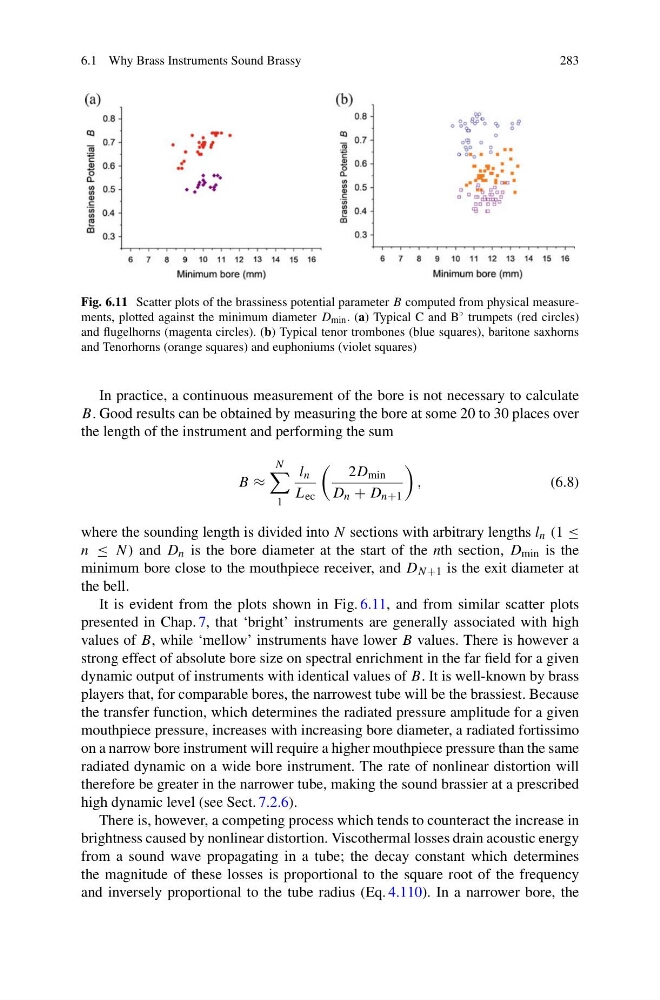
Fig. 6.11 Scatter plots of the brassiness potential parameter B computed from physical measurements, plotted against the minimum diameter D min . (a) Typical C and B trumpets (red circles)
and flugelhorns (magenta circles). (b) Typical tenor trombones (blue squares), baritone saxhorns
and Tenorhorns (orange squares) and euphoniums (violet squares)
In practice, a continuous measurement of the bore is not necessary to calculate
B. Good results can be obtained by measuring the bore at some 20 to 30 places over
the length of the instrument and performing the sum
B ≈
N
1
l n
L ec
2D min
D n + D n+1
,
(6.8)
where the sounding length is divided into N sections with arbitrary lengths l n (1 ≤
n ≤ N) and D n is the bore diameter at the start of the nth section, D min is the
minimum bore close to the mouthpiece receiver, and D N +1 is the exit diameter at
the bell.
It is evident from the plots shown in Fig. 6.11, and from similar scatter plots
presented in Chap. 7, that ‘bright’ instruments are generally associated with high
values of B, while ‘mellow’ instruments have lower B values. There is however a
strong effect of absolute bore size on spectral enrichment in the far field for a given
dynamic output of instruments with identical values of B. It is well-known by brass
players that, for comparable bores, the narrowest tube will be the brassiest. Because
the transfer function, which determines the radiated pressure amplitude for a given
mouthpiece pressure, increases with increasing bore diameter, a radiated fortissimo
on a narrow bore instrument will require a higher mouthpiece pressure than the same
radiated dynamic on a wide bore instrument. The rate of nonlinear distortion will
therefore be greater in the narrower tube, making the sound brassier at a prescribed
high dynamic level (see Sect. 7.2.6).
There is, however, a competing process which tends to counteract the increase in
brightness caused by nonlinear distortion. Viscothermal losses drain acoustic energy
from a sound wave propagating in a tube; the decay constant which determines
the magnitude of these losses is proportional to the square root of the frequency
and inversely proportional to the tube radius (Eq. 4.110). In a narrower bore, the
283
Fig. 6.11 Scatter plots of the brassiness potential parameter B computed from physical measurements, plotted against the minimum diameter D min . (a) Typical C and B trumpets (red circles)
and flugelhorns (magenta circles). (b) Typical tenor trombones (blue squares), baritone saxhorns
and Tenorhorns (orange squares) and euphoniums (violet squares)
In practice, a continuous measurement of the bore is not necessary to calculate
B. Good results can be obtained by measuring the bore at some 20 to 30 places over
the length of the instrument and performing the sum
B ≈
N
1
l n
L ec
2D min
D n + D n+1
,
(6.8)
where the sounding length is divided into N sections with arbitrary lengths l n (1 ≤
n ≤ N) and D n is the bore diameter at the start of the nth section, D min is the
minimum bore close to the mouthpiece receiver, and D N +1 is the exit diameter at
the bell.
It is evident from the plots shown in Fig. 6.11, and from similar scatter plots
presented in Chap. 7, that ‘bright’ instruments are generally associated with high
values of B, while ‘mellow’ instruments have lower B values. There is however a
strong effect of absolute bore size on spectral enrichment in the far field for a given
dynamic output of instruments with identical values of B. It is well-known by brass
players that, for comparable bores, the narrowest tube will be the brassiest. Because
the transfer function, which determines the radiated pressure amplitude for a given
mouthpiece pressure, increases with increasing bore diameter, a radiated fortissimo
on a narrow bore instrument will require a higher mouthpiece pressure than the same
radiated dynamic on a wide bore instrument. The rate of nonlinear distortion will
therefore be greater in the narrower tube, making the sound brassier at a prescribed
high dynamic level (see Sect. 7.2.6).
There is, however, a competing process which tends to counteract the increase in
brightness caused by nonlinear distortion. Viscothermal losses drain acoustic energy
from a sound wave propagating in a tube; the decay constant which determines
the magnitude of these losses is proportional to the square root of the frequency
and inversely proportional to the tube radius (Eq. 4.110). In a narrower bore, the