

5.4 Going Further: From Linear Stability Analysis to Oscillation Regimes
263
upward pressure jump just above the threshold. When the inharmonicity is further
increased to = 0.04, the advantage of a direct bifurcation comes at the cost
of pitch instability, since the oscillation frequency increases with amplitude over
a considerable range of mouth pressures. The balance of low minimum sounding
mouth pressure and constancy of pitch with changing amplitude thus favours the
perfectly harmonic case recommended by the Bouasse-Benade prescription.
The application of continuation methods to the case of a brass instrument, with a
lip valve and many significant resonances, poses additional theoretical and technical
challenges. A promising preliminary study by Fréour et al. (2020) calculated
bifurcation diagrams for a number of different trumpets using the asymptotic
numerical method (ANM) and the harmonic balance technique (Karkar et al. 2013).
The calculation was based on the elementary model of brass playing, with the
resonator represented as a sum of complex modes whose parameters were derived
from analysis of the measured input impedance. Bifurcation diagrams for seven
trumpets were calculated, and all show the classic behaviour of an inverse Hopf
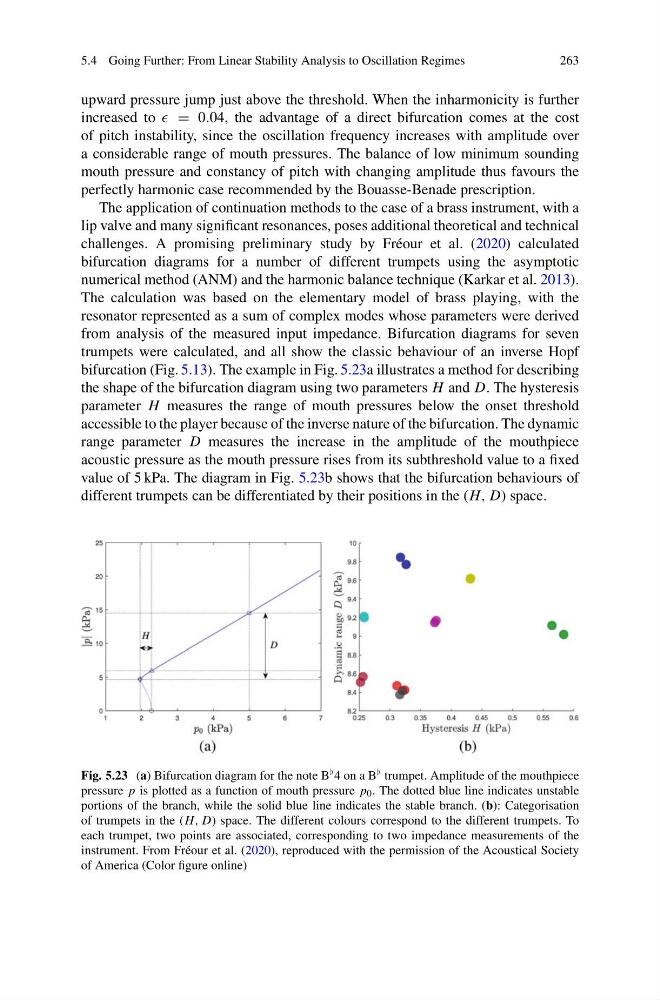
bifurcation (Fig. 5.13). The example in Fig. 5.23a illustrates a method for describing
the shape of the bifurcation diagram using two parameters H and D. The hysteresis
parameter H measures the range of mouth pressures below the onset threshold
accessible to the player because of the inverse nature of the bifurcation. The dynamic
range parameter D measures the increase in the amplitude of the mouthpiece
acoustic pressure as the mouth pressure rises from its subthreshold value to a fixed
value of 5 kPa. The diagram in Fig. 5.23b shows that the bifurcation behaviours of
different trumpets can be differentiated by their positions in the (H, D) space.
Fig. 5.23 (a) Bifurcation diagram for the note B 4 on a B trumpet. Amplitude of the mouthpiece
pressure p is plotted as a function of mouth pressure p 0 . The dotted blue line indicates unstable
portions of the branch, while the solid blue line indicates the stable branch. (b): Categorisation
of trumpets in the (H, D) space. The different colours correspond to the different trumpets. To
each trumpet, two points are associated, corresponding to two impedance measurements of the
instrument. From Fréour et al. (2020), reproduced with the permission of the Acoustical Society
of America (Color figure online)
263
upward pressure jump just above the threshold. When the inharmonicity is further
increased to = 0.04, the advantage of a direct bifurcation comes at the cost
of pitch instability, since the oscillation frequency increases with amplitude over
a considerable range of mouth pressures. The balance of low minimum sounding
mouth pressure and constancy of pitch with changing amplitude thus favours the
perfectly harmonic case recommended by the Bouasse-Benade prescription.
The application of continuation methods to the case of a brass instrument, with a
lip valve and many significant resonances, poses additional theoretical and technical
challenges. A promising preliminary study by Fréour et al. (2020) calculated
bifurcation diagrams for a number of different trumpets using the asymptotic
numerical method (ANM) and the harmonic balance technique (Karkar et al. 2013).
The calculation was based on the elementary model of brass playing, with the
resonator represented as a sum of complex modes whose parameters were derived
from analysis of the measured input impedance. Bifurcation diagrams for seven
trumpets were calculated, and all show the classic behaviour of an inverse Hopf
bifurcation (Fig. 5.13). The example in Fig. 5.23a illustrates a method for describing
the shape of the bifurcation diagram using two parameters H and D. The hysteresis
parameter H measures the range of mouth pressures below the onset threshold
accessible to the player because of the inverse nature of the bifurcation. The dynamic
range parameter D measures the increase in the amplitude of the mouthpiece
acoustic pressure as the mouth pressure rises from its subthreshold value to a fixed
value of 5 kPa. The diagram in Fig. 5.23b shows that the bifurcation behaviours of
different trumpets can be differentiated by their positions in the (H, D) space.
Fig. 5.23 (a) Bifurcation diagram for the note B 4 on a B trumpet. Amplitude of the mouthpiece
pressure p is plotted as a function of mouth pressure p 0 . The dotted blue line indicates unstable
portions of the branch, while the solid blue line indicates the stable branch. (b): Categorisation
of trumpets in the (H, D) space. The different colours correspond to the different trumpets. To
each trumpet, two points are associated, corresponding to two impedance measurements of the
instrument. From Fréour et al. (2020), reproduced with the permission of the Acoustical Society
of America (Color figure online)