

258
5 Blow That Horn: An Elementary Model of Brass Playing
laborious and computationally expensive. In Sect. 5.4.1 continuation methods for
calculating bifurcation diagrams were introduced. A bifurcation diagram gives an
overview of the evolution of periodic regimes as a function of one of the control
parameters: a typical wind instrument bifurcation diagram plots the amplitude and
frequency of the oscillation as a function of the mouth pressure. In the examples
which follow, we will see that these simple curves distil much useful information
about intonation and ease of playing in wind instruments.
In Chap. 4 it was noted that the bores of brass instruments are usually designed
in such a way that the impedance peak frequencies are as close as possible to a
harmonic series. This harmonic alignment of resonances is clearly important for
intonation, since many musically significant intervals are found within the harmonic
series (see Sect. 1.2.2). A more subtle advantage of designing an instrument whose
resonance frequencies are harmonically related is that notes played on it are
generally found to be more stable and easier to sound than on an instrument
with inharmonic resonances. The desirability of harmonically aligned resonances
was accepted and developed by Arthur Benade in his groundbreaking textbook
Fundamentals of Musical Acoustics (Benade 1976), but he noted generously that
the idea originated elsewhere:
The usefulness of the harmonically related air column resonances in fostering stable
oscillations sustained by a reed-valve was first pointed out by the french physicist Henri
Bouasse in his book Instruments à Vent. (Benade 1976)
For this reason we call the recommendation of harmonically related resonances as a
recipe for good playability the ‘Bouasse-Benade prescription’.
To provide a practical demonstration of the validity of the Bouasse-Benade
prescription, Benade designed an instrument which spectacularly failed to follow
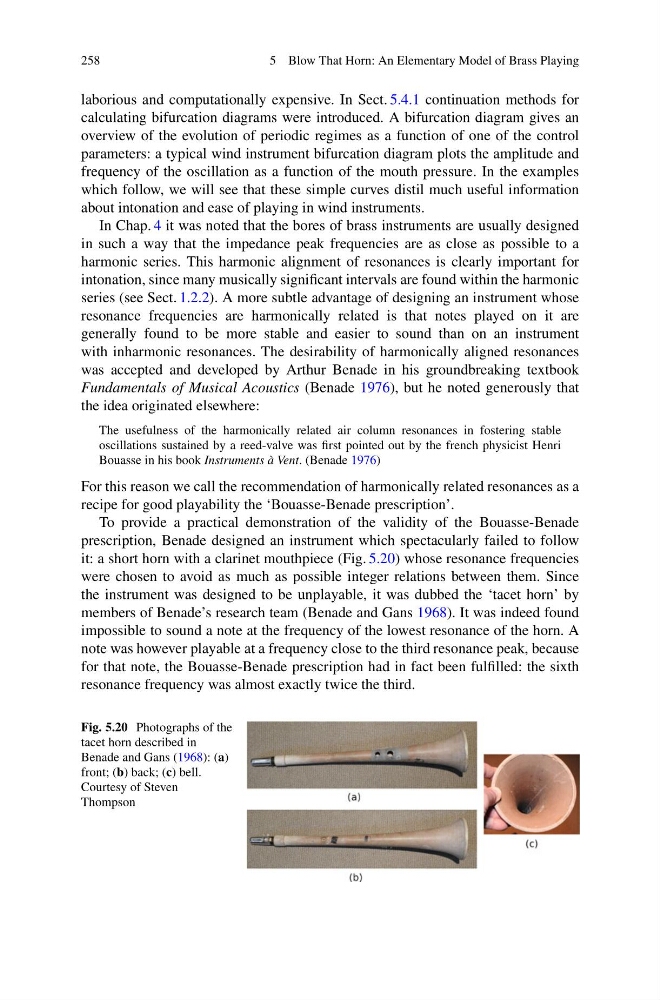
it: a short horn with a clarinet mouthpiece (Fig. 5.20) whose resonance frequencies
were chosen to avoid as much as possible integer relations between them. Since
the instrument was designed to be unplayable, it was dubbed the ‘tacet horn’ by
members of Benade’s research team (Benade and Gans 1968). It was indeed found
impossible to sound a note at the frequency of the lowest resonance of the horn. A
note was however playable at a frequency close to the third resonance peak, because
for that note, the Bouasse-Benade prescription had in fact been fulfilled: the sixth
resonance frequency was almost exactly twice the third.
Fig. 5.20 Photographs of the
tacet horn described in
Benade and Gans (1968): (a)
front; (b) back; (c) bell.
Courtesy of Steven
Thompson
5 Blow That Horn: An Elementary Model of Brass Playing
laborious and computationally expensive. In Sect. 5.4.1 continuation methods for
calculating bifurcation diagrams were introduced. A bifurcation diagram gives an
overview of the evolution of periodic regimes as a function of one of the control
parameters: a typical wind instrument bifurcation diagram plots the amplitude and
frequency of the oscillation as a function of the mouth pressure. In the examples
which follow, we will see that these simple curves distil much useful information
about intonation and ease of playing in wind instruments.
In Chap. 4 it was noted that the bores of brass instruments are usually designed
in such a way that the impedance peak frequencies are as close as possible to a
harmonic series. This harmonic alignment of resonances is clearly important for
intonation, since many musically significant intervals are found within the harmonic
series (see Sect. 1.2.2). A more subtle advantage of designing an instrument whose
resonance frequencies are harmonically related is that notes played on it are
generally found to be more stable and easier to sound than on an instrument
with inharmonic resonances. The desirability of harmonically aligned resonances
was accepted and developed by Arthur Benade in his groundbreaking textbook
Fundamentals of Musical Acoustics (Benade 1976), but he noted generously that
the idea originated elsewhere:
The usefulness of the harmonically related air column resonances in fostering stable
oscillations sustained by a reed-valve was first pointed out by the french physicist Henri
Bouasse in his book Instruments à Vent. (Benade 1976)
For this reason we call the recommendation of harmonically related resonances as a
recipe for good playability the ‘Bouasse-Benade prescription’.
To provide a practical demonstration of the validity of the Bouasse-Benade
prescription, Benade designed an instrument which spectacularly failed to follow
it: a short horn with a clarinet mouthpiece (Fig. 5.20) whose resonance frequencies
were chosen to avoid as much as possible integer relations between them. Since
the instrument was designed to be unplayable, it was dubbed the ‘tacet horn’ by
members of Benade’s research team (Benade and Gans 1968). It was indeed found
impossible to sound a note at the frequency of the lowest resonance of the horn. A
note was however playable at a frequency close to the third resonance peak, because
for that note, the Bouasse-Benade prescription had in fact been fulfilled: the sixth
resonance frequency was almost exactly twice the third.
Fig. 5.20 Photographs of the
tacet horn described in
Benade and Gans (1968): (a)
front; (b) back; (c) bell.
Courtesy of Steven
Thompson