

184
4 After the Lips: Acoustic Resonances and Radiation
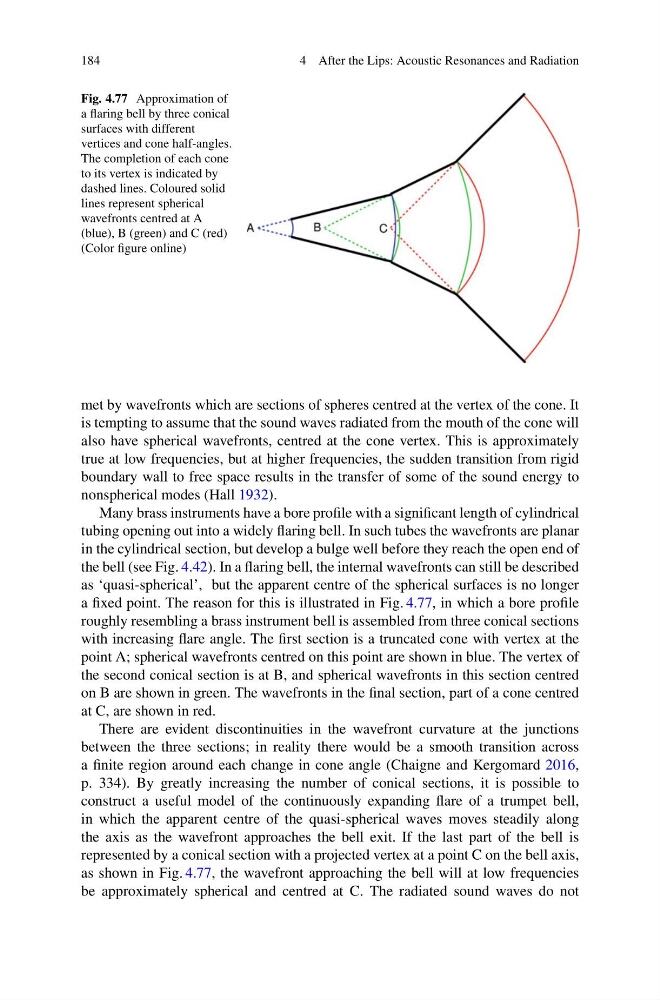
Fig. 4.77 Approximation of
a flaring bell by three conical
surfaces with different
vertices and cone half-angles.
The completion of each cone
to its vertex is indicated by
dashed lines. Coloured solid
lines represent spherical
wavefronts centred at A
(blue), B (green) and C (red)
(Color figure online)
met by wavefronts which are sections of spheres centred at the vertex of the cone. It
is tempting to assume that the sound waves radiated from the mouth of the cone will
also have spherical wavefronts, centred at the cone vertex. This is approximately
true at low frequencies, but at higher frequencies, the sudden transition from rigid
boundary wall to free space results in the transfer of some of the sound energy to
nonspherical modes (Hall 1932).
Many brass instruments have a bore profile with a significant length of cylindrical
tubing opening out into a widely flaring bell. In such tubes the wavefronts are planar
in the cylindrical section, but develop a bulge well before they reach the open end of
the bell (see Fig. 4.42). In a flaring bell, the internal wavefronts can still be described
as ‘quasi-spherical’, but the apparent centre of the spherical surfaces is no longer
a fixed point. The reason for this is illustrated in Fig. 4.77, in which a bore profile
roughly resembling a brass instrument bell is assembled from three conical sections
with increasing flare angle. The first section is a truncated cone with vertex at the
point A; spherical wavefronts centred on this point are shown in blue. The vertex of
the second conical section is at B, and spherical wavefronts in this section centred
on B are shown in green. The wavefronts in the final section, part of a cone centred
at C, are shown in red.
There are evident discontinuities in the wavefront curvature at the junctions
between the three sections; in reality there would be a smooth transition across
a finite region around each change in cone angle (Chaigne and Kergomard 2016,
p. 334). By greatly increasing the number of conical sections, it is possible to
construct a useful model of the continuously expanding flare of a trumpet bell,
in which the apparent centre of the quasi-spherical waves moves steadily along
the axis as the wavefront approaches the bell exit. If the last part of the bell is
represented by a conical section with a projected vertex at a point C on the bell axis,
as shown in Fig. 4.77, the wavefront approaching the bell will at low frequencies
be approximately spherical and centred at C. The radiated sound waves do not
4 After the Lips: Acoustic Resonances and Radiation
Fig. 4.77 Approximation of
a flaring bell by three conical
surfaces with different
vertices and cone half-angles.
The completion of each cone
to its vertex is indicated by
dashed lines. Coloured solid
lines represent spherical
wavefronts centred at A
(blue), B (green) and C (red)
(Color figure online)
met by wavefronts which are sections of spheres centred at the vertex of the cone. It
is tempting to assume that the sound waves radiated from the mouth of the cone will
also have spherical wavefronts, centred at the cone vertex. This is approximately
true at low frequencies, but at higher frequencies, the sudden transition from rigid
boundary wall to free space results in the transfer of some of the sound energy to
nonspherical modes (Hall 1932).
Many brass instruments have a bore profile with a significant length of cylindrical
tubing opening out into a widely flaring bell. In such tubes the wavefronts are planar
in the cylindrical section, but develop a bulge well before they reach the open end of
the bell (see Fig. 4.42). In a flaring bell, the internal wavefronts can still be described
as ‘quasi-spherical’, but the apparent centre of the spherical surfaces is no longer
a fixed point. The reason for this is illustrated in Fig. 4.77, in which a bore profile
roughly resembling a brass instrument bell is assembled from three conical sections
with increasing flare angle. The first section is a truncated cone with vertex at the
point A; spherical wavefronts centred on this point are shown in blue. The vertex of
the second conical section is at B, and spherical wavefronts in this section centred
on B are shown in green. The wavefronts in the final section, part of a cone centred
at C, are shown in red.
There are evident discontinuities in the wavefront curvature at the junctions
between the three sections; in reality there would be a smooth transition across
a finite region around each change in cone angle (Chaigne and Kergomard 2016,
p. 334). By greatly increasing the number of conical sections, it is possible to
construct a useful model of the continuously expanding flare of a trumpet bell,
in which the apparent centre of the quasi-spherical waves moves steadily along
the axis as the wavefront approaches the bell exit. If the last part of the bell is
represented by a conical section with a projected vertex at a point C on the bell axis,
as shown in Fig. 4.77, the wavefront approaching the bell will at low frequencies
be approximately spherical and centred at C. The radiated sound waves do not