

128
4 After the Lips: Acoustic Resonances and Radiation
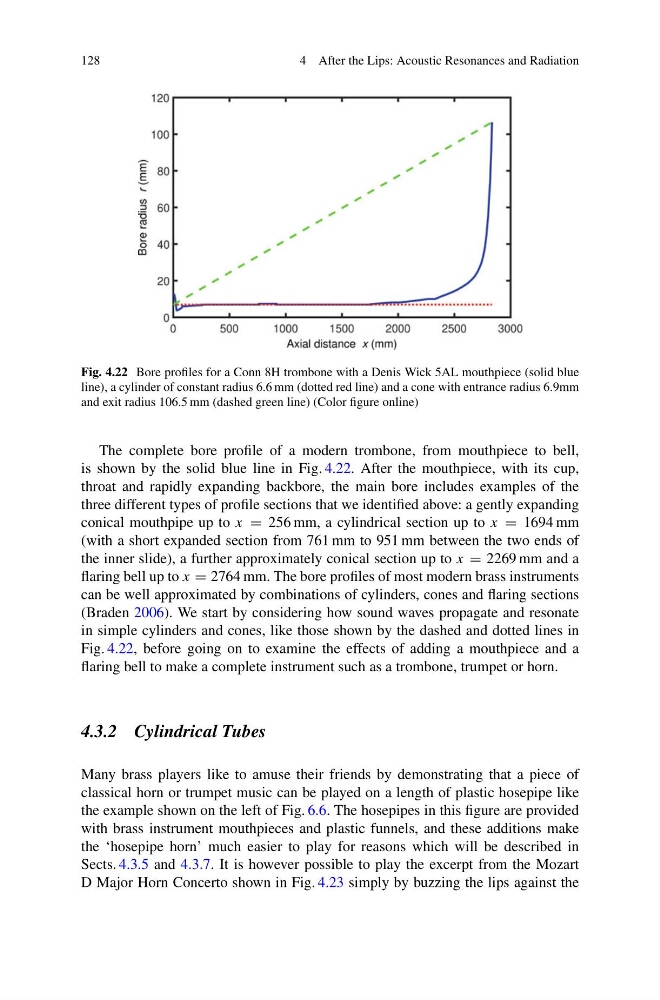
Fig. 4.22 Bore profiles for a Conn 8H trombone with a Denis Wick 5AL mouthpiece (solid blue
line), a cylinder of constant radius 6.6 mm (dotted red line) and a cone with entrance radius 6.9mm
and exit radius 106.5 mm (dashed green line) (Color figure online)
The complete bore profile of a modern trombone, from mouthpiece to bell,
is shown by the solid blue line in Fig. 4.22. After the mouthpiece, with its cup,
throat and rapidly expanding backbore, the main bore includes examples of the
three different types of profile sections that we identified above: a gently expanding
conical mouthpipe up to x = 256 mm, a cylindrical section up to x = 1694 mm
(with a short expanded section from 761 mm to 951 mm between the two ends of
the inner slide), a further approximately conical section up to x = 2269 mm and a
flaring bell up to x = 2764 mm. The bore profiles of most modern brass instruments
can be well approximated by combinations of cylinders, cones and flaring sections
(Braden 2006). We start by considering how sound waves propagate and resonate
in simple cylinders and cones, like those shown by the dashed and dotted lines in
Fig. 4.22, before going on to examine the effects of adding a mouthpiece and a
flaring bell to make a complete instrument such as a trombone, trumpet or horn.
4.3.2 Cylindrical Tubes
Many brass players like to amuse their friends by demonstrating that a piece of
classical horn or trumpet music can be played on a length of plastic hosepipe like
the example shown on the left of Fig. 6.6. The hosepipes in this figure are provided
with brass instrument mouthpieces and plastic funnels, and these additions make
the ‘hosepipe horn’ much easier to play for reasons which will be described in
Sects. 4.3.5 and 4.3.7. It is however possible to play the excerpt from the Mozart
D Major Horn Concerto shown in Fig. 4.23 simply by buzzing the lips against the
4 After the Lips: Acoustic Resonances and Radiation
Fig. 4.22 Bore profiles for a Conn 8H trombone with a Denis Wick 5AL mouthpiece (solid blue
line), a cylinder of constant radius 6.6 mm (dotted red line) and a cone with entrance radius 6.9mm
and exit radius 106.5 mm (dashed green line) (Color figure online)
The complete bore profile of a modern trombone, from mouthpiece to bell,
is shown by the solid blue line in Fig. 4.22. After the mouthpiece, with its cup,
throat and rapidly expanding backbore, the main bore includes examples of the
three different types of profile sections that we identified above: a gently expanding
conical mouthpipe up to x = 256 mm, a cylindrical section up to x = 1694 mm
(with a short expanded section from 761 mm to 951 mm between the two ends of
the inner slide), a further approximately conical section up to x = 2269 mm and a
flaring bell up to x = 2764 mm. The bore profiles of most modern brass instruments
can be well approximated by combinations of cylinders, cones and flaring sections
(Braden 2006). We start by considering how sound waves propagate and resonate
in simple cylinders and cones, like those shown by the dashed and dotted lines in
Fig. 4.22, before going on to examine the effects of adding a mouthpiece and a
flaring bell to make a complete instrument such as a trombone, trumpet or horn.
4.3.2 Cylindrical Tubes
Many brass players like to amuse their friends by demonstrating that a piece of
classical horn or trumpet music can be played on a length of plastic hosepipe like
the example shown on the left of Fig. 6.6. The hosepipes in this figure are provided
with brass instrument mouthpieces and plastic funnels, and these additions make
the ‘hosepipe horn’ much easier to play for reasons which will be described in
Sects. 4.3.5 and 4.3.7. It is however possible to play the excerpt from the Mozart
D Major Horn Concerto shown in Fig. 4.23 simply by buzzing the lips against the