

4.1 Internal Sounds in Brass Instruments
117
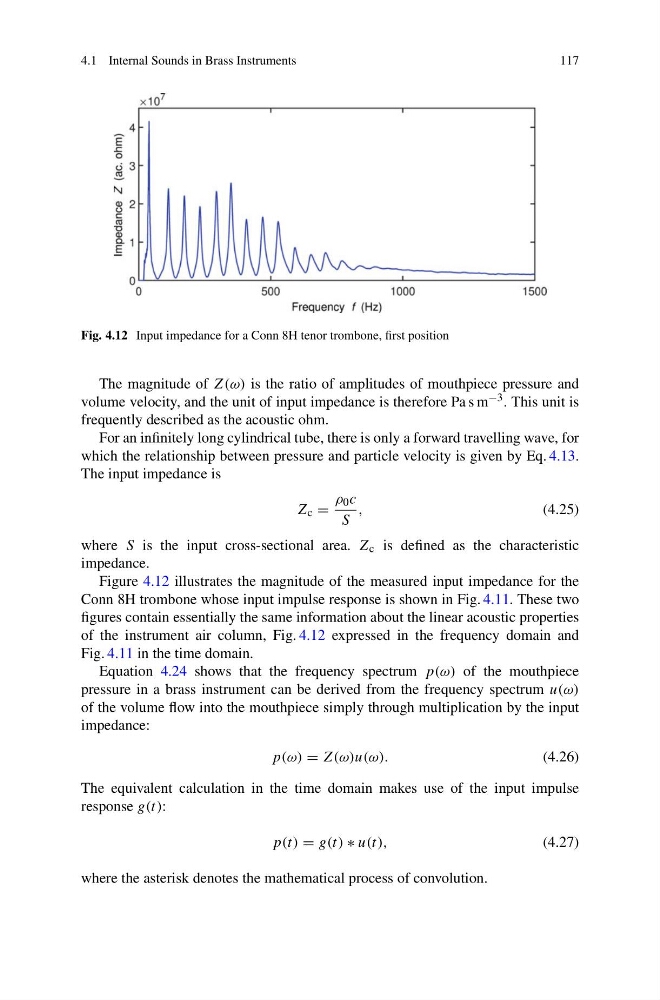
Fig. 4.12 Input impedance for a Conn 8H tenor trombone, first position
The magnitude of Z(ω) is the ratio of amplitudes of mouthpiece pressure and
volume velocity, and the unit of input impedance is therefore Pa s m −3 . This unit is
frequently described as the acoustic ohm.
For an infinitely long cylindrical tube, there is only a forward travelling wave, for
which the relationship between pressure and particle velocity is given by Eq. 4.13.
The input impedance is
Z c =
ρ 0 c
S
,
(4.25)
where S is the input cross-sectional area. Z c is defined as the characteristic
impedance.
Figure 4.12 illustrates the magnitude of the measured input impedance for the
Conn 8H trombone whose input impulse response is shown in Fig. 4.11. These two
figures contain essentially the same information about the linear acoustic properties
of the instrument air column, Fig. 4.12 expressed in the frequency domain and
Fig. 4.11 in the time domain.
Equation 4.24 shows that the frequency spectrum p(ω) of the mouthpiece
pressure in a brass instrument can be derived from the frequency spectrum u(ω)
of the volume flow into the mouthpiece simply through multiplication by the input
impedance:
p(ω) = Z(ω)u(ω).
(4.26)
The equivalent calculation in the time domain makes use of the input impulse
response g(t):
p(t) = g(t) ∗ u(t),
(4.27)
where the asterisk denotes the mathematical process of convolution.
117
Fig. 4.12 Input impedance for a Conn 8H tenor trombone, first position
The magnitude of Z(ω) is the ratio of amplitudes of mouthpiece pressure and
volume velocity, and the unit of input impedance is therefore Pa s m −3 . This unit is
frequently described as the acoustic ohm.
For an infinitely long cylindrical tube, there is only a forward travelling wave, for
which the relationship between pressure and particle velocity is given by Eq. 4.13.
The input impedance is
Z c =
ρ 0 c
S
,
(4.25)
where S is the input cross-sectional area. Z c is defined as the characteristic
impedance.
Figure 4.12 illustrates the magnitude of the measured input impedance for the
Conn 8H trombone whose input impulse response is shown in Fig. 4.11. These two
figures contain essentially the same information about the linear acoustic properties
of the instrument air column, Fig. 4.12 expressed in the frequency domain and
Fig. 4.11 in the time domain.
Equation 4.24 shows that the frequency spectrum p(ω) of the mouthpiece
pressure in a brass instrument can be derived from the frequency spectrum u(ω)
of the volume flow into the mouthpiece simply through multiplication by the input
impedance:
p(ω) = Z(ω)u(ω).
(4.26)
The equivalent calculation in the time domain makes use of the input impulse
response g(t):
p(t) = g(t) ∗ u(t),
(4.27)
where the asterisk denotes the mathematical process of convolution.