

106
4 After the Lips: Acoustic Resonances and Radiation
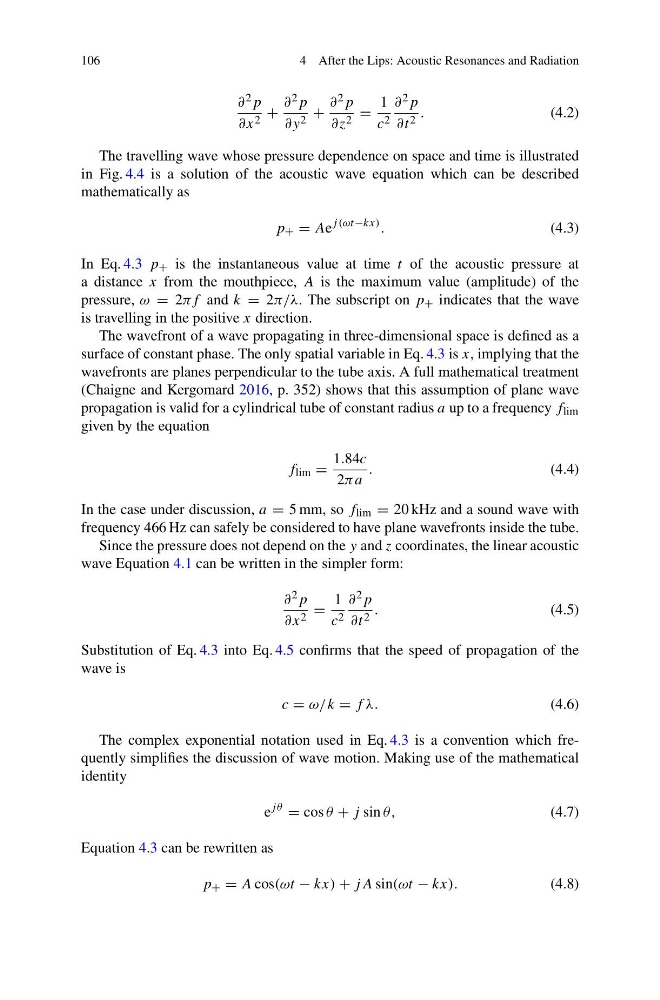
∂ 2 p
∂x 2 +
∂ 2 p
∂y 2 +
∂ 2 p
∂z 2 =
1
c 2
∂ 2 p
∂t 2 .
(4.2)
The travelling wave whose pressure dependence on space and time is illustrated
in Fig. 4.4 is a solution of the acoustic wave equation which can be described
mathematically as
p + = Ae
j (ωt−kx) .
(4.3)
In Eq. 4.3 p + is the instantaneous value at time t of the acoustic pressure at
a distance x from the mouthpiece, A is the maximum value (amplitude) of the
pressure, ω = 2πf and k = 2π/λ. The subscript on p + indicates that the wave
is travelling in the positive x direction.
The wavefront of a wave propagating in three-dimensional space is defined as a
surface of constant phase. The only spatial variable in Eq. 4.3 is x, implying that the
wavefronts are planes perpendicular to the tube axis. A full mathematical treatment
(Chaigne and Kergomard 2016, p. 352) shows that this assumption of plane wave
propagation is valid for a cylindrical tube of constant radius a up to a frequency f lim
given by the equation
f lim =
1.84c
2πa
.
(4.4)
In the case under discussion, a = 5 mm, so f lim = 20 kHz and a sound wave with
frequency 466 Hz can safely be considered to have plane wavefronts inside the tube.
Since the pressure does not depend on the y and z coordinates, the linear acoustic
wave Equation 4.1 can be written in the simpler form:
∂ 2 p
∂x 2 =
1
c 2
∂ 2 p
∂t 2 .
(4.5)
Substitution of Eq. 4.3 into Eq. 4.5 confirms that the speed of propagation of the
wave is
c = ω/k = f λ.
(4.6)
The complex exponential notation used in Eq. 4.3 is a convention which frequently simplifies the discussion of wave motion. Making use of the mathematical
identity
e
jθ
= cos θ + j sin θ,
(4.7)
Equation 4.3 can be rewritten as
p + = A cos(ωt − kx) + jA sin(ωt − kx).
(4.8)
4 After the Lips: Acoustic Resonances and Radiation
∂ 2 p
∂x 2 +
∂ 2 p
∂y 2 +
∂ 2 p
∂z 2 =
1
c 2
∂ 2 p
∂t 2 .
(4.2)
The travelling wave whose pressure dependence on space and time is illustrated
in Fig. 4.4 is a solution of the acoustic wave equation which can be described
mathematically as
p + = Ae
j (ωt−kx) .
(4.3)
In Eq. 4.3 p + is the instantaneous value at time t of the acoustic pressure at
a distance x from the mouthpiece, A is the maximum value (amplitude) of the
pressure, ω = 2πf and k = 2π/λ. The subscript on p + indicates that the wave
is travelling in the positive x direction.
The wavefront of a wave propagating in three-dimensional space is defined as a
surface of constant phase. The only spatial variable in Eq. 4.3 is x, implying that the
wavefronts are planes perpendicular to the tube axis. A full mathematical treatment
(Chaigne and Kergomard 2016, p. 352) shows that this assumption of plane wave
propagation is valid for a cylindrical tube of constant radius a up to a frequency f lim
given by the equation
f lim =
1.84c
2πa
.
(4.4)
In the case under discussion, a = 5 mm, so f lim = 20 kHz and a sound wave with
frequency 466 Hz can safely be considered to have plane wavefronts inside the tube.
Since the pressure does not depend on the y and z coordinates, the linear acoustic
wave Equation 4.1 can be written in the simpler form:
∂ 2 p
∂x 2 =
1
c 2
∂ 2 p
∂t 2 .
(4.5)
Substitution of Eq. 4.3 into Eq. 4.5 confirms that the speed of propagation of the
wave is
c = ω/k = f λ.
(4.6)
The complex exponential notation used in Eq. 4.3 is a convention which frequently simplifies the discussion of wave motion. Making use of the mathematical
identity
e
jθ
= cos θ + j sin θ,
(4.7)
Equation 4.3 can be rewritten as
p + = A cos(ωt − kx) + jA sin(ωt − kx).
(4.8)