

3.2 An Equation of Motion for the Lips
87
corresponding to an increase in p, results in an decrease in the lip opening height
h(t).
The small amplitude vibration behaviour of the outward-swinging door lip model
is described by Eq. 3.12. For very slow pressure changes, this equation can be
written as
ω
2
l (h(t) − h eq ) −
p(t)
μ
.
(3.14)
The negative sign of the term on the left-hand side of Eq. 3.14 confirms that the
swinging door model has the character of an outward-striking reed: a decrease in
the outlet pressure p(t), corresponding to an increase in results in an increase
in the lip opening height h(t).
The swinging door model is not the only possible basis for an outward-striking
pressure-controlled valve, although it is probably the most realistic picture of the
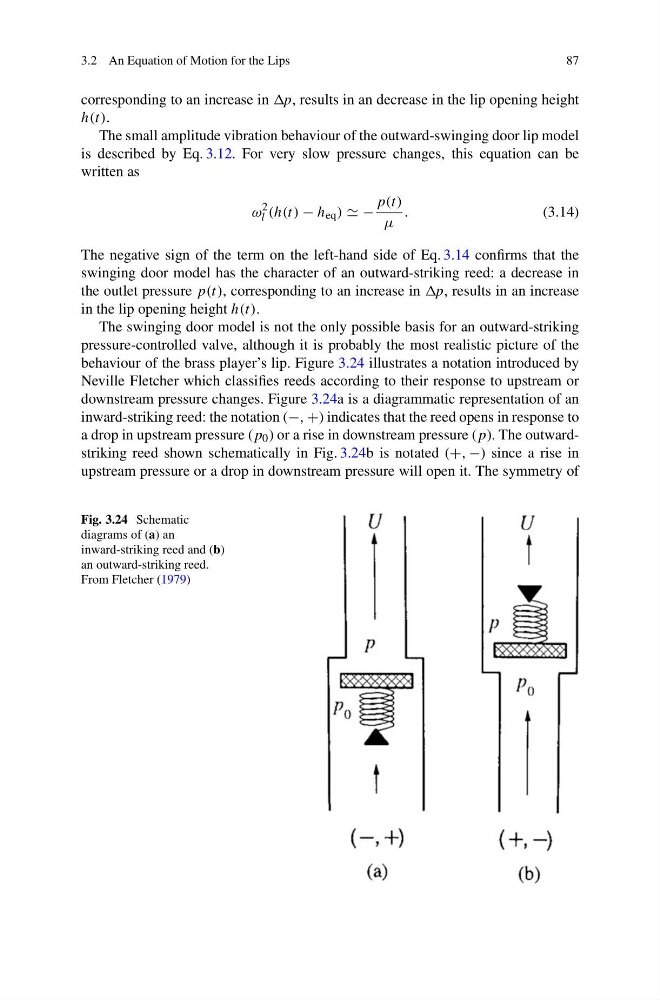
behaviour of the brass player’s lip. Figure 3.24 illustrates a notation introduced by
Neville Fletcher which classifies reeds according to their response to upstream or
downstream pressure changes. Figure 3.24a is a diagrammatic representation of an
inward-striking reed: the notation (−, +) indicates that the reed opens in response to
a drop in upstream pressure (p 0 ) or a rise in downstream pressure (p). The outwardstriking reed shown schematically in Fig. 3.24b is notated (+, −) since a rise in
upstream pressure or a drop in downstream pressure will open it. The symmetry of
Fig. 3.24 Schematic
diagrams of (a) an
inward-striking reed and (b)
an outward-striking reed.
From Fletcher (1979)
87
corresponding to an increase in p, results in an decrease in the lip opening height
h(t).
The small amplitude vibration behaviour of the outward-swinging door lip model
is described by Eq. 3.12. For very slow pressure changes, this equation can be
written as
ω
2
l (h(t) − h eq ) −
p(t)
μ
.
(3.14)
The negative sign of the term on the left-hand side of Eq. 3.14 confirms that the
swinging door model has the character of an outward-striking reed: a decrease in
the outlet pressure p(t), corresponding to an increase in results in an increase
in the lip opening height h(t).
The swinging door model is not the only possible basis for an outward-striking
pressure-controlled valve, although it is probably the most realistic picture of the
behaviour of the brass player’s lip. Figure 3.24 illustrates a notation introduced by
Neville Fletcher which classifies reeds according to their response to upstream or
downstream pressure changes. Figure 3.24a is a diagrammatic representation of an
inward-striking reed: the notation (−, +) indicates that the reed opens in response to
a drop in upstream pressure (p 0 ) or a rise in downstream pressure (p). The outwardstriking reed shown schematically in Fig. 3.24b is notated (+, −) since a rise in
upstream pressure or a drop in downstream pressure will open it. The symmetry of
Fig. 3.24 Schematic
diagrams of (a) an
inward-striking reed and (b)
an outward-striking reed.
From Fletcher (1979)