

6 On the Fragment Production and Phase Transition Using QMD + SACA Model
69
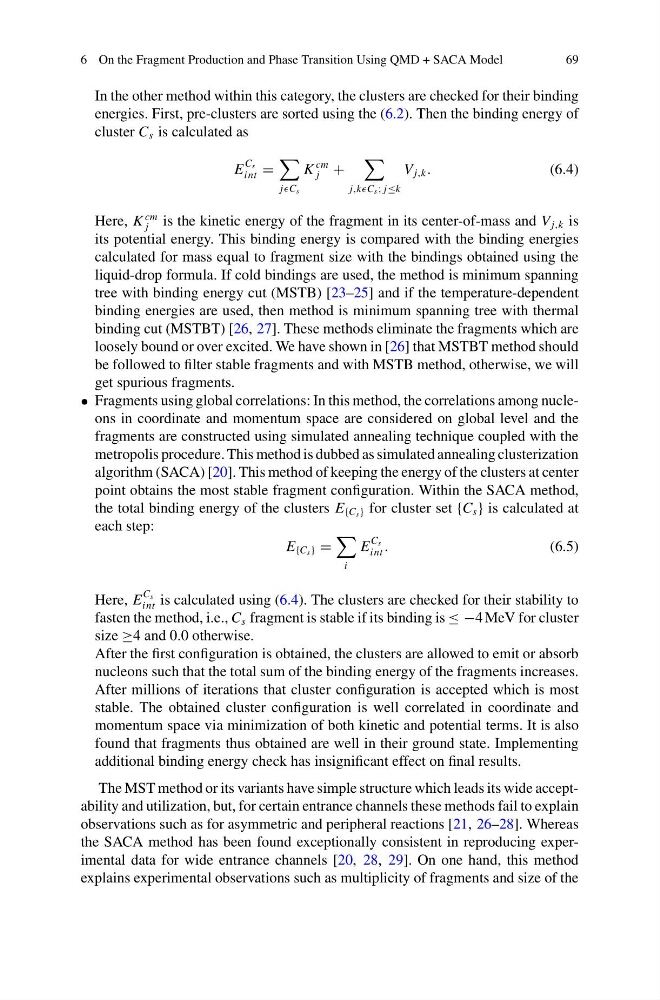
In the other method within this category, the clusters are checked for their binding
energies. First, pre-clusters are sorted using the (6.2). Then the binding energy of
cluster C s is calculated as
E
C s
int =
jC s
K
cm
j +
j,kC s ; j≤k
V j,k .
(6.4)
Here, K
cm
j is the kinetic energy of the fragment in its center-of-mass and V j,k is
its potential energy. This binding energy is compared with the binding energies
calculated for mass equal to fragment size with the bindings obtained using the
liquid-drop formula. If cold bindings are used, the method is minimum spanning
tree with binding energy cut (MSTB) [23–25] and if the temperature-dependent
binding energies are used, then method is minimum spanning tree with thermal
binding cut (MSTBT) [26, 27]. These methods eliminate the fragments which are
loosely bound or over excited. We have shown in [26] that MSTBT method should
be followed to filter stable fragments and with MSTB method, otherwise, we will
get spurious fragments.
• Fragments using global correlations: In this method, the correlations among nucleons in coordinate and momentum space are considered on global level and the
fragments are constructed using simulated annealing technique coupled with the
metropolis procedure. This method is dubbed as simulated annealing clusterization
algorithm (SACA) [20]. This method of keeping the energy of the clusters at center
point obtains the most stable fragment configuration. Within the SACA method,
the total binding energy of the clusters E {C s } for cluster set {C s } is calculated at
each step:
E {C s } =
i
E
C s
int .
(6.5)
Here, E
C s
int is calculated using (6.4). The clusters are checked for their stability to
fasten the method, i.e., C s fragment is stable if its binding is ≤ −4 MeV for cluster
size ≥4 and 0.0 otherwise.
After the first configuration is obtained, the clusters are allowed to emit or absorb
nucleons such that the total sum of the binding energy of the fragments increases.
After millions of iterations that cluster configuration is accepted which is most
stable. The obtained cluster configuration is well correlated in coordinate and
momentum space via minimization of both kinetic and potential terms. It is also
found that fragments thus obtained are well in their ground state. Implementing
additional binding energy check has insignificant effect on final results.
The MST method or its variants have simple structure which leads its wide acceptability and utilization, but, for certain entrance channels these methods fail to explain
observations such as for asymmetric and peripheral reactions [21, 26–28]. Whereas
the SACA method has been found exceptionally consistent in reproducing experimental data for wide entrance channels [20, 28, 29]. On one hand, this method
explains experimental observations such as multiplicity of fragments and size of the
69
In the other method within this category, the clusters are checked for their binding
energies. First, pre-clusters are sorted using the (6.2). Then the binding energy of
cluster C s is calculated as
E
C s
int =
jC s
K
cm
j +
j,kC s ; j≤k
V j,k .
(6.4)
Here, K
cm
j is the kinetic energy of the fragment in its center-of-mass and V j,k is
its potential energy. This binding energy is compared with the binding energies
calculated for mass equal to fragment size with the bindings obtained using the
liquid-drop formula. If cold bindings are used, the method is minimum spanning
tree with binding energy cut (MSTB) [23–25] and if the temperature-dependent
binding energies are used, then method is minimum spanning tree with thermal
binding cut (MSTBT) [26, 27]. These methods eliminate the fragments which are
loosely bound or over excited. We have shown in [26] that MSTBT method should
be followed to filter stable fragments and with MSTB method, otherwise, we will
get spurious fragments.
• Fragments using global correlations: In this method, the correlations among nucleons in coordinate and momentum space are considered on global level and the
fragments are constructed using simulated annealing technique coupled with the
metropolis procedure. This method is dubbed as simulated annealing clusterization
algorithm (SACA) [20]. This method of keeping the energy of the clusters at center
point obtains the most stable fragment configuration. Within the SACA method,
the total binding energy of the clusters E {C s } for cluster set {C s } is calculated at
each step:
E {C s } =
i
E
C s
int .
(6.5)
Here, E
C s
int is calculated using (6.4). The clusters are checked for their stability to
fasten the method, i.e., C s fragment is stable if its binding is ≤ −4 MeV for cluster
size ≥4 and 0.0 otherwise.
After the first configuration is obtained, the clusters are allowed to emit or absorb
nucleons such that the total sum of the binding energy of the fragments increases.
After millions of iterations that cluster configuration is accepted which is most
stable. The obtained cluster configuration is well correlated in coordinate and
momentum space via minimization of both kinetic and potential terms. It is also
found that fragments thus obtained are well in their ground state. Implementing
additional binding energy check has insignificant effect on final results.
The MST method or its variants have simple structure which leads its wide acceptability and utilization, but, for certain entrance channels these methods fail to explain
observations such as for asymmetric and peripheral reactions [21, 26–28]. Whereas
the SACA method has been found exceptionally consistent in reproducing experimental data for wide entrance channels [20, 28, 29]. On one hand, this method
explains experimental observations such as multiplicity of fragments and size of the