

5 Isospin Effects: Nuclear Fragmentation as a Probe
53
addition of neutrons on the energy corresponding to maximum production of HMFs
and MMFs.
Further, we will proceed with our study on isospin effects via nuclear fragmentation by dividing the final fragmentation pattern into free particles (A = 1) and
fragments (A > 1) by labeling them as gas and liquid, respectively, and will analyze
the beam energy dependence of such gas/liquid content for semi-central collisions
of different asymmetric reacting partners. The present study is carried out by using
Isospin-dependent Quantum Molecular Dynamics (IQMD) model [27, 28] which
is discussed in the next section. The isospin effects in our model (IQMD) comes
via nuclear mean-field (through Coulomb and symmetry potential) and nn scattering
cross section (being isospin-dependent).
5.2 Isospin-Dependent Quantum Molecular Dynamics
(IQMD) Model
The Isospin-dependent Quantum Molecular Dynamics (IQMD) model is the
advanced version of QMD model introduced by Hartnack et al. [29, 30]. This model
deals with distinctive charge states of nucleons, deltas, and pions explicitly. The
isospin degree of freedom is incorporated through Coulomb potential, nuclear symmetry potential, and nucleon–nucleon scattering cross section. Here, every hadron
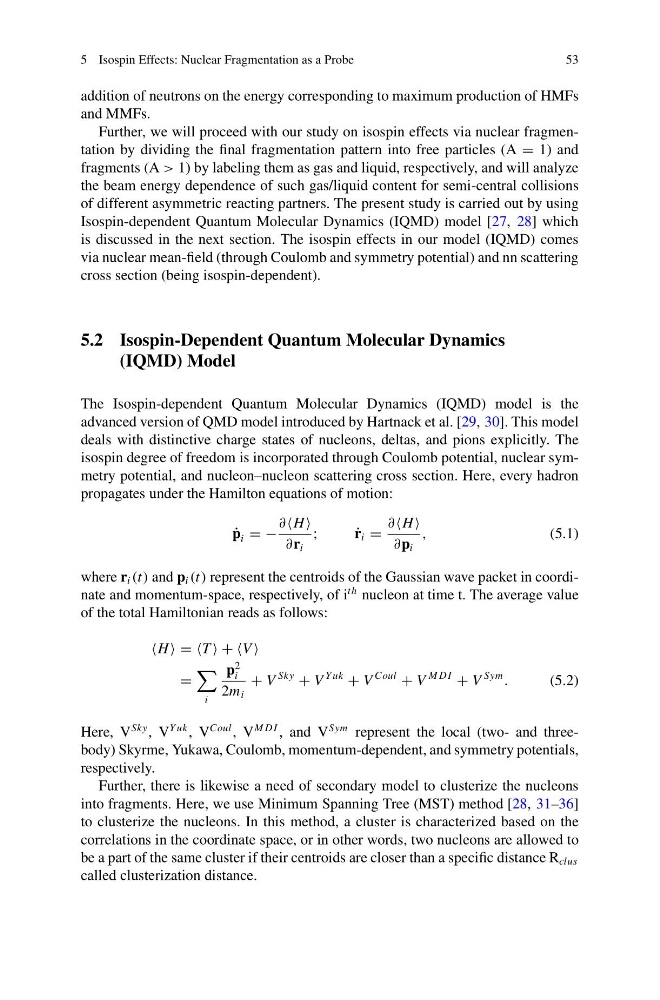
propagates under the Hamilton equations of motion:
˙
p i = −
∂H
∂r i
;
˙
r i =
∂H
∂p i
,
(5.1)
where r i (t) and p i (t) represent the centroids of the Gaussian wave packet in coordinate and momentum-space, respectively, of i
th nucleon at time t. The average value
of the total Hamiltonian reads as follows:
H = =T + +V
=
i
p
2
i
2m i
+ V
Sky
+ V
Y uk
+ V
Coul
+ V
M DI
+ V
Sym
.
(5.2)
Here, V
Sky , V
Y uk , V
Coul , V
M DI , and V
Sym represent the local (two- and threebody) Skyrme, Yukawa, Coulomb, momentum-dependent, and symmetry potentials,
respectively.
Further, there is likewise a need of secondary model to clusterize the nucleons
into fragments. Here, we use Minimum Spanning Tree (MST) method [28, 31–36]
to clusterize the nucleons. In this method, a cluster is characterized based on the
correlations in the coordinate space, or in other words, two nucleons are allowed to
be a part of the same cluster if their centroids are closer than a specific distance R clus
called clusterization distance.
53
addition of neutrons on the energy corresponding to maximum production of HMFs
and MMFs.
Further, we will proceed with our study on isospin effects via nuclear fragmentation by dividing the final fragmentation pattern into free particles (A = 1) and
fragments (A > 1) by labeling them as gas and liquid, respectively, and will analyze
the beam energy dependence of such gas/liquid content for semi-central collisions
of different asymmetric reacting partners. The present study is carried out by using
Isospin-dependent Quantum Molecular Dynamics (IQMD) model [27, 28] which
is discussed in the next section. The isospin effects in our model (IQMD) comes
via nuclear mean-field (through Coulomb and symmetry potential) and nn scattering
cross section (being isospin-dependent).
5.2 Isospin-Dependent Quantum Molecular Dynamics
(IQMD) Model
The Isospin-dependent Quantum Molecular Dynamics (IQMD) model is the
advanced version of QMD model introduced by Hartnack et al. [29, 30]. This model
deals with distinctive charge states of nucleons, deltas, and pions explicitly. The
isospin degree of freedom is incorporated through Coulomb potential, nuclear symmetry potential, and nucleon–nucleon scattering cross section. Here, every hadron
propagates under the Hamilton equations of motion:
˙
p i = −
∂H
∂r i
;
˙
r i =
∂H
∂p i
,
(5.1)
where r i (t) and p i (t) represent the centroids of the Gaussian wave packet in coordinate and momentum-space, respectively, of i
th nucleon at time t. The average value
of the total Hamiltonian reads as follows:
H = =T + +V
=
i
p
2
i
2m i
+ V
Sky
+ V
Y uk
+ V
Coul
+ V
M DI
+ V
Sym
.
(5.2)
Here, V
Sky , V
Y uk , V
Coul , V
M DI , and V
Sym represent the local (two- and threebody) Skyrme, Yukawa, Coulomb, momentum-dependent, and symmetry potentials,
respectively.
Further, there is likewise a need of secondary model to clusterize the nucleons
into fragments. Here, we use Minimum Spanning Tree (MST) method [28, 31–36]
to clusterize the nucleons. In this method, a cluster is characterized based on the
correlations in the coordinate space, or in other words, two nucleons are allowed to
be a part of the same cluster if their centroids are closer than a specific distance R clus
called clusterization distance.