

4 Study of Isospin Effects in Heavy-Ion Collisions at Intermediate Energies …
45
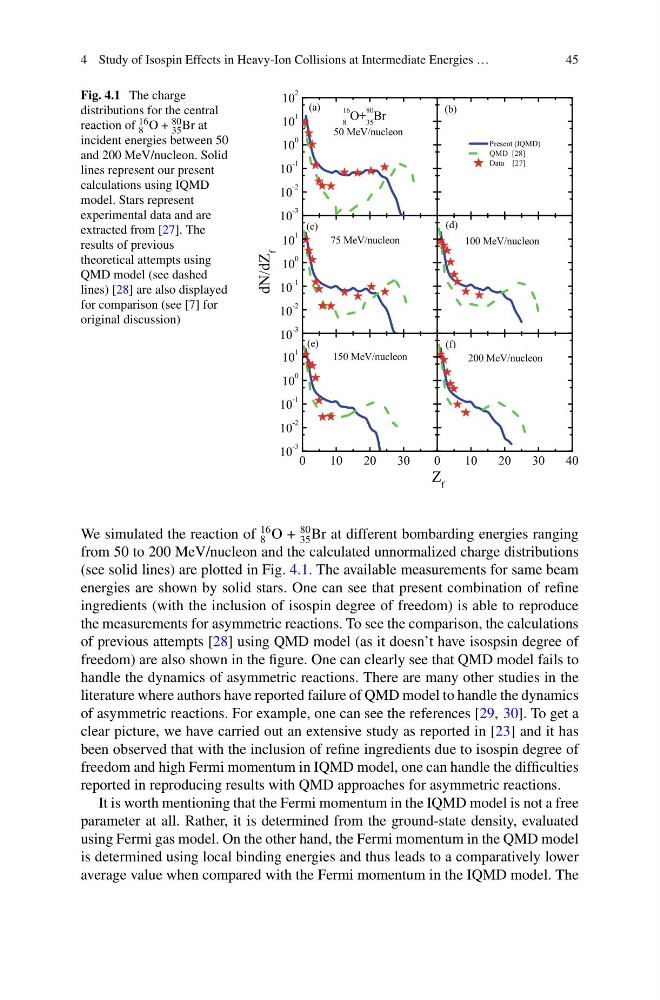
Fig. 4.1 The charge
distributions for the central
reaction of 16
8 O + 80
35 Br at
incident energies between 50
and 200 MeV/nucleon. Solid
lines represent our present
calculations using IQMD
model. Stars represent
experimental data and are
extracted from [27]. The
results of previous
theoretical attempts using
QMD model (see dashed
lines) [28] are also displayed
for comparison (see [7] for
original discussion)
We simulated the reaction of
16
8 O +
80
35 Br at different bombarding energies ranging
from 50 to 200 MeV/nucleon and the calculated unnormalized charge distributions
(see solid lines) are plotted in Fig. 4.1. The available measurements for same beam
energies are shown by solid stars. One can see that present combination of refine
ingredients (with the inclusion of isospin degree of freedom) is able to reproduce
the measurements for asymmetric reactions. To see the comparison, the calculations
of previous attempts [28] using QMD model (as it doesn’t have isospsin degree of
freedom) are also shown in the figure. One can clearly see that QMD model fails to
handle the dynamics of asymmetric reactions. There are many other studies in the
literature where authors have reported failure of QMD model to handle the dynamics
of asymmetric reactions. For example, one can see the references [29, 30]. To get a
clear picture, we have carried out an extensive study as reported in [23] and it has
been observed that with the inclusion of refine ingredients due to isospin degree of
freedom and high Fermi momentum in IQMD model, one can handle the difficulties
reported in reproducing results with QMD approaches for asymmetric reactions.
It is worth mentioning that the Fermi momentum in the IQMD model is not a free
parameter at all. Rather, it is determined from the ground-state density, evaluated
using Fermi gas model. On the other hand, the Fermi momentum in the QMD model
is determined using local binding energies and thus leads to a comparatively lower
average value when compared with the Fermi momentum in the IQMD model. The
45
Fig. 4.1 The charge
distributions for the central
reaction of 16
8 O + 80
35 Br at
incident energies between 50
and 200 MeV/nucleon. Solid
lines represent our present
calculations using IQMD
model. Stars represent
experimental data and are
extracted from [27]. The
results of previous
theoretical attempts using
QMD model (see dashed
lines) [28] are also displayed
for comparison (see [7] for
original discussion)
We simulated the reaction of
16
8 O +
80
35 Br at different bombarding energies ranging
from 50 to 200 MeV/nucleon and the calculated unnormalized charge distributions
(see solid lines) are plotted in Fig. 4.1. The available measurements for same beam
energies are shown by solid stars. One can see that present combination of refine
ingredients (with the inclusion of isospin degree of freedom) is able to reproduce
the measurements for asymmetric reactions. To see the comparison, the calculations
of previous attempts [28] using QMD model (as it doesn’t have isospsin degree of
freedom) are also shown in the figure. One can clearly see that QMD model fails to
handle the dynamics of asymmetric reactions. There are many other studies in the
literature where authors have reported failure of QMD model to handle the dynamics
of asymmetric reactions. For example, one can see the references [29, 30]. To get a
clear picture, we have carried out an extensive study as reported in [23] and it has
been observed that with the inclusion of refine ingredients due to isospin degree of
freedom and high Fermi momentum in IQMD model, one can handle the difficulties
reported in reproducing results with QMD approaches for asymmetric reactions.
It is worth mentioning that the Fermi momentum in the IQMD model is not a free
parameter at all. Rather, it is determined from the ground-state density, evaluated
using Fermi gas model. On the other hand, the Fermi momentum in the QMD model
is determined using local binding energies and thus leads to a comparatively lower
average value when compared with the Fermi momentum in the IQMD model. The