

3 Statistical and Dynamical Bimodality in Multifragmentation Reactions
29
in Sect. 3.2, the coupling conditions between the dynamical and statistica treatment
are explained in Sect. 3.3, the results concerning the different conditions of dynamical
and statistical bimodal behavior are described in Sects. 3.4 and 3.5 respectively, and
finally, summary is presented in Sect. 3.6.
3.2 Improvement in BUU Model with Fluctuation
The BUU transport model calculation [23–26] for heavy-ion collisions starts with
two nuclei in their respective ground states approaching each other with specified
velocities and impact parameters. The ground-state energies and densities of the
projectile (mass number A p ) and target (mass number A t ) nuclei are constructed
using the Thomas–Fermi approximation [25]. The Thomas-Fermi phase-space distribution is then sampled using Monte Carlo technique by choosing test particles
(we use N test = 100 for each nucleon) with appropriate positions and momenta. As
the projectile and target nuclei propagate in time, the test particles move in a meanfield and occasionally suffer two-body collisions, with probability determined by the
nucleon–nucleon scattering cross section, provided the final state of the collision is
not blocked by the Pauli principle. The mean-field propagation is done using the
lattice Hamiltonian method which conserves energy and momentum very accurately
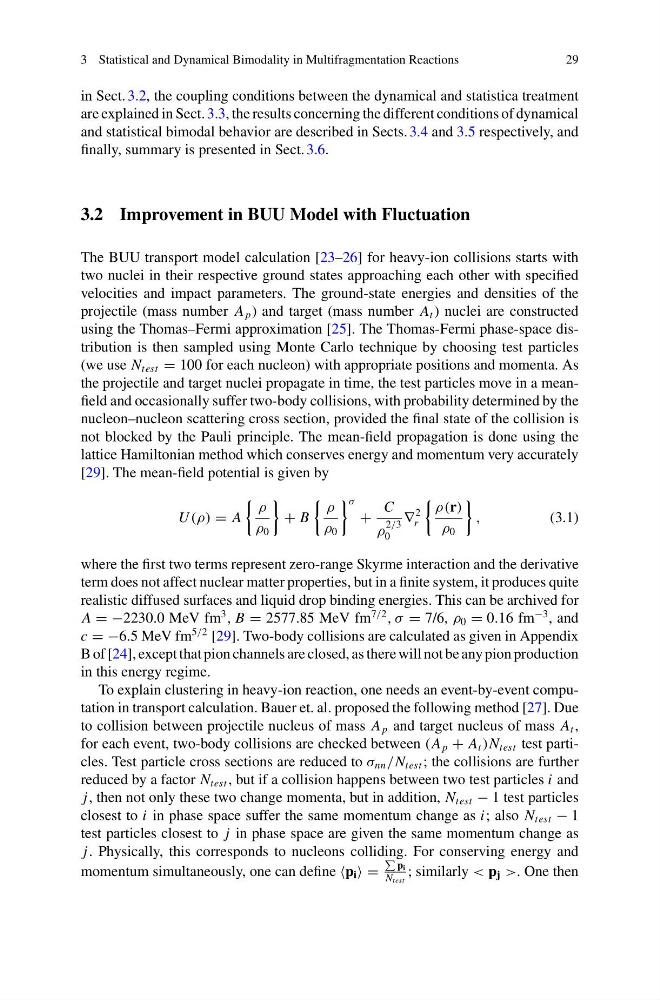
[29]. The mean-field potential is given by
U (ρ) = A
ρ
ρ 0
+ B
ρ
ρ 0
σ
+
C
ρ
2/3
0
∇
2
r
ρ(r)
ρ 0
,
(3.1)
where the first two terms represent zero-range Skyrme interaction and the derivative
term does not affect nuclear matter properties, but in a finite system, it produces quite
realistic diffused surfaces and liquid drop binding energies. This can be archived for
A = −2230.0 MeV fm
3
, B = 2577.85 MeV fm
7/2
, σ = 7/6, ρ 0 = 0.16 fm
−3 , and
c = −6.5 MeV fm
5/2 [29]. Two-body collisions are calculated as given in Appendix
B of [24], except that pion channels are closed, as there will not be any pion production
in this energy regime.
To explain clustering in heavy-ion reaction, one needs an event-by-event computation in transport calculation. Bauer et. al. proposed the following method [27]. Due
to collision between projectile nucleus of mass A p and target nucleus of mass A t ,
for each event, two-body collisions are checked between (A p + A t )N test test particles. Test particle cross sections are reduced to σ nn /N test ; the collisions are further
reduced by a factor N test , but if a collision happens between two test particles i and
j, then not only these two change momenta, but in addition, N test − 1 test particles
closest to i in phase space suffer the same momentum change as i; also N test − 1
test particles closest to j in phase space are given the same momentum change as
j. Physically, this corresponds to nucleons colliding. For conserving energy and
momentum simultaneously, one can define p i =
p i
N test
; similarly < p j >. One then
29
in Sect. 3.2, the coupling conditions between the dynamical and statistica treatment
are explained in Sect. 3.3, the results concerning the different conditions of dynamical
and statistical bimodal behavior are described in Sects. 3.4 and 3.5 respectively, and
finally, summary is presented in Sect. 3.6.
3.2 Improvement in BUU Model with Fluctuation
The BUU transport model calculation [23–26] for heavy-ion collisions starts with
two nuclei in their respective ground states approaching each other with specified
velocities and impact parameters. The ground-state energies and densities of the
projectile (mass number A p ) and target (mass number A t ) nuclei are constructed
using the Thomas–Fermi approximation [25]. The Thomas-Fermi phase-space distribution is then sampled using Monte Carlo technique by choosing test particles
(we use N test = 100 for each nucleon) with appropriate positions and momenta. As
the projectile and target nuclei propagate in time, the test particles move in a meanfield and occasionally suffer two-body collisions, with probability determined by the
nucleon–nucleon scattering cross section, provided the final state of the collision is
not blocked by the Pauli principle. The mean-field propagation is done using the
lattice Hamiltonian method which conserves energy and momentum very accurately
[29]. The mean-field potential is given by
U (ρ) = A
ρ
ρ 0
+ B
ρ
ρ 0
σ
+
C
ρ
2/3
0
∇
2
r
ρ(r)
ρ 0
,
(3.1)
where the first two terms represent zero-range Skyrme interaction and the derivative
term does not affect nuclear matter properties, but in a finite system, it produces quite
realistic diffused surfaces and liquid drop binding energies. This can be archived for
A = −2230.0 MeV fm
3
, B = 2577.85 MeV fm
7/2
, σ = 7/6, ρ 0 = 0.16 fm
−3 , and
c = −6.5 MeV fm
5/2 [29]. Two-body collisions are calculated as given in Appendix
B of [24], except that pion channels are closed, as there will not be any pion production
in this energy regime.
To explain clustering in heavy-ion reaction, one needs an event-by-event computation in transport calculation. Bauer et. al. proposed the following method [27]. Due
to collision between projectile nucleus of mass A p and target nucleus of mass A t ,
for each event, two-body collisions are checked between (A p + A t )N test test particles. Test particle cross sections are reduced to σ nn /N test ; the collisions are further
reduced by a factor N test , but if a collision happens between two test particles i and
j, then not only these two change momenta, but in addition, N test − 1 test particles
closest to i in phase space suffer the same momentum change as i; also N test − 1
test particles closest to j in phase space are given the same momentum change as
j. Physically, this corresponds to nucleons colliding. For conserving energy and
momentum simultaneously, one can define p i =
p i
N test
; similarly < p j >. One then