

2 New Signatures of Phase Transition from Models of Nuclear Multifragmentation
13
ω I,J =
V f
h 3 (2π mT )
3/2 A
3/2
× z I,J (int).
(2.2)
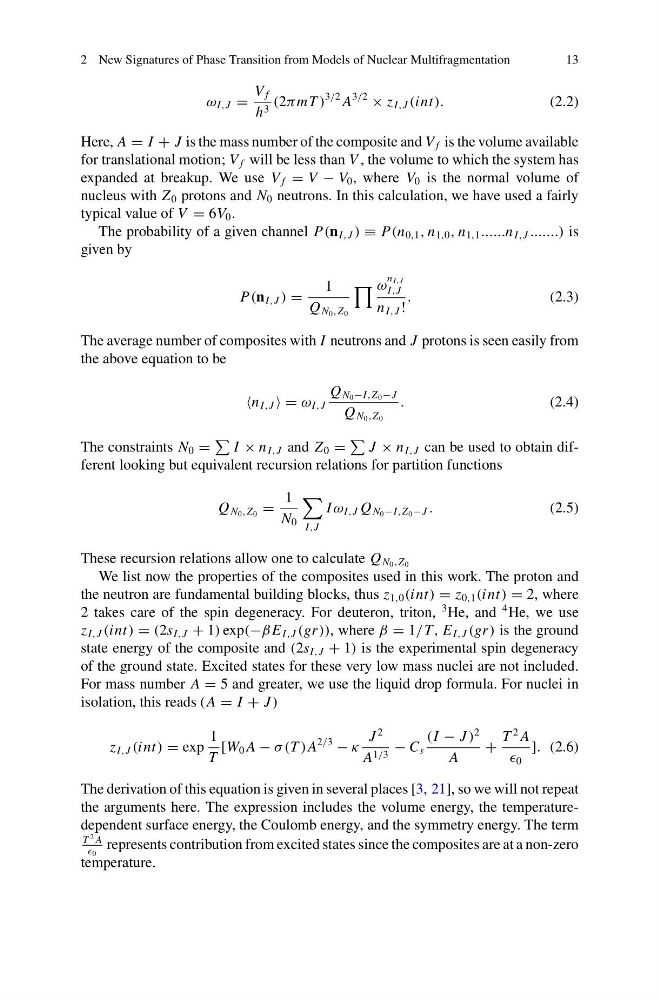
Here, A = I + J is the mass number of the composite and V f is the volume available
for translational motion; V f will be less than V , the volume to which the system has
expanded at breakup. We use V f = V − V 0 , where V 0 is the normal volume of
nucleus with Z 0 protons and N 0 neutrons. In this calculation, we have used a fairly
typical value of V = 6V 0 .
The probability of a given channel P(n I,J ) ≡ P(n 0,1 , n 1,0 , n 1,1 ......n I,J .......) is
given by
P(n I,J ) =
1
Q N 0 ,Z 0
ω
n I,J
I,J
n I,J !
.
(2.3)
The average number of composites with I neutrons and J protons is seen easily from
the above equation to be
n I,J = ω I,J
Q N 0 −I,Z 0 −J
Q N 0 ,Z 0
.
(2.4)
The constraints N 0 =
I × n I,J and Z 0 =
J × n I,J can be used to obtain different looking but equivalent recursion relations for partition functions
Q N 0 ,Z 0 =
1
N 0
I,J
I ω I,J Q N 0 −I,Z 0 −J .
(2.5)
These recursion relations allow one to calculate Q N 0 ,Z 0
We list now the properties of the composites used in this work. The proton and
the neutron are fundamental building blocks, thus z 1,0 (int) = z 0,1 (int) = 2, where
2 takes care of the spin degeneracy. For deuteron, triton,
3 He, and
4 He, we use
z I,J (int) = (2s I,J + 1) exp(−β E I,J (gr)), where β = 1/T, E I,J (gr) is the ground
state energy of the composite and (2s I,J + 1) is the experimental spin degeneracy
of the ground state. Excited states for these very low mass nuclei are not included.
For mass number A = 5 and greater, we use the liquid drop formula. For nuclei in
isolation, this reads ( A = I + J )
z I,J (int) = exp
1
T
[W 0 A − σ (T )A
2/3
− κ
J
2
A 1/3 − C s
(I − J )
2
A
+
T
2 A
0
]. (2.6)
The derivation of this equation is given in several places [3, 21], so we will not repeat
the arguments here. The expression includes the volume energy, the temperaturedependent surface energy, the Coulomb energy, and the symmetry energy. The term
T
2 A
0
represents contribution from excited states since the composites are at a non-zero
temperature.
13
ω I,J =
V f
h 3 (2π mT )
3/2 A
3/2
× z I,J (int).
(2.2)
Here, A = I + J is the mass number of the composite and V f is the volume available
for translational motion; V f will be less than V , the volume to which the system has
expanded at breakup. We use V f = V − V 0 , where V 0 is the normal volume of
nucleus with Z 0 protons and N 0 neutrons. In this calculation, we have used a fairly
typical value of V = 6V 0 .
The probability of a given channel P(n I,J ) ≡ P(n 0,1 , n 1,0 , n 1,1 ......n I,J .......) is
given by
P(n I,J ) =
1
Q N 0 ,Z 0
ω
n I,J
I,J
n I,J !
.
(2.3)
The average number of composites with I neutrons and J protons is seen easily from
the above equation to be
n I,J = ω I,J
Q N 0 −I,Z 0 −J
Q N 0 ,Z 0
.
(2.4)
The constraints N 0 =
I × n I,J and Z 0 =
J × n I,J can be used to obtain different looking but equivalent recursion relations for partition functions
Q N 0 ,Z 0 =
1
N 0
I,J
I ω I,J Q N 0 −I,Z 0 −J .
(2.5)
These recursion relations allow one to calculate Q N 0 ,Z 0
We list now the properties of the composites used in this work. The proton and
the neutron are fundamental building blocks, thus z 1,0 (int) = z 0,1 (int) = 2, where
2 takes care of the spin degeneracy. For deuteron, triton,
3 He, and
4 He, we use
z I,J (int) = (2s I,J + 1) exp(−β E I,J (gr)), where β = 1/T, E I,J (gr) is the ground
state energy of the composite and (2s I,J + 1) is the experimental spin degeneracy
of the ground state. Excited states for these very low mass nuclei are not included.
For mass number A = 5 and greater, we use the liquid drop formula. For nuclei in
isolation, this reads ( A = I + J )
z I,J (int) = exp
1
T
[W 0 A − σ (T )A
2/3
− κ
J
2
A 1/3 − C s
(I − J )
2
A
+
T
2 A
0
]. (2.6)
The derivation of this equation is given in several places [3, 21], so we will not repeat
the arguments here. The expression includes the volume energy, the temperaturedependent surface energy, the Coulomb energy, and the symmetry energy. The term
T
2 A
0
represents contribution from excited states since the composites are at a non-zero
temperature.