

2 New Signatures of Phase Transition from Models of Nuclear Multifragmentation
11
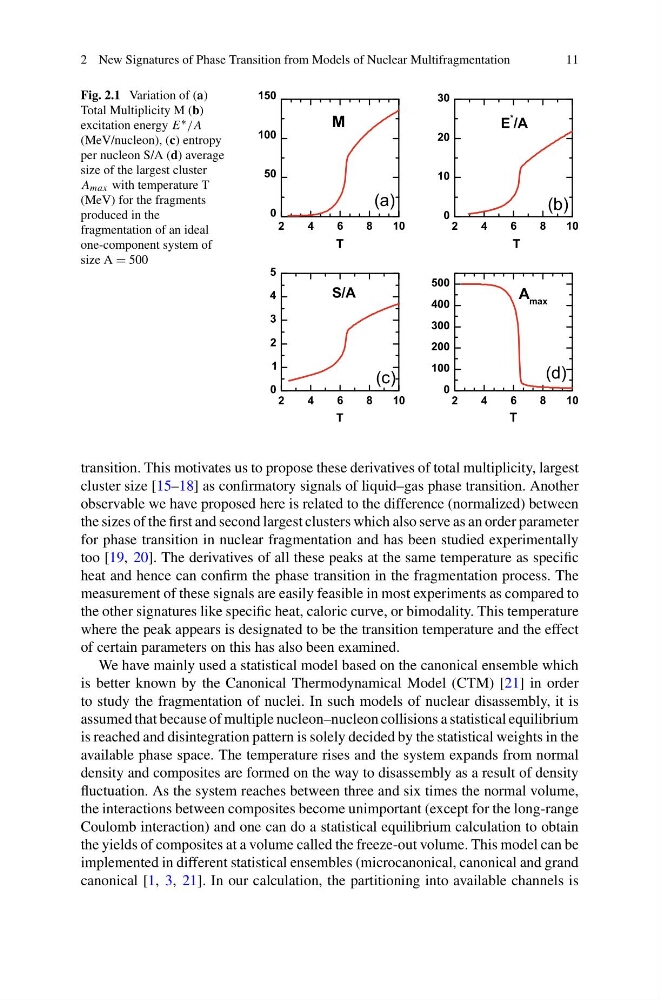
Fig. 2.1 Variation of (a)
Total Multiplicity M (b)
excitation energy E ∗ /A
(MeV/nucleon), (c) entropy
per nucleon S/A (d) average
size of the largest cluster
A max with temperature T
(MeV) for the fragments
produced in the
fragmentation of an ideal
one-component system of
size A = 500
transition. This motivates us to propose these derivatives of total multiplicity, largest
cluster size [15–18] as confirmatory signals of liquid–gas phase transition. Another
observable we have proposed here is related to the difference (normalized) between
the sizes of the first and second largest clusters which also serve as an order parameter
for phase transition in nuclear fragmentation and has been studied experimentally
too [19, 20]. The derivatives of all these peaks at the same temperature as specific
heat and hence can confirm the phase transition in the fragmentation process. The
measurement of these signals are easily feasible in most experiments as compared to
the other signatures like specific heat, caloric curve, or bimodality. This temperature
where the peak appears is designated to be the transition temperature and the effect
of certain parameters on this has also been examined.
We have mainly used a statistical model based on the canonical ensemble which
is better known by the Canonical Thermodynamical Model (CTM) [21] in order
to study the fragmentation of nuclei. In such models of nuclear disassembly, it is
assumed that because of multiple nucleon–nucleon collisions a statistical equilibrium
is reached and disintegration pattern is solely decided by the statistical weights in the
available phase space. The temperature rises and the system expands from normal
density and composites are formed on the way to disassembly as a result of density
fluctuation. As the system reaches between three and six times the normal volume,
the interactions between composites become unimportant (except for the long-range
Coulomb interaction) and one can do a statistical equilibrium calculation to obtain
the yields of composites at a volume called the freeze-out volume. This model can be
implemented in different statistical ensembles (microcanonical, canonical and grand
canonical [1, 3, 21]. In our calculation, the partitioning into available channels is
11
Fig. 2.1 Variation of (a)
Total Multiplicity M (b)
excitation energy E ∗ /A
(MeV/nucleon), (c) entropy
per nucleon S/A (d) average
size of the largest cluster
A max with temperature T
(MeV) for the fragments
produced in the
fragmentation of an ideal
one-component system of
size A = 500
transition. This motivates us to propose these derivatives of total multiplicity, largest
cluster size [15–18] as confirmatory signals of liquid–gas phase transition. Another
observable we have proposed here is related to the difference (normalized) between
the sizes of the first and second largest clusters which also serve as an order parameter
for phase transition in nuclear fragmentation and has been studied experimentally
too [19, 20]. The derivatives of all these peaks at the same temperature as specific
heat and hence can confirm the phase transition in the fragmentation process. The
measurement of these signals are easily feasible in most experiments as compared to
the other signatures like specific heat, caloric curve, or bimodality. This temperature
where the peak appears is designated to be the transition temperature and the effect
of certain parameters on this has also been examined.
We have mainly used a statistical model based on the canonical ensemble which
is better known by the Canonical Thermodynamical Model (CTM) [21] in order
to study the fragmentation of nuclei. In such models of nuclear disassembly, it is
assumed that because of multiple nucleon–nucleon collisions a statistical equilibrium
is reached and disintegration pattern is solely decided by the statistical weights in the
available phase space. The temperature rises and the system expands from normal
density and composites are formed on the way to disassembly as a result of density
fluctuation. As the system reaches between three and six times the normal volume,
the interactions between composites become unimportant (except for the long-range
Coulomb interaction) and one can do a statistical equilibrium calculation to obtain
the yields of composites at a volume called the freeze-out volume. This model can be
implemented in different statistical ensembles (microcanonical, canonical and grand
canonical [1, 3, 21]. In our calculation, the partitioning into available channels is