

256
T. R. Routray et al.
ρ [fm
-3 ]
0
10
20
30
40
50
60
TS
0,n
(
ρ ,T) [MeV fm
-3
]
0
0. 4
0. 8
1. 2
1.6
0
0. 4
0. 8
1. 2
1.6
ρ [fm
-3 ]
0
20
40
60
80
100
120
T=40 MeV
T=60 MeV
SNM
SNM
ε
l
ex
=0
ε ex /3
2 ε ex /3
ε ex
ε
l
ex
=0
ε ex /3
2 ε ex /3
ε ex
(a)
(b)
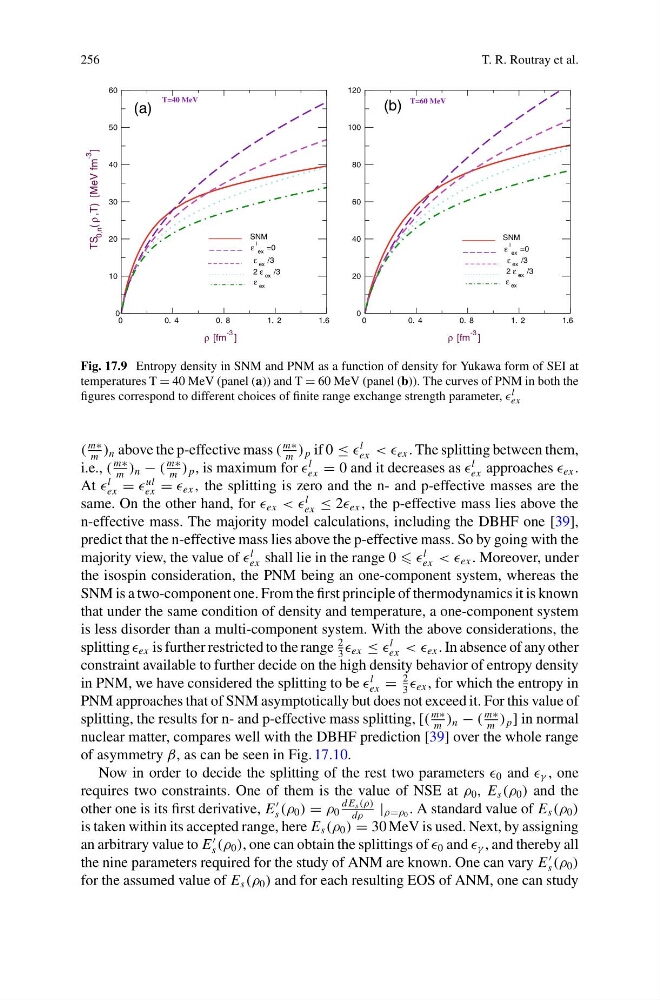
Fig. 17.9 Entropy density in SNM and PNM as a function of density for Yukawa form of SEI at
temperatures T = 40 MeV (panel (a)) and T = 60 MeV (panel (b)). The curves of PNM in both the
figures correspond to different choices of finite range exchange strength parameter, l
ex
(
m∗
m
) n above the p-effective mass (
m∗
m
) p if 0 ≤
l
ex < < ex . The splitting between them,
i.e., (
m∗
m
) n − (
m∗
m
) p , is maximum for
l
ex = 0 and it decreases as
l
ex approaches ex .
At
l
ex =
ul
ex = ex , the splitting is zero and the n- and p-effective masses are the
same. On the other hand, for ex < <
l
ex ≤ 2 ex , the p-effective mass lies above the
n-effective mass. The majority model calculations, including the DBHF one [39],
predict that the n-effective mass lies above the p-effective mass. So by going with the
majority view, the value of
l
ex shall lie in the range 0
l
ex < < ex . Moreover, under
the isospin consideration, the PNM being an one-component system, whereas the
SNM is a two-component one. From the first principle of thermodynamics it is known
that under the same condition of density and temperature, a one-component system
is less disorder than a multi-component system. With the above considerations, the
splitting ex is further restricted to the range
2
3
ex ≤
l
ex < < ex . In absence of any other
constraint available to further decide on the high density behavior of entropy density
in PNM, we have considered the splitting to be
l
ex =
2
3
ex , for which the entropy in
PNM approaches that of SNM asymptotically but does not exceed it. For this value of
splitting, the results for n- and p-effective mass splitting, [(
m∗
m
) n − (
m∗
m
) p ] in normal
nuclear matter, compares well with the DBHF prediction [39] over the whole range
of asymmetry β, as can be seen in Fig. 17.10.
Now in order to decide the splitting of the rest two parameters 0 and γ , one
requires two constraints. One of them is the value of NSE at ρ 0 , E s (ρ 0 ) and the
other one is its first derivative, E
s (ρ 0 ) = ρ 0
d E s (ρ)
dρ
| ρ=ρ 0 . A standard value of E s (ρ 0 )
is taken within its accepted range, here E s (ρ 0 ) = 30 MeV is used. Next, by assigning
an arbitrary value to E
s (ρ 0 ), one can obtain the splittings of 0 and γ , and thereby all
the nine parameters required for the study of ANM are known. One can vary E
s (ρ 0 )
for the assumed value of E s (ρ 0 ) and for each resulting EOS of ANM, one can study
T. R. Routray et al.
ρ [fm
-3 ]
0
10
20
30
40
50
60
TS
0,n
(
ρ ,T) [MeV fm
-3
]
0
0. 4
0. 8
1. 2
1.6
0
0. 4
0. 8
1. 2
1.6
ρ [fm
-3 ]
0
20
40
60
80
100
120
T=40 MeV
T=60 MeV
SNM
SNM
ε
l
ex
=0
ε ex /3
2 ε ex /3
ε ex
ε
l
ex
=0
ε ex /3
2 ε ex /3
ε ex
(a)
(b)
Fig. 17.9 Entropy density in SNM and PNM as a function of density for Yukawa form of SEI at
temperatures T = 40 MeV (panel (a)) and T = 60 MeV (panel (b)). The curves of PNM in both the
figures correspond to different choices of finite range exchange strength parameter, l
ex
(
m∗
m
) n above the p-effective mass (
m∗
m
) p if 0 ≤
l
ex < < ex . The splitting between them,
i.e., (
m∗
m
) n − (
m∗
m
) p , is maximum for
l
ex = 0 and it decreases as
l
ex approaches ex .
At
l
ex =
ul
ex = ex , the splitting is zero and the n- and p-effective masses are the
same. On the other hand, for ex < <
l
ex ≤ 2 ex , the p-effective mass lies above the
n-effective mass. The majority model calculations, including the DBHF one [39],
predict that the n-effective mass lies above the p-effective mass. So by going with the
majority view, the value of
l
ex shall lie in the range 0
l
ex < < ex . Moreover, under
the isospin consideration, the PNM being an one-component system, whereas the
SNM is a two-component one. From the first principle of thermodynamics it is known
that under the same condition of density and temperature, a one-component system
is less disorder than a multi-component system. With the above considerations, the
splitting ex is further restricted to the range
2
3
ex ≤
l
ex < < ex . In absence of any other
constraint available to further decide on the high density behavior of entropy density
in PNM, we have considered the splitting to be
l
ex =
2
3
ex , for which the entropy in
PNM approaches that of SNM asymptotically but does not exceed it. For this value of
splitting, the results for n- and p-effective mass splitting, [(
m∗
m
) n − (
m∗
m
) p ] in normal
nuclear matter, compares well with the DBHF prediction [39] over the whole range
of asymmetry β, as can be seen in Fig. 17.10.
Now in order to decide the splitting of the rest two parameters 0 and γ , one
requires two constraints. One of them is the value of NSE at ρ 0 , E s (ρ 0 ) and the
other one is its first derivative, E
s (ρ 0 ) = ρ 0
d E s (ρ)
dρ
| ρ=ρ 0 . A standard value of E s (ρ 0 )
is taken within its accepted range, here E s (ρ 0 ) = 30 MeV is used. Next, by assigning
an arbitrary value to E
s (ρ 0 ), one can obtain the splittings of 0 and γ , and thereby all
the nine parameters required for the study of ANM are known. One can vary E
s (ρ 0 )
for the assumed value of E s (ρ 0 ) and for each resulting EOS of ANM, one can study