

254
T. R. Routray et al.
0
0.5
1
1.5
2
ρ [fm
-3 ]
0
0.2
0.4
0.6
0.8
1
v/c
SEI(Yukawa)
SEI(Gaussian)
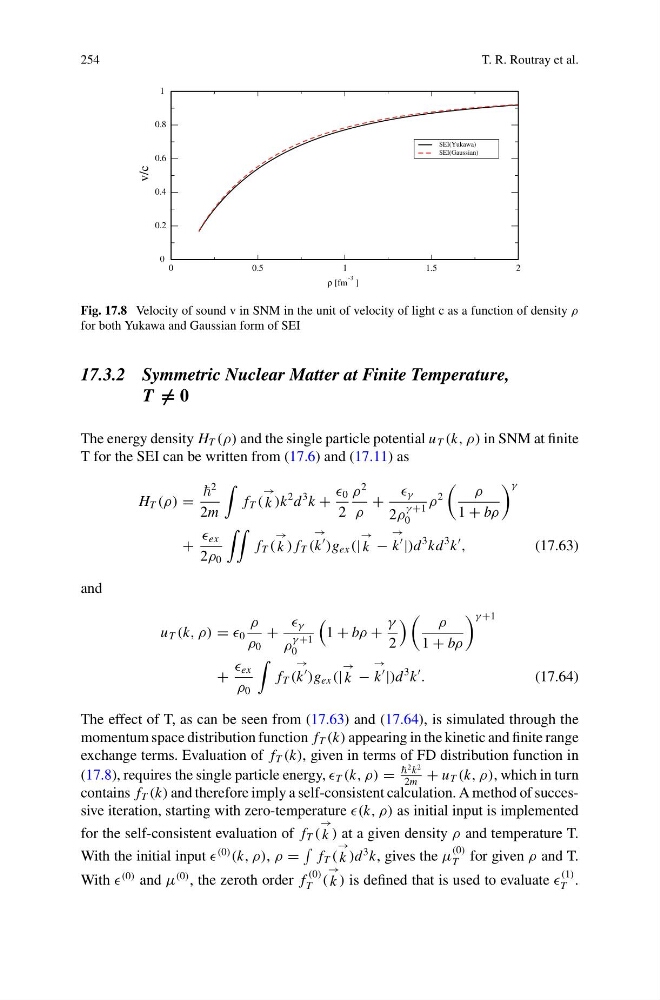
Fig. 17.8 Velocity of sound v in SNM in the unit of velocity of light c as a function of density ρ
for both Yukawa and Gaussian form of SEI
17.3.2 Symmetric Nuclear Matter at Finite Temperature,
T = 0
The energy density H T (ρ) and the single particle potential u T (k, ρ) in SNM at finite
T for the SEI can be written from (17.6) and (17.11) as
H T (ρ) =
2
2m
f T (
→
k )k
2 d
3 k +
0
2
ρ
2
ρ
+
γ
2ρ
γ +1
0
ρ
2
ρ
1 + bρ
γ
+
ex
2ρ 0
f T (
→
k ) f T (
→
k
)g ex (|
→
k −
→
k
|)d
3 kd
3 k
,
(17.63)
and
u T (k, ρ) = 0
ρ
ρ 0
+
γ
ρ
γ +1
0
1 + bρ +
γ
2
ρ
1 + bρ
γ +1
+
ex
ρ 0
f T (
→
k
)g ex (|
→
k −
→
k
|)d
3 k
.
(17.64)
The effect of T, as can be seen from (17.63) and (17.64), is simulated through the
momentum space distribution function f T (k) appearing in the kinetic and finite range
exchange terms. Evaluation of f T (k), given in terms of FD distribution function in
(17.8), requires the single particle energy, T (k, ρ) =
2 k
2
2m
+ u T (k, ρ), which in turn
contains f T (k) and therefore imply a self-consistent calculation. A method of successive iteration, starting with zero-temperature ρ) as initial input is implemented
for the self-consistent evaluation of f T (
→
k ) at a given density ρ and temperature T.
With the initial input
(0)
(k, ρ), ρ =
f T (
→
k )d
3 k, gives the μ
(0)
T for given ρ and T.
With
(0) and μ
(0) , the zeroth order f
(0)
T (
→
k ) is defined that is used to evaluate
(1)
T .
T. R. Routray et al.
0
0.5
1
1.5
2
ρ [fm
-3 ]
0
0.2
0.4
0.6
0.8
1
v/c
SEI(Yukawa)
SEI(Gaussian)
Fig. 17.8 Velocity of sound v in SNM in the unit of velocity of light c as a function of density ρ
for both Yukawa and Gaussian form of SEI
17.3.2 Symmetric Nuclear Matter at Finite Temperature,
T = 0
The energy density H T (ρ) and the single particle potential u T (k, ρ) in SNM at finite
T for the SEI can be written from (17.6) and (17.11) as
H T (ρ) =
2
2m
f T (
→
k )k
2 d
3 k +
0
2
ρ
2
ρ
+
γ
2ρ
γ +1
0
ρ
2
ρ
1 + bρ
γ
+
ex
2ρ 0
f T (
→
k ) f T (
→
k
)g ex (|
→
k −
→
k
|)d
3 kd
3 k
,
(17.63)
and
u T (k, ρ) = 0
ρ
ρ 0
+
γ
ρ
γ +1
0
1 + bρ +
γ
2
ρ
1 + bρ
γ +1
+
ex
ρ 0
f T (
→
k
)g ex (|
→
k −
→
k
|)d
3 k
.
(17.64)
The effect of T, as can be seen from (17.63) and (17.64), is simulated through the
momentum space distribution function f T (k) appearing in the kinetic and finite range
exchange terms. Evaluation of f T (k), given in terms of FD distribution function in
(17.8), requires the single particle energy, T (k, ρ) =
2 k
2
2m
+ u T (k, ρ), which in turn
contains f T (k) and therefore imply a self-consistent calculation. A method of successive iteration, starting with zero-temperature ρ) as initial input is implemented
for the self-consistent evaluation of f T (
→
k ) at a given density ρ and temperature T.
With the initial input
(0)
(k, ρ), ρ =
f T (
→
k )d
3 k, gives the μ
(0)
T for given ρ and T.
With
(0) and μ
(0) , the zeroth order f
(0)
T (
→
k ) is defined that is used to evaluate
(1)
T .