

17 Momentum and Density Dependence of the Nuclear Mean Field …
251
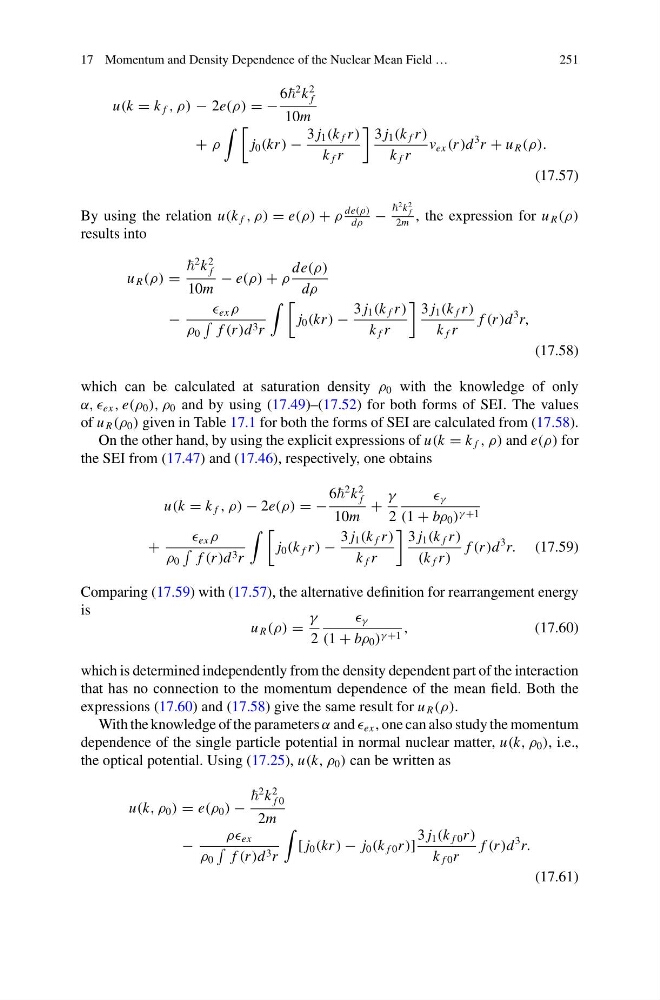
u(k = k f , ρ) − 2e(ρ) = −
6
2 k
2
f
10m
+ ρ
j 0 (kr) −
3 j 1 (k f r )
k f r
3 j 1 (k f r )
k f r
v ex (r )d
3 r + u R (ρ).
(17.57)
By using the relation u(k f , ρ) = e(ρ) + ρ
de(ρ)
dρ
−
2 k
2
f
2m
, the expression for u R (ρ)
results into
u R (ρ) =
2 k
2
f
10m
− e(ρ) + ρ
de(ρ)
dρ
−
ex ρ
ρ 0
f (r )d 3 r
j 0 (kr) −
3 j 1 (k f r )
k f r
3 j 1 (k f r )
k f r
f (r )d
3 r,
(17.58)
which can be calculated at saturation density ρ 0 with the knowledge of only
α, , ex , e(ρ 0 ), ρ 0 and by using (17.49)–(17.52) for both forms of SEI. The values
of u R (ρ 0 ) given in Table 17.1 for both the forms of SEI are calculated from (17.58).
On the other hand, by using the explicit expressions of u(k = k f , ρ) and e(ρ) for
the SEI from (17.47) and (17.46), respectively, one obtains
u(k = k f , ρ) − 2e(ρ) = −
6
2 k
2
f
10m
+
γ
2
γ
(1 + bρ 0 ) γ +1
+
ex ρ
ρ 0
f (r )d 3 r
j 0 (k f r ) −
3 j 1 (k f r )
k f r
3 j 1 (k f r )
(k f r )
f (r )d
3 r. (17.59)
Comparing (17.59) with (17.57), the alternative definition for rearrangement energy
is
u R (ρ) =
γ
2
γ
(1 + bρ 0 ) γ +1 ,
(17.60)
which is determined independently from the density dependent part of the interaction
that has no connection to the momentum dependence of the mean field. Both the
expressions (17.60) and (17.58) give the same result for u R (ρ).
With the knowledge of the parameters α and ex , one can also study the momentum
dependence of the single particle potential in normal nuclear matter, u(k, ρ 0 ), i.e.,
the optical potential. Using (17.25), u(k, ρ 0 ) can be written as
u(k, ρ 0 ) = e(ρ 0 ) −
2 k
2
f 0
2m
−
ρρ ex
ρ 0
f (r )d 3 r
[ j 0 (kr) − j 0 (k f 0 r )]
3 j 1 (k f 0 r )
k f 0 r
f (r )d
3 r.
(17.61)
251
u(k = k f , ρ) − 2e(ρ) = −
6
2 k
2
f
10m
+ ρ
j 0 (kr) −
3 j 1 (k f r )
k f r
3 j 1 (k f r )
k f r
v ex (r )d
3 r + u R (ρ).
(17.57)
By using the relation u(k f , ρ) = e(ρ) + ρ
de(ρ)
dρ
−
2 k
2
f
2m
, the expression for u R (ρ)
results into
u R (ρ) =
2 k
2
f
10m
− e(ρ) + ρ
de(ρ)
dρ
−
ex ρ
ρ 0
f (r )d 3 r
j 0 (kr) −
3 j 1 (k f r )
k f r
3 j 1 (k f r )
k f r
f (r )d
3 r,
(17.58)
which can be calculated at saturation density ρ 0 with the knowledge of only
α, , ex , e(ρ 0 ), ρ 0 and by using (17.49)–(17.52) for both forms of SEI. The values
of u R (ρ 0 ) given in Table 17.1 for both the forms of SEI are calculated from (17.58).
On the other hand, by using the explicit expressions of u(k = k f , ρ) and e(ρ) for
the SEI from (17.47) and (17.46), respectively, one obtains
u(k = k f , ρ) − 2e(ρ) = −
6
2 k
2
f
10m
+
γ
2
γ
(1 + bρ 0 ) γ +1
+
ex ρ
ρ 0
f (r )d 3 r
j 0 (k f r ) −
3 j 1 (k f r )
k f r
3 j 1 (k f r )
(k f r )
f (r )d
3 r. (17.59)
Comparing (17.59) with (17.57), the alternative definition for rearrangement energy
is
u R (ρ) =
γ
2
γ
(1 + bρ 0 ) γ +1 ,
(17.60)
which is determined independently from the density dependent part of the interaction
that has no connection to the momentum dependence of the mean field. Both the
expressions (17.60) and (17.58) give the same result for u R (ρ).
With the knowledge of the parameters α and ex , one can also study the momentum
dependence of the single particle potential in normal nuclear matter, u(k, ρ 0 ), i.e.,
the optical potential. Using (17.25), u(k, ρ 0 ) can be written as
u(k, ρ 0 ) = e(ρ 0 ) −
2 k
2
f 0
2m
−
ρρ ex
ρ 0
f (r )d 3 r
[ j 0 (kr) − j 0 (k f 0 r )]
3 j 1 (k f 0 r )
k f 0 r
f (r )d
3 r.
(17.61)