

244
T. R. Routray et al.
where u
ex
τ (k, ρ) is the functional that simulates the k-dependence for u τ (k, ρ) and
is given by
u
ex
τ (k, ρ) =
ρ
2
[ j 0 (kr) − j 0 (k f r )] j 0 (k f r )
v
l
ex (r ) − v
ul
ex (r )
d
3 r.
(17.37)
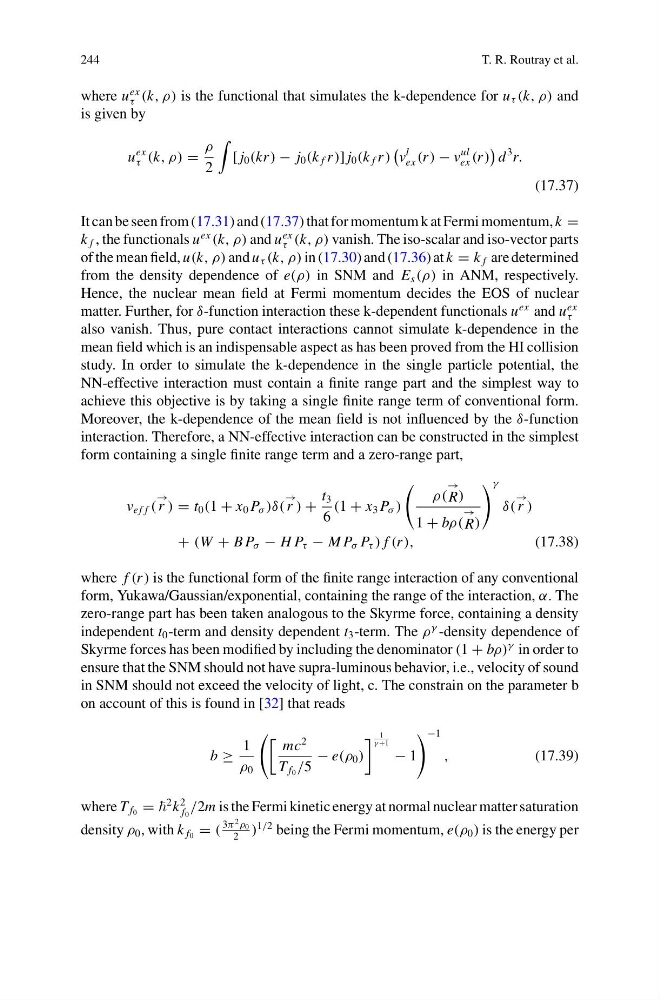
It can be seen from (17.31) and (17.37) that for momentum k at Fermi momentum, k =
k f , the functionals u
ex
(k, ρ) and u
ex
τ (k, ρ) vanish. The iso-scalar and iso-vector parts
of the mean field, u(k, ρ) and u τ (k, ρ) in (17.30) and (17.36) at k = k f are determined
from the density dependence of e(ρ) in SNM and E s (ρ) in ANM, respectively.
Hence, the nuclear mean field at Fermi momentum decides the EOS of nuclear
matter. Further, for δ-function interaction these k-dependent functionals u
ex and u
ex
τ
also vanish. Thus, pure contact interactions cannot simulate k-dependence in the
mean field which is an indispensable aspect as has been proved from the HI collision
study. In order to simulate the k-dependence in the single particle potential, the
NN-effective interaction must contain a finite range part and the simplest way to
achieve this objective is by taking a single finite range term of conventional form.
Moreover, the k-dependence of the mean field is not influenced by the δ-function
interaction. Therefore, a NN-effective interaction can be constructed in the simplest
form containing a single finite range term and a zero-range part,
v e f f (
→
r ) = t 0 (1 + x 0 P σ )δ(
→
r ) +
t 3
6
(1 + x 3 P σ )
ρ(
→
R)
1 + bρ(
→
R)
γ
δ(
→
r )
+ (W + B P σ − H P τ − M P σ P τ ) f (r ),
(17.38)
where f (r ) is the functional form of the finite range interaction of any conventional
form, Yukawa/Gaussian/exponential, containing the range of the interaction, α. The
zero-range part has been taken analogous to the Skyrme force, containing a density
independent t 0 -term and density dependent t 3 -term. The ρ
γ -density dependence of
Skyrme forces has been modified by including the denominator (1 + bρ)
γ in order to
ensure that the SNM should not have supra-luminous behavior, i.e., velocity of sound
in SNM should not exceed the velocity of light, c. The constrain on the parameter b
on account of this is found in [32] that reads
b ≥
1
ρ 0
mc
2
T f 0 /5
− e(ρ 0 )
1
γ +1
− 1
−1
,
(17.39)
where T f 0 =
2 k
2
f 0
/2m is the Fermi kinetic energy at normal nuclear matter saturation
density ρ 0 , with k f 0 = (
3π
2 ρ 0
2
)
1/2 being the Fermi momentum, e(ρ 0 ) is the energy per
T. R. Routray et al.
where u
ex
τ (k, ρ) is the functional that simulates the k-dependence for u τ (k, ρ) and
is given by
u
ex
τ (k, ρ) =
ρ
2
[ j 0 (kr) − j 0 (k f r )] j 0 (k f r )
v
l
ex (r ) − v
ul
ex (r )
d
3 r.
(17.37)
It can be seen from (17.31) and (17.37) that for momentum k at Fermi momentum, k =
k f , the functionals u
ex
(k, ρ) and u
ex
τ (k, ρ) vanish. The iso-scalar and iso-vector parts
of the mean field, u(k, ρ) and u τ (k, ρ) in (17.30) and (17.36) at k = k f are determined
from the density dependence of e(ρ) in SNM and E s (ρ) in ANM, respectively.
Hence, the nuclear mean field at Fermi momentum decides the EOS of nuclear
matter. Further, for δ-function interaction these k-dependent functionals u
ex and u
ex
τ
also vanish. Thus, pure contact interactions cannot simulate k-dependence in the
mean field which is an indispensable aspect as has been proved from the HI collision
study. In order to simulate the k-dependence in the single particle potential, the
NN-effective interaction must contain a finite range part and the simplest way to
achieve this objective is by taking a single finite range term of conventional form.
Moreover, the k-dependence of the mean field is not influenced by the δ-function
interaction. Therefore, a NN-effective interaction can be constructed in the simplest
form containing a single finite range term and a zero-range part,
v e f f (
→
r ) = t 0 (1 + x 0 P σ )δ(
→
r ) +
t 3
6
(1 + x 3 P σ )
ρ(
→
R)
1 + bρ(
→
R)
γ
δ(
→
r )
+ (W + B P σ − H P τ − M P σ P τ ) f (r ),
(17.38)
where f (r ) is the functional form of the finite range interaction of any conventional
form, Yukawa/Gaussian/exponential, containing the range of the interaction, α. The
zero-range part has been taken analogous to the Skyrme force, containing a density
independent t 0 -term and density dependent t 3 -term. The ρ
γ -density dependence of
Skyrme forces has been modified by including the denominator (1 + bρ)
γ in order to
ensure that the SNM should not have supra-luminous behavior, i.e., velocity of sound
in SNM should not exceed the velocity of light, c. The constrain on the parameter b
on account of this is found in [32] that reads
b ≥
1
ρ 0
mc
2
T f 0 /5
− e(ρ 0 )
1
γ +1
− 1
−1
,
(17.39)
where T f 0 =
2 k
2
f 0
/2m is the Fermi kinetic energy at normal nuclear matter saturation
density ρ 0 , with k f 0 = (
3π
2 ρ 0
2
)
1/2 being the Fermi momentum, e(ρ 0 ) is the energy per